Frete grátis para todos os pedidos acima de US$ 75 nos Estados Unidos

Quando se trata de ouro, garantimos a utilização de ouro 100% verdadeiro em todos os nossos produtos de ouro.

Italian fancy gold bracelets

Corrente Feminina

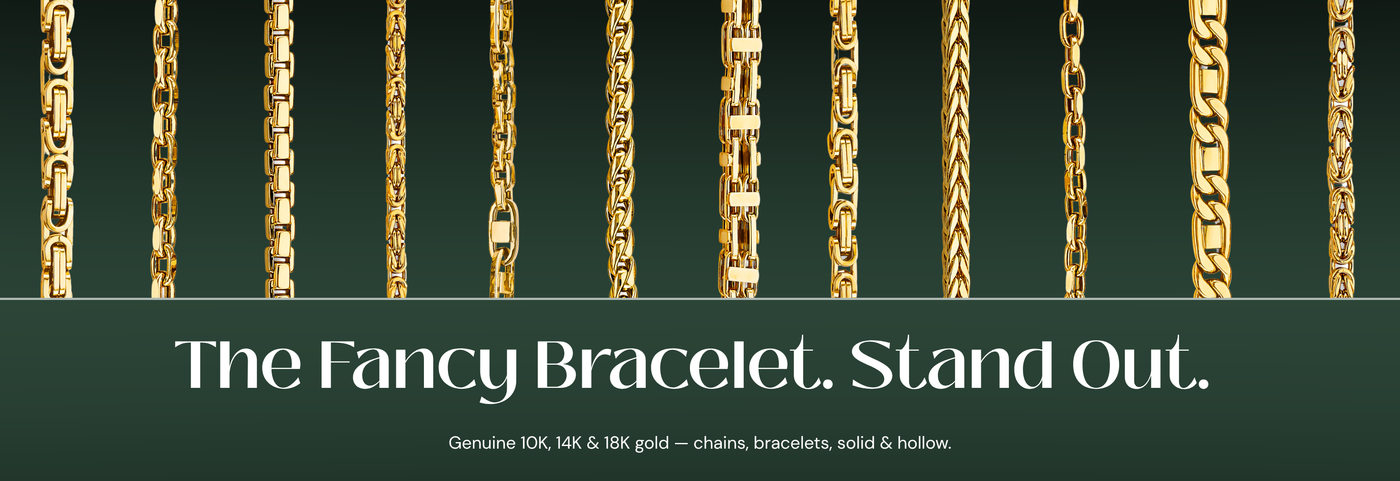
Sometimes the right bracelet is the piece that finishes an entire look. Our Fancy Bracelet collection brings together more elaborate, eye-catching designs in solid 10K and 14K yellow gold — pieces with intricate linkwork, layered textures, or decorative detailing that go beyond a classic chain or bangle.

Browse styles featuring woven and interlocking link patterns, mixed-finish designs that combine polished and textured gold, and pieces with subtle dimensional detailing that catches the light differently from every angle. These are bracelets designed to be noticed — whether worn on their own as a statement piece or layered alongside simpler everyday styles for contrast.

Every bracelet is crafted by experienced Italian goldsmiths and karat-stamped for authenticity, so the intricate detailing you see is backed by genuine, solid gold construction — not a plated or hollow imitation. That makes this collection an excellent choice for special occasions, milestone gifts, or simply treating yourself to something a little more elevated than your everyday pieces.

Pair your fancy bracelet with a matching necklace or earrings from our collection to build a coordinated look for an event, or wear it as a standout piece against simpler jewelry for everyday contrast. All pieces ship from our U.S. warehouse and are backed by our standard quality guarantee.

Ver como

Understanding Fancy Bracelets

What is a fancy gold bracelet?

A fancy bracelet is one whose design comes from ornament rather than from a single repeated structural link. It may combine link types, set decorative elements into chain, change texture along its length, or use links that are themselves decorative forms.

The word is a classification used by makers, and it is silent on karat, width and finish. It marks the bracelet out as one that was composed as a piece rather than cut to length from a continuous run of one link.

On the wrist the classification matters for two practical reasons: the bracelet is worn as the single point of interest on the arm, and it is altered by a jeweller in a different way from a plain chain, since there is no repeat to count.

Why is ornament more visible on a bracelet than on a necklace?

Distance. A necklace is seen from across a table or a room, and small detail is lost at that range. A bracelet is seen by its wearer at arm's length and by others at a handshake, close enough for a pierced link or a hammered surface to be read.

Movement adds to it. A wrist is rarely still, so a bracelet turns and catches light continually, and each change of texture or form on it registers as it passes.

Fancy bracelets are designed for that scrutiny, with finer ornament and subtler changes than a chain of the same character. The detail is the point, and the wearer is expected to look at it.

How is a bracelet made from several link types joined together?

Two links of unlike form seldom thread straight into one another, because their eyes are different sizes and sit at different angles. The maker bridges the change with a joining piece, which on a bracelet is most often a small ring or a short bar, chosen to sit as quietly as possible between the two sections.

Where a rigid decorative element is set into chain, a loop or a ring is soldered to the element and the chain is attached through it. Those loops carry the full load of the bracelet when the arm swings.

Joining pieces and soldered loops are the structural points of a combination bracelet, and a jeweller goes to them first when it comes in. The more changes of link a bracelet has, the more of them there are to look at.

Will a decorative bracelet turn over on the wrist?

A bracelet with any slack travels around the wrist, and where its elements come to rest depends on their weight and shape. Flat elements fall face-up on the back of the wrist; rounded ones roll until their heavier side is down.

If one element is much heavier than the rest, the bracelet turns until that element is underneath. A design that has been balanced distributes weight around the circumference, or places the heaviest element at the clasp so the clasp, not the ornament, rides below.

The listing photograph shows the elements at rest and lets them be compared for size, which is a fair guide to how the bracelet will sit. A bracelet whose elements are all of a size tends to stay where it is put.

Can a fancy bracelet be shortened?

Yes, but not by counting links. The jeweller takes length from the plain chain nearest the clasp, equally from each end so the ornament stays centred, and re-attaches the clasp. On a bracelet with stations, the spacing between stations is left alone.

Where the ornament runs all the way to the clasp, shortening may mean removing an element, and the jeweller will discuss which one and how the design reads without it.

The design, not the metal, decides how much can be taken out. A bracelet bought with later adjustment in mind is better chosen a little long, since adding length to a fancy bracelet means finding chain that matches and may no longer be available.

Should a fancy bracelet be worn with other bracelets?

It is designed to be worn alone. Its elements stand slightly proud of the chain, and anything else on the same wrist knocks against them. A bangle in particular strikes a decorative bracelet with every movement of the arm and, over months, marks the high points of its ornament.

Worn alone, it has the space the design assumes, and the elements are seen in the order the maker set them. It becomes the single point of interest on that arm.

A watch belongs on the other wrist. If it must share, a watch with a flat strap does less harm than a metal bracelet strap, which is itself a chain and will rub the ornament at every turn.

How do sleeves and cuffs treat a decorative bracelet?

A loose sleeve passes over a fancy bracelet without trouble, since the elements, though raised, are small and rounded at their edges. A close-fitting cuff or a knitted sleeve is more likely to catch on a pierced element, and on a bracelet with pointed stations the sleeve is worth checking.

Under a cuff the bracelet is held still and protected from desks and tables, so the elements keep their finish longer than on a bare wrist.

A bracelet whose ornament is meant to be seen is ordinarily worn where the cuff ends rather than under it, and a wearer who wants it on show will push the cuff back or choose a sleeve that stops short of the wrist.

Where does a fancy bracelet wear first?

At the high points of its ornament. Whatever stands proudest of the chain meets desks, tables and door handles before anything else, so the tops of stations, the ridges of hammered elements and the edges of pierced links are where the finish softens first.

The joints between rigid elements and the chain that connects them wear as any hinge does, and the loops through which the chain passes can open a fraction over years. That is ordinary ageing, and a jeweller closes them.

Polished elements show wear sooner than textured ones beside them, since marks on a brushed or hammered surface disappear into the existing texture. A re-finish treats each element in its own way.

Can a fancy bracelet be repaired if one decorative link is damaged?

Usually. A damaged plain link is replaced with a matching one. A damaged joining piece is replaced with a new one of the same form. A damaged decorative element is the harder case, since it may be the only one of its kind on the bracelet.

If the maker can supply a matching element, it is swapped in. If not, the jeweller repairs the element in place where that is possible, or replaces it with a plain section that matches its neighbours and keeps the length.

A jeweller asks to see the whole bracelet before giving a quotation, because the question is how the mended part will sit among the rest. On the wrist, where the bracelet is seen close up, the repair has to be invisible or it is not a repair.

Does a combination-link bracelet flex as freely as a plain chain?

Not usually. A plain chain bends at every link. A combination bracelet with rigid elements bends only in the chain between them, so it follows the wrist as a series of flat segments joined by short flexible runs, in the way a watch bracelet does.

A bracelet that combines two flexible link types without rigid elements flexes almost as freely as a plain chain, since every joint still hinges; it merely hinges differently at each change of link.

The difference is felt more than seen. A bracelet with rigid elements sits with a slightly firmer, more settled feel, and the wearer is aware of the elements as separate objects. A fully flexible one drapes and moves with the wrist.

How a Fancy Bracelet Is Built, Sits and Is Altered

Comparar /3

A carregar...