Frete grátis para todos os pedidos acima de US$ 75 nos Estados Unidos

Quando se trata de ouro, garantimos a utilização de ouro 100% verdadeiro em todos os nossos produtos de ouro.

Italian Cuban gold bracelets

Pulseiras Cubanas

Pulseiras Cubanas
Ver como

Understanding the Cuban Bracelet

What is a Cuban bracelet?

A bracelet made from the Cuban link: thick oval links with rounded edges, each closed tightly into the next so that the band reads as two continuous rails with a scalloped seam between them.

On a wrist the run is short enough for each link to be seen as a unit, and the depth of the link, which is lost along a necklace, shows plainly from the side.

It is made in widths from around five millimetres to very broad, fastened with a lobster clasp at the narrower sizes and a box clasp at the wider. Each listing states the width, karat and clasp.

Why does a Cuban bracelet read heavier than a Cuban chain of the same width?

Because it is seen at short range and from the side. A chain runs past the eye as a band; a bracelet holds only a handful of links, each of which can be taken in as a shape, and the arm's movement shows the depth of the link constantly.

The rails along the edge become two bright curves following the wrist, and the crescents along the seam are a visible rhythm rather than a texture.

The width has not changed, but the proportion of link to piece has. A single oval is a larger share of a bracelet than it is of a chain, and it reads accordingly.

Does a Cuban bracelet turn over on the wrist?

It turns with the arm as one piece, and its weight brings the clasp to the underside whenever the hand hangs. Because the top and the underside of a Cuban link are the same rounded profile, the band looks the same whichever part is uppermost.

There is no front and back to keep in place, and no flat face to lose. What matters is only where the clasp comes to rest, and gravity takes it to the bottom.

A bracelet fitted a little snugly turns less and sits higher on the forearm; one worn loose slides to the wrist bone and settles there. Either way the pattern is unaffected by turning.

Where does a Cuban bracelet settle when the arm hangs?

On the wrist bone. The bracelet slides down the forearm until the bone stops it, and its weight rolls the clasp to the underside and leaves the plain run of links on top.

Lifting the arm slides it back up the forearm, and it comes down again as soon as the hand drops. The movement is smooth, since the rounded links slide over skin without catching.

The firm curve of the nested links keeps the band round through all of this, so it does not fold or bunch on the way down, and it needs no straightening when it arrives.

What does a desk edge do to a Cuban bracelet?

It polishes it. The underside of the bracelet rests on the desk as the hands work, and the links that touch it are burnished a little brighter than those facing up, while a clasp housing that lands there gathers fine scratches.

The rounded link is a kindness here. A cushioned surface slides across an edge rather than catching on it, so the desk rubs the bracelet rather than gouging it.

Turning the bracelet occasionally so a different section rests on the desk evens the effect, and a polish at a jeweller's bench brings the whole band back to one finish.

Will a Cuban bracelet slide under a shirt cuff?

At narrower widths, yes. The rounded edges let the cuff pass over the links in either direction without snagging, and the bracelet moves in and out of the sleeve as the arm bends.

At wider widths the bracelet stands too far off the wrist to go under comfortably, and it is worn outside the cuff, where it holds the cloth slightly away from the skin.

A knitted cuff is the one to be careful with, since the ring of a lobster clasp can pick up a loose loop. The links themselves, being rounded on every edge, will not.

How is a Cuban bracelet shortened?

By removing whole links. The jeweller cuts one link at its seam, frees it from the two ovals it nests into, lifts out the number of links needed, and threads the cut link through its new neighbour before soldering it closed.

Because every link is the same, the rails and the seam continue across the join and the pattern is undisturbed. The joint is rounded and polished so it matches the rest of the band.

Length is normally taken from the clasp end so the clasp stays in its place. At wide widths a single link is a noticeable step, and the jeweller will say how close to the wanted length the nearest whole link comes.

Why do some Cuban bracelets have a box clasp and others a lobster?

The clasp follows the width. A lobster clasp, a sprung hook closing on a ring, suits narrower bracelets: it is small, hidden, and can be fastened by feel with one hand against the wrist.

As the links grow, a lobster's ring looks undersized against them and becomes the weakest point in the band. From about eight millimetres a box clasp is fitted instead.

The box housing is made to the same width and rounded profile as the links, so it reads as one more oval. A folded tongue clicks into it, and a hinged latch on each side closes over the joint by thumb.

Why is the underside of my Cuban bracelet brighter than the top?

Because that is the side that touches things. When the hand hangs, the bracelet's weight rolls the plain run to the underside, and those links rest on desks, tables and the arm of a chair all day, where they are burnished by contact.

The upward-facing links touch only air and cloth, so they keep the original finish longer and, by comparison, look softer. The difference is a matter of polish, not of wear through the metal.

A jeweller's polish evens the two sides, and turning the bracelet from time to time so different links rest on the desk slows the difference from building again.

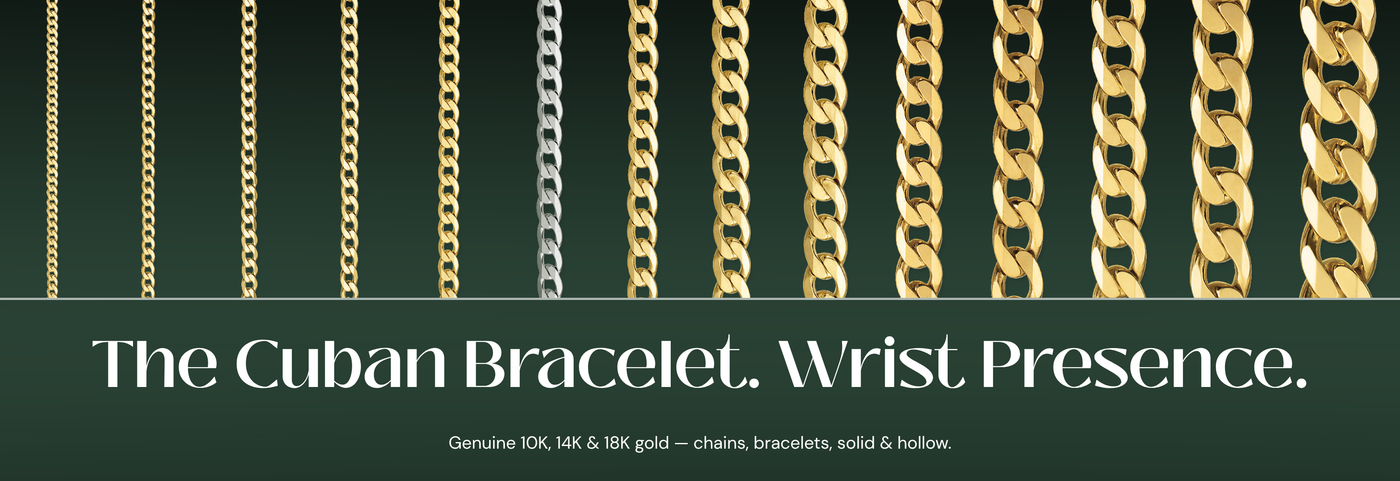
What widths are Cuban bracelets made in?

From around five millimetres, where the band is a firm everyday piece that slips under a cuff, through seven to ten millimetres, which is the range most often worn as a visible band on its own.

From twelve millimetres upward the bracelet stands well off the wrist and is worn outside the sleeve; eighteen millimetres and wider are made for those who want the wrist to carry the whole statement.

The oval is the same form at every size. What changes is the gauge of the wire and the size of each link, and, from about eight millimetres, the clasp moves from a lobster to a box.

About Cuban Gold Bracelets

How a Cuban Bracelet Sits and Moves on the Wrist

A Cuban bracelet and a Cuban chain use the same link pattern, but they wear completely differently. A chain's primary relationship is with light and drape — how it falls and reflects. A bracelet's primary relationship is with weight and movement — how it feels on the wrist, how it moves when you gesture, how it sits when your arm is at rest. The same link width that looks correct on a chain often needs to be scaled up on a bracelet to achieve the same visual presence.

The clasp is where Cuban bracelets reveal their quality most directly. Wide, heavy Cuban bracelets — anything above 8mm — should use a box clasp with a double safety latch. This clasp type is designed to handle the leverage created by a heavy chain pulling against its hinge point. Lobster claw clasps, while secure for chains, put all the closure force on a single spring mechanism that heavy bracelets will eventually stress.

Miami Cuban bracelets tend to look proportionally better at wider widths than standard Cuban bracelets because the larger link scale fills the wrist space more naturally. A 6mm Miami Cuban reads differently than a 6mm standard Cuban — the bigger link proportions give it more visual weight without requiring more physical metal.

Comparar /3

A carregar...