Genuine karat gold — never plated, gold-filled, or overlaid.

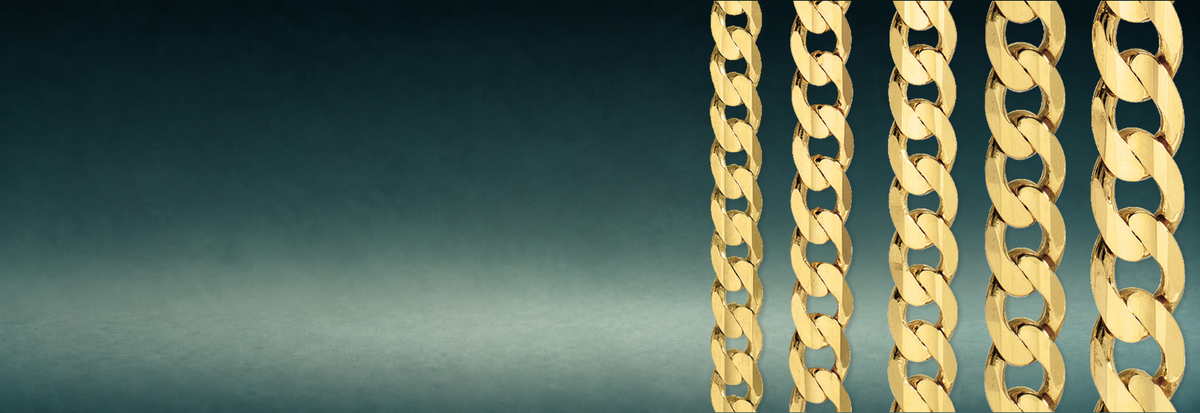
Yellow gold Cuban link chains on a teal background

Compare width, length and karat

Cuban Gold Bracelets

Explore Cuban gold bracelets and check the details of each piece.

Cuban Bracelets by Width, Karat & Clasp

A Cuban bracelet takes the thick, rounded, closely nested oval link and wraps it around the wrist, where a length of only a hand's span holds a countable number of links and every one of them is in view. At that scale the two continuous rails and the scalloped centre seam become the whole design, and the bracelet reads as a visually continuous band of gold; this describes its appearance, not whether its links are solid or hollow. This page describes how the link behaves at wrist length, how the bracelet settles and turns, what desks and cuffs do to it, how it is shortened, and the clasps fitted. Check the width and karat stated in the product details, and ask us about anything missing.

View as

How a Cuban Bracelet Sits and Moves on the Wrist

A bracelet is the link at short range, and the Cuban at short range can look like a continuous band. This guide covers how the nested ovals read over a few repeats, how the bracelet settles and turns on a moving joint, what a desk edge and a cuff do to it, how it is shortened, the clasps used at the wrist, and how the surface may change with wear.

Understanding the Cuban Bracelet

What is a Cuban bracelet?

A bracelet made from the Cuban link: thick oval links with rounded edges, each closed tightly into the next so that the band reads as two continuous rails with a scalloped seam between them.

On a wrist the run is short enough for each link to be seen as a unit, and the depth of the link, which is lost along a necklace, shows plainly from the side.

Check the width, karat and clasp type stated in the product details, and ask us about anything missing.

Does a Cuban bracelet read differently from a Cuban chain of the same width?

It can, because it is seen at short range and from the side. A chain runs past the eye as a band; a bracelet holds only a handful of links, each of which can be taken in as a shape, and the arm's movement shows the depth of the link constantly.

The rails along the edge become two bright curves following the wrist, and the crescents along the seam are a visible rhythm rather than a texture.

The width has not changed, but the proportion of link to piece has. A single oval is a larger share of a bracelet than it is of a chain, and it reads accordingly.

Does a Cuban bracelet turn over on the wrist?

A Cuban bracelet may turn or slide on the wrist, depending on its construction, fit, width and weight. Closely nested links can give a band-like appearance, but they do not guarantee that the clasp will settle underneath the wrist.

Check both sides of the actual bracelet and its clasp rather than assuming that every surface has the same profile or finish. A snugger fit may limit movement; choose a fit that is comfortable and secure rather than relying on gravity to position the clasp.

Where does a Cuban bracelet settle when the arm hangs?

It may settle near the wrist bone when the hand hangs, but that depends on wrist shape, bracelet length, width and weight. The bracelet and clasp can shift as the arm is raised or lowered.

Closely nested Cuban links create a band-like appearance; they do not guarantee a fixed clasp position or prevent catching or pressure against the skin. Check the fit through comfortable hand movements.

Does a desk edge affect a Cuban bracelet?

The underside of the bracelet rests on the desk as the hands work, so the contact area may rub against the edge; a rounded link profile does not guarantee that it will slide without catching.

How a specific bracelet's finish changes with wear, and whether it can be evened by polishing, depends on its construction, finish and use; ask a jeweller before any polishing.

Will a Cuban bracelet slide under a shirt cuff?

A narrower bracelet may fit under a cuff, but the cuff opening, bracelet thickness and clasp all affect clearance. Check the particular bracelet against the fabric; rounded links do not guarantee snag-free movement.

At wider widths the bracelet stands further off the wrist and may not pass under a cuff comfortably.

Loosely knitted fabrics can catch on a clasp ring; check the clasp type of a specific bracelet.

Can a Cuban bracelet be shortened?

A jeweller may be able to adjust the length by removing links, where the design permits. Whether and how a specific bracelet can be shortened, from which end, and by how much, depends on its construction and clasp; ask a jeweller before any alteration.

Why do some Cuban bracelets have a box clasp and others a lobster?

Clasp types vary by piece, and the width of the bracelet is one factor a maker considers. A lobster clasp is a sprung hook closing on a ring; a box clasp is a housing into which a folded tongue clicks. Check the clasp type in the product details and the product images, and ask us if it is not stated.

Why might the underside of a Cuban bracelet look brighter than the top?

Contact is one cause: the underside may rub against desks, tables or chair arms more often than other areas, although any part of the bracelet can contact surfaces.

How visible this is on a specific bracelet, and whether it can be evened by polishing, depends on its construction, finish and use; ask a jeweller before any polishing.

How should I compare Cuban bracelet widths?

Compare the available width and length measurements before choosing between designs. Ask us about any measurement that is missing. Link size, thickness and proportions can change between widths and makers, so compare the actual pieces as well as the measurements. Check the clasp type stated for the specific piece.

Compare /3

Loading...