FLASH SALE — Save 25% | Code: HAPPY25NOW

When it comes to gold, we guarantee the use of 100% real gold in all our gold products.

Italian heart gold pendants

Heart Gold Pendants

Gold Heart Pendants — 10K, 14K, and 18K

Gold heart pendants in solid 10K, 14K, and 18K yellow and white gold — from fine 10mm hearts for delicate everyday wear to bold 30mm+ statement pendants. Made in Italy, karat-stamped, ships from the U.S. in 1–3 business days.

Design Range and Sizing

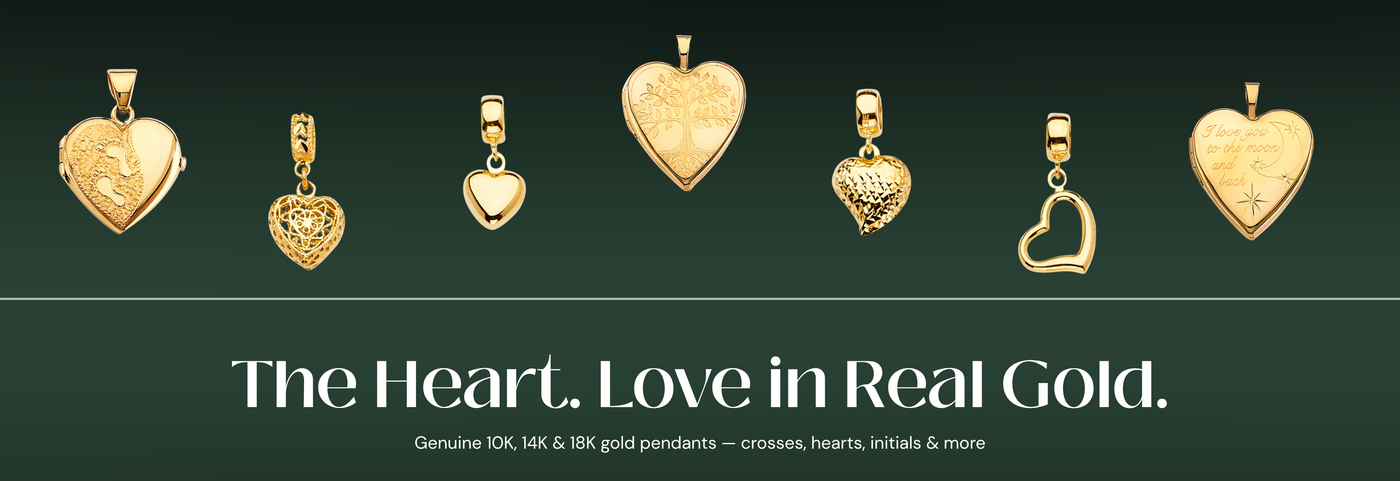
Heart pendants span a wide range of interpretations: flat polished discs; open-outline wire hearts; dimensional heart shapes; hearts with textured or hammered finishes. Size matters for context — a 10–15mm heart reads as subtle and refined for daily wear; 20–25mm is clearly a statement pendant; 30mm+ is an occasion piece. The right size also depends on chain width — a large heart needs a chain with enough visual weight to balance it.

Gifting and Chain Pairing

Heart pendants are among the most frequently gifted gold jewelry items. For gifting: yellow gold in 14K is the most versatile choice. White gold suits recipients who prefer cooler metal tones. If giving pendant and chain together, match karats for consistent color. Most pendants fit chains up to 3mm through the bail — verify bail width for wider chains.

View as

Choosing a Heart Pendant

Is a hollow heart pendant weaker than a solid one?

It is more susceptible to denting, because a thin shell can be pushed in by a sharp knock where solid metal would resist. In ordinary wear on the chest that rarely arises.

Against that, a hollow form puts far less load on the loop, the chain link and the clasp, which are the places a necklace actually comes apart.

The rim, where the two halves are joined, is the part to inspect over time, and any lifting there is worth showing to a jeweller early.

Can a dent in a hollow heart be pushed back out?

Sometimes. A shallow dent in a smooth area can occasionally be raised from inside where there is access, or eased out by a jeweller working the metal around it.

A crease that has folded the shell, or a dent running across a soldered joint, is much harder, because the metal has stretched and cannot simply be returned.

Repair of this kind usually involves heat, so any stones or enamel on the piece decide what is possible before anything else does. Ask a jeweller what the work will involve before authorising it.

How far does a raised heart stand off the chest?

Most domed hearts carry somewhere between two and four millimetres measured from the back plate to the highest point of the curve, though larger sculptural pieces go further.

That figure matters more than overall width for anyone who wears close-fitting knitwear, since relief is what makes a shape read through fabric and what decides whether the piece lies flat or stands away.

Where a listing gives a depth or a thickness in millimetres, it is describing this dimension rather than the gauge of the metal itself, which on a hollow piece is very much thinner.

Is the back of a heart pendant finished as well as the front?

On a well-made piece it is, and it should be, because a pendant turns during wear and its reverse is seen regularly by anyone sitting opposite the wearer.

What to look for is an even polish, a joint that cannot be felt with a fingernail, and no dimple where a hollow has been closed with filler.

A flat and cleanly finished back also keeps the piece's options open, since that is the surface a jeweller has to work with afterwards, whether the job in question is a repair or an addition.

What holds a hinged heart closed?

A small catch, usually a sprung tongue that snaps into a lip on the opposite rim, or else a friction fit where the two halves grip each other along the edge.

A sprung catch gives a definite click and is easier to trust; a friction fit loosens gradually as the rim wears and can open without being noticed.

Either way the hinge and the catch are the moving parts of the piece, and they deserve the same periodic look that a clasp does, since both wear at their point of contact.

Where is a stone usually placed on a heart pendant?

Most often at the centre of the face or a little above it, where the widest part of the form gives a setting room to sit without breaking the outline.

A stone set near the point at the bottom is more exposed and more likely to meet things, so it is usually kept small or sunk into the metal.

The listing names the stone and states its size; the images show where it sits on the form, which is what actually governs how the finished piece reads at normal viewing distance.

How do I judge a heart pendant against my own build?

Measure the width of the piece and compare it with the span between your collarbones. A heart occupying a small part of that distance reads as delicate; one occupying much of it reads as a statement.

Relief counts alongside width, since a deeply domed heart occupies visual space that a flat outline of the same measurement does not, and it also stands further off the body.

Both figures appear on the listing in millimetres, which is a steadier guide than judging scale from a photograph, where the framing and the model between them distort any comparison.

Should I buy a heart pendant or a finished heart necklace?

A finished necklace removes a decision and arrives ready to wear, with the chain chosen by whoever designed the piece to suit its weight and its proportions.

A pendant bought on its own lets you set the drop yourself and use a chain you already like, which matters if you layer or have a preferred length.

Listings on this page state whether a chain is included, so the choice is visible before you buy rather than after the parcel arrives, and where one is supplied the stated length tells you where the piece will sit.

Can a heart pendant hang alongside something else on the same chain?

It can, provided the chain and its clasp carry the combined weight and both openings are wide enough for the pieces to slide freely along the links.

Two pieces sharing one chain will find their own positions and touch each other constantly, so softer metals and exposed settings can mark over time, particularly where one of them is much the heavier.

Where two elements are meant to sit apart from one another, a chain with fixed stations, or simply two separate chains worn at different lengths, is the more dependable arrangement.

Can a heart pendant be made to open if it was not built that way?

No. An opening design is built as two halves around a hinge and a catch from the outset, with a rim thick enough to house both. Converting a sealed piece would mean remaking it.

A jeweller can sometimes add a component to the outside of an existing piece, a fitting or a loop, but that achieves something different and does not turn a sealed heart into a hinged one.

If an opening piece is what you want, it is a decision to take at the point of purchase rather than afterwards, because the construction is settled long before the metal is ever formed.

About Heart Gold Pendants

How a Heart Pendant Is Built

Gold heart pendants span a wider range of design interpretations than almost any other pendant style. The same basic silhouette can be executed as a flat, polished disc that reflects light like a mirror; an open-outline heart in gold wire; a dimensional heart with front and back surfaces; a heart with diamond accents; or a heart with a texture that diffuses rather than reflects. The choice between these interpretations depends on how literal, how delicate, or how dimensional the wearer wants the piece to be.

Size is the most practical consideration for pendant buying. A small heart (10–15mm height) reads as subtle and refined, appropriate for everyday wear across most professional and social contexts. A medium heart (20–25mm) is clearly a statement pendant — visible from across a room, chosen when the jewelry is meant to be noticed. Large hearts (30mm+) are more typically statement or occasion pieces. The right size also depends on the chain: a large heart on a delicate 1mm chain looks proportionally mismatched; a small heart can disappear on a wide chain.

Heart pendants are among the most frequently purchased gold jewelry items as gifts. For gifting: yellow gold is the most traditional choice and pairs with the widest range of existing jewelry. White gold in 14K is appropriate for recipients who prefer a cooler metal tone. A pendant purchased without a chain needs to fit the chain's bail width — most standard pendants fit chains up to 3mm; pendants with narrow bails may not accommodate wider chains. If giving a complete set, matching karat between pendant and chain ensures color consistency.

Compare /3

Loading...