Free shipping on all orders over $75 in the United States

When it comes to gold, we guarantee the use of 100% real gold in all our gold products.

FLASH SALE— Save 25%

HAPPY25NOW
Italian solid gold chains in multiple styles

Solid Gold Chain

Solid Gold Chains — 10K, 14K, and 18K, All Styles

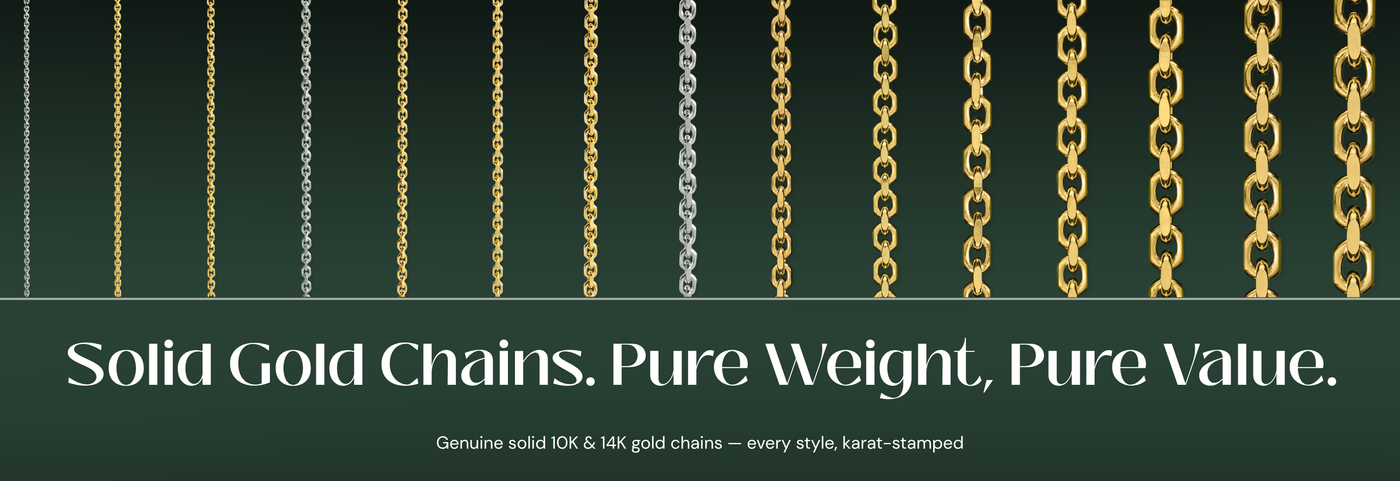
Solid gold chains in every major style — Cuban, Franco, rope, Figaro, box, mariner, and more. Solid construction means every link is gold through and through: no hollow core, no filled interior, no plating. Made in Italy, stamped with karat, ships from the U.S.

Solid vs. Hollow: What the Difference Means

Solid gold links don't dent or compress under the friction of daily wear. Hollow links — formed from thin gold tubing — can dent permanently if caught between hard surfaces. Solid chains can be resized, repaired, and have links added or removed by any jeweler without structural concerns. For a chain worn every day, solid construction is the long-term recommendation.

Weight, Karat, and Value

Solid chains cost more than hollow chains of the same style and karat because they contain significantly more gold by weight. Every listing includes gram weight — the most reliable metric for comparing value across different solid chain styles. A heavier chain at the same karat has more gold content and more intrinsic value.

View as

What is a solid gold chain?

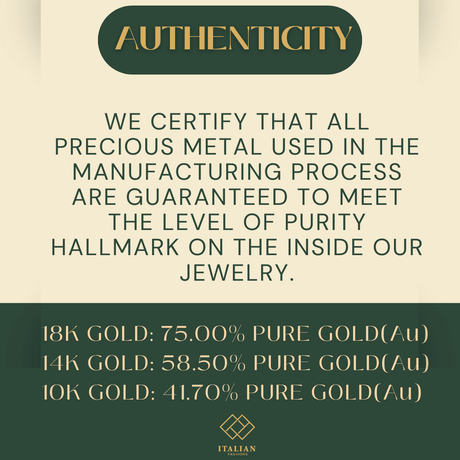
A solid gold chain is a chain made from genuine gold alloy throughout every link — the gold content extends from the outer surface through the complete interior of each link, with no hollow core, no base metal core, and no plating over another metal. Solid gold chains are categorized by karat: 10K (41.7% gold), 14K (58.3% gold), and 18K (75% gold) are the most common in the US market.

The 'solid' designation in fine jewelry terminology is legally precise: a solid gold chain must be the same gold alloy material throughout. This distinguishes it from hollow gold chains (thin gold shells over empty cores), gold-filled chains (a thick mechanical bond of gold over base metal), and gold-plated chains (a microscopic electroplated layer of gold over base metal or silver). The solid/hollow/plated distinction is the single most consequential quality distinction in the chain market, and the one most frequently exploited by sellers who describe plated or hollow pieces using language that implies solid construction.

For buyers: the weight test is the most accessible field verification for solid construction. A solid 14K gold rope chain at 24" and 3mm should weigh approximately 12–18 grams. The same visual dimensions in hollow construction weigh 4–7 grams. When a seller can't provide gram weight or won't weigh the chain in front of you, they're hiding that the piece isn't solid. Solid gold chains have a definitive, satisfying weight that hollow or plated alternatives simply cannot replicate.

What is the difference between solid gold and hollow gold chains?

A solid gold chain has genuine gold alloy from surface to center in every link; a hollow gold chain has a thin gold shell over an empty interior. Both can look identical in photographs and display cases. The difference is in hand: solid gold chains feel substantially heavier, and the weight is proportional to the visual size. Hollow chains weigh 60–75% less than solid equivalents at the same visual dimensions.

The hollow chain is the most prevalent source of buyer disappointment and financial harm in the gold jewelry market. Hollow chains are not inherently fraudulent — they're a legitimate product with legitimate applications (lower-cost gold appearance, lighter weight for comfort) when correctly described and priced. The fraud occurs when hollow chains are sold using language, pricing, or implied claims that lead buyers to believe they're purchasing solid construction. A hollow chain at 10mm and 24" that weighs 8 grams contains dramatically less gold than a buyer imagines when looking at that visual size.

The financial consequence: a hollow chain purchased as solid is paying solid prices for hollow gold content. At current gold prices, a 20-gram solid 14K chain contains approximately $700 in gold melt value. The same visual size in hollow construction might contain 6 grams of gold worth $210 in melt. The buyer paid for the appearance of the solid piece while receiving the gold value of the hollow. The gram weight verification before purchase — not after — is the only protection.

What is the difference between solid gold and gold-plated chains?

A solid gold chain is genuine gold alloy throughout, with 10K–18K gold content and permanent intrinsic value. A gold-plated chain has a base metal core (usually brass, copper, or silver) covered by a microscopically thin layer of gold deposited by electroplating — typically 0.5–2.5 microns thick. Gold plating eventually wears through to reveal the base metal beneath. Solid gold never reveals a base metal core because there is no base metal core.

Gold plating's lifespan varies dramatically by plating thickness and wear conditions. A well-plated fashion chain worn occasionally might look gold for 2–5 years before the base metal shows through at high-wear points. The same chain worn daily might show base metal within months. But regardless of how long the gold appearance lasts, the chain never gains intrinsic value — when the plating wears, the underlying base metal is worth essentially nothing as precious metal. A solid gold chain worn for 50 years remains exactly as valuable as when new; the gold content doesn't diminish from wear.

Identification: the karat stamp is the definitive test. A solid gold chain carries '10K', '14K', '18K', '417', '585', or '750' stamped on the clasp or a link. A gold-plated chain carries 'GP' (gold-plated), 'GF' (gold-filled), 'GE' (gold electroplated), or no stamp at all. The absence of a karat stamp on a 'gold' chain is not an oversight — it's disclosure. Federal law requires that solid gold be stamped at the stated purity. No karat stamp means no solid gold.

Is a solid gold chain worth buying?

Yes — a solid gold chain is one of the best-value fine jewelry purchases available. It combines permanent aesthetic appeal with genuine precious metal value that appreciates with gold prices over time, provides daily wearability without degradation, and represents a multi-decade ownership experience rather than a depreciating fashion purchase. Heavy solid gold chains (15+ grams) function simultaneously as fine jewelry and stored precious metal value.

The 'worth it' question for solid gold chains has a clear answer when you understand what you're actually buying. You're not paying a premium for a fashion item that will look dated in five years — you're acquiring a documented weight of pure gold (at 14K, 58.3% of every gram) in a functional, wearable form. The gold content's value is independent of fashion, style trends, or the chain's age. A 20-gram solid 14K gold chain purchased today will contain the same 11.66 grams of pure gold in 20 years, worth whatever gold's spot price is at that future date.

The comparison that clarifies the value: a $1,200 solid 14K gold chain versus a $150 gold-plated equivalent. After five years, the solid chain has appreciated with gold prices and shows no degradation in gold content. The plated chain has revealed base metal at wear points, cannot be repaired to its original gold appearance, and has no recoverable precious metal value. The $1,050 difference bought 30–40 years of additional service, preserved gold value, and the ability to sell or melt the piece at its gold content value at any point.

What does 14K solid gold chain mean?

A 14K solid gold chain is a chain made entirely from 14-karat gold alloy — meaning 58.3% pure gold combined with 41.7% alloying metals (typically copper, silver, and zinc for yellow gold; or palladium and silver for white gold). The '14K' refers to the gold purity (14 out of 24 parts gold), and 'solid' confirms the alloy is present throughout every link with no hollow core or base metal.

Understanding karat arithmetic is straightforward: 24K is pure gold; 18K is 18/24 = 75% gold; 14K is 14/24 = 58.3% gold; 10K is 10/24 = 41.7% gold. For chain buyers, 14K represents the optimal balance point: enough pure gold for rich warm color and meaningful intrinsic value, combined with enough alloying metal to provide the hardness that chain links need to survive flexion cycles, clasp stress, and daily wear. 10K provides more hardness but less color richness and gold value; 18K provides more color richness but less hardness and more cost.

The stamp to look for: '14K' or '585' (the European decimal equivalent, meaning 585 parts per 1,000 are gold — same as 58.5%). Both marks are legally equivalent and confirm 14-karat gold content. Italian pieces often carry '585' alongside manufacturer and assay office marks. American pieces typically carry '14K'. Either stamp on the clasp confirms genuine 14-karat solid gold content.

What are the different types of solid gold chain styles?

The main solid gold chain styles are: curb/Cuban link (interlocked flat oval links, bold and uniform); rope chain (twisted strands creating a spiraling pattern, versatile and popular); box chain (square links in a clean line, very durable); figaro chain (alternating pattern of small round links and larger oval links, classic Italian style); wheat/Spiga chain (braided four-strand, flexible and durable); Franco chain (V-shaped interlocking links, extremely durable, bold); and cable chain (simple round or oval links, classic baseline style).

Each chain style has a distinct visual identity and practical performance profile. Rope chains are the most popular solid gold chain style globally — their twisted construction creates a spiraling light-reflection pattern that catches and returns light from every angle, making a rope chain appear to 'shine' more actively than flat-link styles. Cuban/curb links provide maximum visual presence per link width, with flat faces that create a broad, mirror-like reflection. Box chains offer the cleanest, most architectural look and the most durable link construction — the square link geometry resists the link-on-link wear that affects round-link styles.

For buyers choosing between styles: rope chains for maximum light play and versatility with pendants; Cuban/curb links for bold cultural resonance and visual statement; box chains for durability and clean architectural aesthetics; figaro for classic Italian pattern work; Franco for maximum durability in a bold style. Width matters as much as style: a 2mm rope chain is a delicate everyday piece; a 5mm rope chain is a bold statement.

What is the most durable solid gold chain style?

Box chains and Franco chains are the most durable solid gold chain styles. The box chain's square link geometry distributes mechanical stress across all four link faces rather than concentrating it at single contact points, making it resistant to kinking, knotting, and link fatigue. The Franco chain's V-shaped interlocking links create a virtually indestructible structure that resists both kinking and breaking under tension.

The durability hierarchy in solid gold chains tracks link geometry. A delicate Singapore chain (twisted fine links) concentrates wear stress at the link joints — the thinnest, weakest point of the construction. A box chain distributes the same stress across the flat face of each square link. The same gold content in a box chain construction lasts significantly longer under daily wear than in a delicate twisted-link construction.

For buyers prioritizing durability above style: box chain or Franco chain in solid 14K at 2–3mm width is the specification that will last decades of daily wear without kinking, breaking, or developing weak points. For buyers who prefer rope chain: solid construction is significantly more durable than hollow rope — hollow rope chains, despite their popularity, are the single style most commonly brought in for repair because the hollow link structure is vulnerable to kinking that creates permanent weak points.

What is a rope chain in solid gold?

A solid gold rope chain is a chain style constructed by twisting multiple gold strands together in opposing helical patterns, creating a spiraling 'rope' appearance. The construction produces a chain that catches and returns light from every angle as it moves, creating an active shimmer that distinguishes rope chains from flat-link styles. Solid gold rope chains are one of the most popular chain styles globally at every width from 1.5mm to 10mm+.

The rope chain's light-return property is its defining characteristic — it's why rope chains appear 'shinier' than chains of equal quality in other styles. The spiraling construction creates micro-facets that face in every direction simultaneously, meaning the chain is always reflecting light toward the viewer regardless of body position or lighting angle. This omnidirectional light return is impossible to achieve with flat-link construction and is the reason rope chains have remained the most popular chain style for over 50 years.

Solid vs. hollow rope chains: this is the most important distinction in rope chain purchasing because hollow rope chains are exceptionally common and easily mistaken for solid. A solid rope chain is rigid in a satisfying way — pick it up and it holds its form, feels substantial, and doesn't collapse. A hollow rope chain feels light and slightly soft — it drapes rather than holding form and weighs a fraction of the solid equivalent. At 3mm and 24", a solid 14K rope should weigh 10–16 grams; hollow at the same dimensions weighs 3–6 grams.

What is a Cuban link chain in solid gold?

A solid gold Cuban link chain features interlocked, flat oval links set at a slight diagonal angle, creating a smooth, flat surface that lies flush against the skin. The link geometry reflects light in broad, uniform sheets rather than scattered sparkle, giving Cuban links their distinctive visual presence. Cuban link chains are available in widths from 3mm to 20mm+, with wider widths becoming increasingly bold and culturally resonant.

The Cuban link's cultural significance is inseparable from its design — the style that originated in Italian jewelry manufacturing and was elevated to global prominence through Cuban-American and hip-hop communities carries meaning that purely functional chain styles don't. Wearing a Cuban link chain communicates something specific and intentional about the wearer's aesthetic identity, regardless of width. The style is simultaneously the most culturally specific and the most consistently popular men's chain style of the past 40 years.

Width selection for Cuban link chains: 3–4mm for a subtle everyday statement; 5–7mm for a clear, confident everyday chain; 8–12mm for a bold fashion statement; 14mm+ for maximum-impact jewelry. At each width increment, the solid construction requirement becomes more important — at 8mm+, the weight difference between solid and hollow construction is dramatic and the aesthetic of proper weight is part of what the style communicates.

What is a figaro chain in solid gold?

A solid gold figaro chain alternates between multiple small round or oval links and one larger elongated oval link — typically a 3:1 or 2:1 pattern. This alternating rhythm gives figaro chains their distinctive Italian-craftsmanship feel: ordered, precise, and traditionally balanced. Figaro chains are one of the oldest named chain styles in Italian fine jewelry manufacturing, originating in the Arezzo district's centuries of goldsmithing tradition.

The figaro chain's aesthetic is that of deliberate pattern rather than uniform texture. Where a rope chain reads as a continuous spiral and a Cuban reads as a continuous flat sheet, the figaro reads as a counted pattern — you can follow the rhythm of small-large, small-small-large across the chain's length. This rhythmic quality gives figaro chains a handmade, artisanal feeling that resonates with buyers who appreciate visible craftsmanship in their jewelry. It's not a coincidence that the figaro is one of the signature styles associated with Italian jewelry manufacture.

Figaro chains work particularly well as pendant chains — the pattern creates visual interest along the chain's length that complements rather than competes with a pendant's design. At 3–5mm, a solid 14K figaro chain is versatile across gender and occasion. At 6mm+, it becomes a statement piece that works well worn alone.

About Solid Gold Chains

What 'Solid Gold' Actually Means — and Why It Matters

A solid gold chain is constructed entirely from solid gold metal — each link is formed from gold that is solid throughout, with no hollow core or filled interior. This is distinct from hollow gold chains, where the links are formed from thin gold tubing bent into shape, and from gold-filled or gold-plated chains, where a base metal core is covered in a gold layer. The karat marking (10K, 14K, 18K) indicates the gold purity, not the construction method — a solid gold chain and a hollow gold chain can both be stamped 14K; the difference is in how much actual gold is in each link.

The practical advantages of solid construction are durability and longevity. Solid gold links don't dent, compress, or deform under the pressure of daily wear. Hollow links can dent if caught between hard surfaces or compressed in a drawer — once a hollow link dents, the deformation is permanent and difficult to repair. Solid chains can be resized, repaired, and have links added or removed without the structural concerns that come with hollow construction. For jewelry worn every day for years, solid construction is the professional recommendation.

Solid gold chains cost more than hollow chains of the same style and karat because they contain significantly more gold by weight. A solid 14K Cuban link and a hollow 14K Cuban link of the same visual width and length may look nearly identical — the difference shows in the weight when you hold them and in the price. For buyers choosing between the two, the question is whether the durability premium of solid construction is worth the additional cost for the intended wear pattern. A chain worn daily benefits clearly from solid construction; a chain worn occasionally may not.

Compare /3

Loading...