Frete grátis para todos os pedidos acima de US$ 75 nos Estados Unidos

Quando se trata de ouro, garantimos a utilização de ouro 100% verdadeiro em todos os nossos produtos de ouro.

FLASH SALE— Save 25%

HAPPY25NOW
Italian 10K yellow gold bracelet

Pulseira Amarela 10k

10K Yellow Gold Bracelets: The Full Style Range in the Hardest Standard Gold

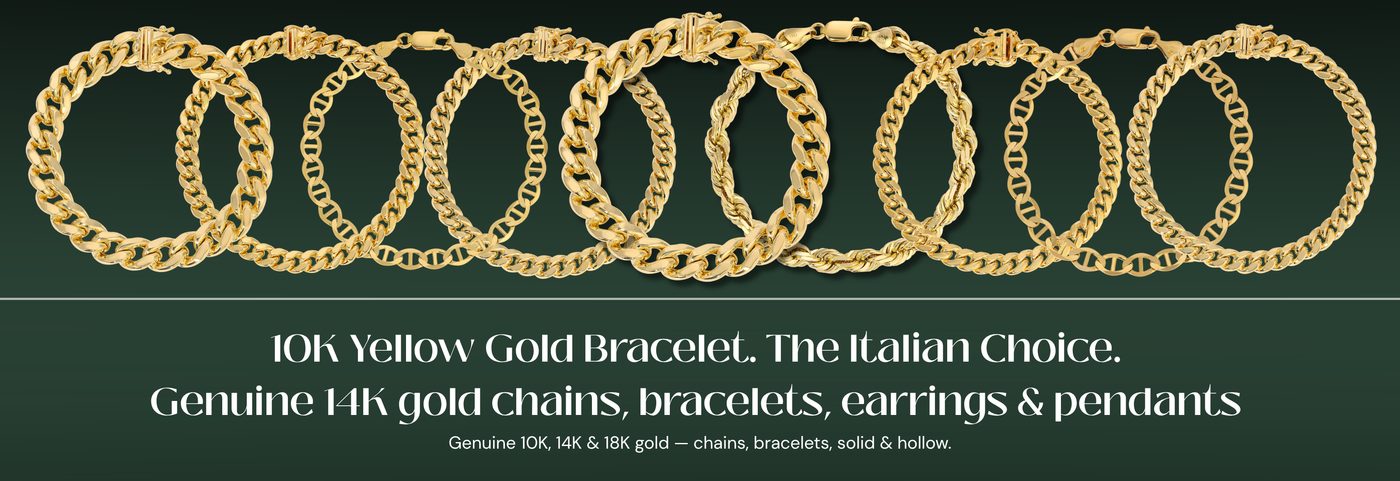
A 10K yellow gold bracelet brings the durability advantage of the hardest standard karat to wrist jewelry — where daily contact, hand movement, and surface friction are more intense than at the neck. At 41.7% pure gold, 10K outperforms 14K in scratch resistance under these conditions, making it particularly well-suited to bracelets worn without removal.

Why Karat Choice Matters More for Bracelets Than Chains

A necklace chain rests against skin and clothing with relatively low contact friction. A bracelet moves constantly against surfaces — desks, steering wheels, shirt cuffs, other jewelry, skin during hand and arm movement. This elevated wear pattern accelerates the surface abrasion that dulls gold jewelry over time. At 10K, the harder alloy provides measurably better resistance to this surface contact, meaning a 10K bracelet will look newer longer than a 14K bracelet of identical construction under identical wear conditions.

Selecting Your 10K Yellow Gold Bracelet

10K yellow gold bracelets are available in the same style range as 14K — Cuban link, rope, Figaro, curb, box, tennis, and bangles. Width and length selection follow standard principles: 7 inches fits most women's wrists, 8 inches fits most men's, with 7.5 inches the most commonly requested unisex length. The price advantage of 10K over 14K means buyers can access wider, heavier bracelets at the same budget.

Ver como

What is a 10K yellow gold bracelet?

A 10K yellow gold bracelet is a fine gold wrist ornament crafted from an alloy that is 41.7% pure gold -- 10 parts gold out of 24 on the karat scale -- combined with 58.3% alloy metals, primarily silver and copper, which both preserve yellow gold's warm color and give the alloy the hardness needed for durable bracelet wear. At 10K, the bracelet qualifies as fine gold jewelry under U.S. trade law, which requires a minimum of 10 parts pure gold per 24 to be sold as gold. The 10K yellow gold bracelet occupies the entry tier of genuine fine gold jewelry, offering authentic gold at an accessible price point.

10K yellow gold bracelets are produced in a wide range of styles: curb link, figaro, rope, wheat, and box chain bracelets; solid bangle bracelets; charm bracelets; and more elaborate design-forward styles. Each style type is available in a range of widths and gram weights, from fine and delicate to heavy and substantial. In yellow gold, the 10K alloy's warm, golden color is distinctive despite the lower gold percentage -- copper in the alloy enhances the warm tone, and many buyers find 10K yellow gold's color visually comparable to higher karat yellow gold to the naked eye.

The 10K yellow gold bracelet is the most commercially popular karat for yellow gold bracelets in the U.S. market among buyers prioritizing affordability and durability over maximum gold content. It is widely available from both domestic and international producers, with Italian-made 10K yellow gold bracelets representing the quality benchmark -- identifiable by the 417 hallmark (for 41.7% gold content), a registered manufacturer mark, and an independent government assay office stamp. These hallmarks together certify both the gold content and the Italian origin of the piece.

What does 10K mean in a 10K yellow gold bracelet?

The 10K designation in a 10K yellow gold bracelet indicates that the gold alloy is 41.7% pure gold -- 10 parts out of 24 on the karat measurement scale. The karat system divides gold purity into 24 equal parts: 24 karats is pure gold (99.9%), 18 karats is 75% gold, 14 karats is 58.5% gold, and 10 karats is 41.7% gold. The 10K karat designation is the minimum gold content permitted to be sold as gold jewelry in the United States under Federal Trade Commission regulations. A bracelet marked 10K or 10KT certifies it meets this minimum fine gold standard.

At 41.7% pure gold, the remaining 58.3% of a 10K yellow gold bracelet consists of alloy metals -- silver and copper predominantly, with possible additions of zinc and nickel. In yellow gold alloys, copper is the key color-enhancing metal: higher copper content produces a warmer, more orange-toned gold, while higher silver content produces a more pale, greenish-yellow gold. The specific proportion of copper and silver in a 10K yellow gold alloy determines the exact hue of the bracelet, with most commercial 10K yellow gold aiming for a warm, rich yellow tone. The alloy composition also determines the bracelet's hardness -- 10K is harder than 14K or 18K due to its lower gold and higher alloy content.

On a 10K yellow gold bracelet, the karat is indicated by a hallmark stamp on the clasp or an attached tag. In the United States the stamp reads 10K or 10KT. On Italian-made bracelets, the equivalent 417 mark (representing 41.7% gold) appears in Italy's numeric hallmarking system, accompanied by an assay office mark that independently certifies the gold content through government testing. The 417 designation on Italian bracelets is the equivalent of the U.S. 10K stamp and confirms the same 41.7% gold standard. For buyers unfamiliar with European hallmarking, 417 = 10K -- both refer to the same gold content level.

What types of 10K yellow gold bracelets are available?

10K yellow gold bracelets are available in a broad range of styles, each with a distinct visual character and structural approach. Chain-style bracelets are the most common category: curb link (flat interlocking oval links), figaro (alternating long and short links), rope (twisted helical links with multi-directional sparkle), wheat (a four-sided braid pattern), and box chain (square links in a rigid line). Each chain style produces a fundamentally different look from the same yellow gold metal, allowing buyers to select the character that best suits their taste -- from the clean, structured look of curb link to the sparkle-forward brilliance of rope.

Beyond chain styles, 10K yellow gold bracelets include solid bangle bracelets -- rigid circular or oval bands in a continuous gold tube or solid bar. Bangles stack naturally and are worn in multiples or alone. They are available in smooth, high-polish finishes; brushed satin finishes; and engraved or textured surfaces. Charm bracelets with a chain base and soldered or removable loops for charm attachment are another 10K yellow gold bracelet category, widely used for gift and milestone jewelry. Tennis bracelets -- a continuous line of prong-set or bezel-set stones (typically cubic zirconia or diamonds) in a 10K yellow gold setting -- represent the gemstone-set bracelet tier.

The most commercially popular 10K yellow gold bracelet styles in the fine chain category are curb link and rope in widths from 3mm to 7mm, at bracelet lengths of 7 inches (standard women's) and 8 inches to 9 inches (men's). At these dimensions, the bracelet is substantial enough to wear as a standalone fine jewelry piece while remaining comfortable for daily wear. Italian-made 10K yellow gold bracelets in curb link and rope styles represent the quality benchmark in this market -- produced on precision chain-making machinery with link dimensions and closures held to tighter tolerances than mass-produced alternatives from other producing regions.

Is a 10K yellow gold bracelet considered fine jewelry?

Yes -- a 10K yellow gold bracelet qualifies as fine jewelry under U.S. trade standards. The Federal Trade Commission defines fine jewelry as pieces made with precious metals at minimum purity standards, and 10K -- at 41.7% pure gold -- meets the minimum gold content required to be sold as gold in the United States. A 10K gold bracelet is genuine gold jewelry, not gold-plated, gold-filled, or gold-toned fashion jewelry. The distinction matters because fine jewelry contains real precious metal with intrinsic gold value, while fashion jewelry contains little or no precious metal and has no gold melt value.

The fine jewelry classification of a 10K bracelet has practical implications. A 10K yellow gold bracelet has a calculable intrinsic gold value (gram weight x 0.417 x current gold price per gram) that represents a real floor value recoverable through gold buyers, jewelers, or refiners. This floor value persists indefinitely -- it does not degrade over time the way the aesthetic or fashion value of a piece might. The 10K bracelet can be sold, pawned, refined, or passed on as a genuine gold asset at any point in time, which is a capability unavailable with fashion or costume jewelry regardless of how it looks.

Within the fine jewelry spectrum, 10K occupies the entry karat level -- above fashion jewelry (no gold content) and below 14K (58.5% gold), 18K (75% gold), and 24K (pure gold). The entry level positioning means 10K offers the accessibility of the lowest gold price within genuine fine jewelry, making it the right choice for buyers who want real gold at an approachable price point. For buyers who need to wear gold every day and want to be practical about cost while still owning authentic fine gold jewelry, 10K yellow gold bracelets are the most commercially sensible choice at the entry level of the fine gold jewelry category.

What are the hallmarks on a genuine 10K yellow gold bracelet?

A genuine 10K yellow gold bracelet carries specific hallmarks that certify its gold content. In the United States, the primary hallmark is the karat stamp: 10K or 10KT, stamped on or near the clasp or on a small attached tag. This stamp certifies that the bracelet's gold alloy meets the 41.7% minimum gold content required under U.S. trade law for gold jewelry. The stamp should be clearly legible with a 10x loupe. The absence of a hallmark on a bracelet represented as 10K yellow gold is a significant red flag -- legitimate fine gold jewelry from reputable manufacturers always carries identifiable hallmarks.

Italian-made 10K yellow gold bracelets carry additional required hallmarks beyond the basic karat mark. Italy's numeric hallmarking system uses 417 (representing 41.7% gold content) instead of or alongside the 10K designation. Italian bracelets additionally carry a manufacturer's trademark -- a registered identifier code in a geometric border linking the piece to a specific Italian goldsmith or company -- and an assay office mark from one of Italy's government-accredited testing facilities. The assay mark certifies that the declared gold content has been independently verified by a government authority, not merely claimed by the manufacturer. This three-mark system is mandatory for Italian gold jewelry sold legally under Italian law.

When examining a 10K yellow gold bracelet's hallmarks, check the clasp mechanism first -- the stamp is most commonly located on the barrel of the lobster-claw clasp or the spring-ring clasp. On bangle bracelets, the hallmark may appear on the inner surface of the bangle tube. On charm bracelets, it is typically on the clasp. Under a 10x loupe, look for clear, sharply stamped characters -- a poorly struck or unclear stamp warrants question. On Italian bracelets, confirm the presence of both the 417 purity code and the geometric assay office mark. Any reputable Italian fine jewelry retailer should be able to point to and explain each hallmark on request.

What metals make up 10K yellow gold?

10K yellow gold is composed of 41.7% pure gold combined with 58.3% alloy metals. In yellow gold alloys, the two primary alloying metals are silver and copper. Silver adds strength and slightly softens the gold's color toward a paler, greener yellow, while copper adds hardness and warms the color toward a richer, more orange-toned gold. The specific ratio of silver to copper in a 10K yellow gold alloy determines the bracelet's exact color character: alloys with more copper produce a deeper, warmer gold tone, while alloys with more silver produce a lighter, more classic gold color. Small amounts of zinc may also be present to improve workability and reduce porosity during casting or fabrication.

At 10K, the 58.3% alloy content is substantially higher than at 14K (41.5% alloy) or 18K (25% alloy). This higher proportion of hardening metals makes 10K yellow gold the hardest and most scratch-resistant of the common commercial gold karats. The hardness of 10K is a practical advantage for bracelet wear -- bracelets contact hard surfaces (tables, countertops, wristwatch metal) far more frequently than neck chains, and the harder 10K alloy withstands this contact better than the softer 14K or 18K alloys. For buyers prioritizing scratch resistance and durability in daily bracelet wear, 10K yellow gold's alloy composition is a functional benefit rather than a compromise.

The alloy composition of 10K yellow gold does have some implications for sensitive skin. Copper and zinc are generally well-tolerated by most skin types, but nickel -- occasionally present in trace amounts in some 10K alloy formulations -- is a common contact allergen. For buyers with known metal sensitivities, confirming a nickel-free alloy composition is advisable before purchasing a 10K yellow gold bracelet intended for long-term daily wear. Reputable Italian manufacturers typically specify alloy composition on request. The higher alloy content (and thus higher potential alloy metal skin contact) in 10K compared to 14K or 18K means that sensitive skin concerns are slightly more relevant at the 10K level, though most wearers experience no issues.

How durable is 10K yellow gold for bracelet wear?

10K yellow gold is among the most durable of the commercial gold alloys for bracelet wear, making it well-suited to the demands of daily wrist jewelry. The key reason is alloy hardness: at 41.7% pure gold and 58.3% alloy metals (silver, copper, and zinc), 10K's higher proportion of hardening metals produces a harder material than 14K or 18K. On the Vickers hardness scale, 10K yellow gold typically measures harder than 14K yellow gold, which is in turn harder than 18K. For bracelets, which absorb more mechanical stress than necklaces due to wrist movement and surface contact, this hardness advantage translates directly into better scratch resistance and longer maintenance of the original surface finish.

The structural durability of a 10K yellow gold bracelet also depends heavily on construction quality. A solid curb link or rope bracelet in 10K yellow gold with properly closed links, a secure lobster-claw clasp, and adequate gram weight for its stated width is among the most durable everyday fine jewelry constructions available. A hollow bracelet, regardless of karat, will be more vulnerable to dent damage from impact than a solid bracelet. The clasp is another critical durability variable -- a quality lobster-claw clasp (the most secure common bracelet clasp type) holds under the pulling and wearing forces of daily activity far better than a spring-ring clasp or toggle clasp. Always examine both the bracelet construction and the clasp quality when evaluating durability.

Practical durability precautions for a 10K yellow gold bracelet include: removing the bracelet before activities that could subject it to hard impacts (contact sports, manual labor, weightlifting where the bracelet could be caught on a bar or machine), before chemical exposure (chlorinated pool water, cleaning products, solvents that can degrade the alloy metals), and before water activities if the clasp mechanism or any gemstone settings could be compromised by prolonged moisture. Within the normal range of daily life activities -- desk work, casual exercise, social activities -- a well-constructed solid 10K yellow gold bracelet requires no special precautions and will provide years of reliable everyday wear.

Does 10K yellow gold tarnish?

10K yellow gold does not tarnish in the sense that sterling silver tarnishes. True tarnish -- the grey-to-black surface discoloration caused by metal reacting with atmospheric sulfur -- is a characteristic of silver, not gold. The 41.7% pure gold in 10K yellow gold alloy makes the metal resistant to the sulfur reaction that causes silver tarnish. Under normal daily wear and storage conditions, a 10K yellow gold bracelet will not develop the grey or black surface discoloration associated with silver jewelry. This tarnish resistance is one of the meaningful practical advantages of genuine gold jewelry over silver alternatives for daily wear.

What 10K yellow gold can experience over time is different from tarnish but can superficially resemble it. Fine surface scratches accumulate on the bracelet's finish through normal wear, dulling the original high-polish mirror surface to a more muted, satiny appearance over time. Additionally, the copper content in 10K yellow gold alloys can occasionally react with skin sweat and body chemistry, producing a faint greenish or dark tinge at the metal-skin contact points -- not tarnish in the silver sense, but a surface residue from copper oxidation. This is more common in 10K than in 14K or 18K (which have less copper) and is easily addressed by cleaning.

Certain chemical exposures accelerate 10K yellow gold surface degradation beyond normal wear. Chlorine -- in pools and hot tubs -- is the most damaging: it reacts with the copper and other alloy metals in 10K gold, causing progressive alloy degradation that can visibly discolor or weaken the metal with repeated exposure. Household cleaning chemicals, bleach, and ammonia-based products should never contact the bracelet. Cosmetic residue from lotions, perfumes, and sunscreen dulls the surface finish. Regular cleaning with warm soapy water and a soft brush removes accumulated residue and restores surface brightness. If surface scratches have significantly dulled the finish, professional polishing by a jeweler restores the original mirror quality.

Is 10K yellow gold hypoallergenic?

10K yellow gold is not classified as hypoallergenic, though most wearers experience no allergic reactions to it. The alloy metals in 10K yellow gold -- primarily silver, copper, and zinc -- are generally well-tolerated by most skin types. However, some 10K yellow gold alloys contain trace amounts of nickel, which is the most common metal contact allergen and can cause dermatitis in sensitive individuals. At 10K, the 58.3% alloy content means there is a higher proportion of potential alloy metals in contact with skin than at 14K or 18K, making sensitivity concerns slightly more relevant at 10K than at higher karats.

For buyers with known nickel sensitivities, the relevant question is not the karat but the specific alloy composition. A nickel-free 10K yellow gold alloy (formulated with silver, copper, and zinc only) carries no nickel risk regardless of the lower gold content. Many European and Italian manufacturers specifically formulate nickel-free yellow gold alloys to comply with EU nickel directive standards, which limit nickel content in jewelry worn against skin more strictly than U.S. regulations. Italian 10K yellow gold bracelets from manufacturers who specify nickel-free formulations are a better choice for sensitive buyers than unspecified-alloy alternatives.

The vast majority of buyers -- including those who might describe themselves as having sensitive skin to inexpensive fashion jewelry -- experience no reaction to 10K yellow gold bracelets. Fashion jewelry reactions are typically caused by base metal alloys (brass, zinc alloy, copper-plated metals) with no gold content -- materials fundamentally different from 10K fine gold alloys. If you have experienced reactions to gold-colored costume jewelry, those reactions were almost certainly to the base metals, not to actual gold. Reactions to genuine 10K gold jewelry, while possible for nickel-sensitive individuals, are significantly less common than reactions to fashion jewelry, and can be avoided entirely by choosing a confirmed nickel-free 10K alloy.

How does the color of 10K yellow gold compare to 14K or 18K?

10K yellow gold has a visibly different color from 14K and 18K yellow gold, though the differences are subtle and may not be obvious without direct side-by-side comparison. The color of yellow gold alloys is primarily determined by the gold content: higher gold content produces a richer, deeper, more saturated yellow. 18K yellow gold (75% gold) has the deepest, most saturated warm yellow color. 14K yellow gold (58.5% gold) is slightly less deep and warm. 10K yellow gold (41.7% gold) is the lightest and least saturated of the three, with a more pale or muted yellow tone compared to 14K and 18K at the same finish.

The copper content in the alloy also affects color. Higher copper proportion in the alloy formula warms and deepens the yellow tone -- some 10K yellow gold formulations with high copper content can appear close to 14K in color at normal viewing distances. The surface finish also plays a major role: a high-polish 10K bracelet reflects light intensely and appears brighter and more golden than a brushed 14K bracelet, because the polish quality affects how light is perceived more than the base alloy color in many lighting conditions. Side-by-side comparison with consistent surface finishes is the only reliable way to see the alloy color difference.

For practical purposes, the color difference between 10K and 14K yellow gold bracelets is minor enough that most casual observers will not notice it. The difference between 10K and 18K is more apparent -- 18K's deeper, richer gold tone is distinguishable to trained eyes in direct comparison. For buyers who want maximum gold color depth, 18K or 22K is the appropriate choice. For buyers who want warm yellow gold color at an accessible price point, 10K delivers visually adequate yellow gold character at the lowest genuine fine gold price, with only a subtle color difference from 14K that is not readily apparent in daily wear without a side-by-side reference.

About 10K Yellow Gold Bracelets

10K Yellow Gold Bracelets: The Full Style Range in the Hardest Standard Gold

10K yellow gold bracelets combine the hardest standard gold karat with the full bracelet style catalog. At the wrist — where contact friction from daily movement is higher than at the neck — 10K's superior scratch resistance translates directly to bracelets that look newer longer than 14K counterparts.

Bracelets accumulate surface wear faster than necklaces because they move against hard surfaces constantly: desks, steering wheels, shirt cuffs, other jewelry. The harder 10K alloy resists this friction better under identical wear conditions.

Available in Cuban, rope, Figaro, curb, box, tennis, and bangle styles. Standard lengths: 7 inches for women, 8 inches for men, 7.5 inches for a versatile fit. The 10K price advantage makes wider, heavier bracelets accessible at the same budget as a single 14K bracelet.

Comparar /3

A carregar...