Frete grátis para todos os pedidos acima de US$ 75 nos Estados Unidos

Quando se trata de ouro, garantimos a utilização de ouro 100% verdadeiro em todos os nossos produtos de ouro.

Italian Singapore gold chain

Cadeia de Cingapura

Cadeia de Cingapura
Ver como

Understanding the Singapore Link

What is a Singapore chain?

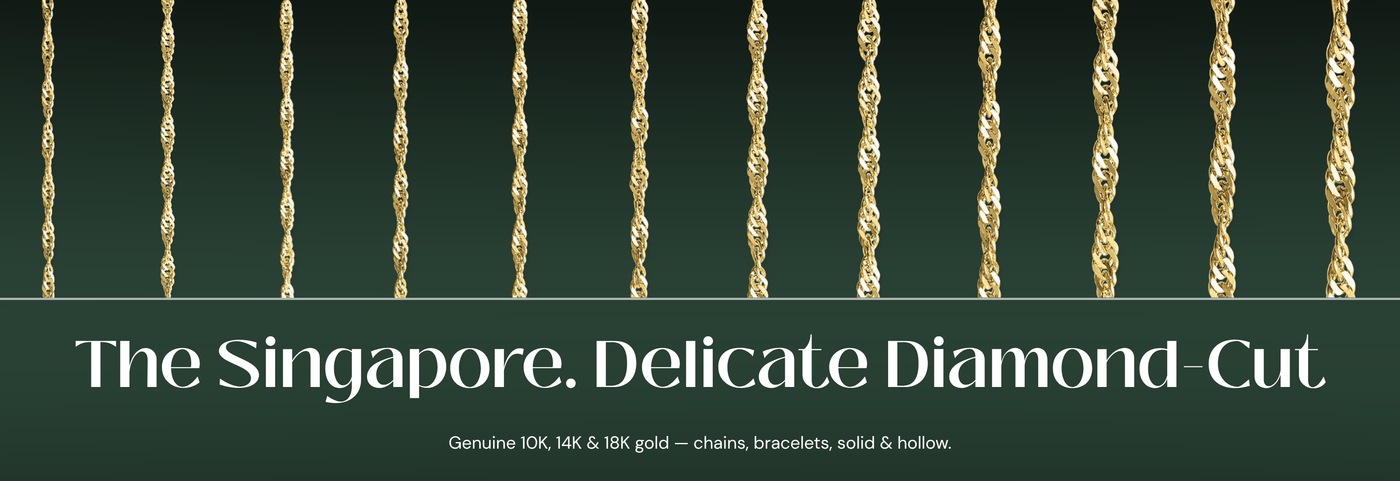
A fine chain of small flattened links, each cut with facets and each joined to the next with a slight rotation, so that the chain spirals gently along its length without being twisted by hand. It is light, bright, and almost always worn as a pendant chain.

The facets on the spiralling links catch light from every direction in turn, which gives the chain a shimmer that seems to run along it as it moves, rather than a series of separate flashes.

It is made in fine widths only, from about a millimetre to two and a half, and its built-in twist is what makes it coil when slack and what keeps it from kinking when it is folded.

Why does a Singapore chain twist on its own?

Because the twist is built into the way the links are joined. Each flattened link is set at a slight rotation to the one before it, and those small rotations add up along the chain, so that after a short run the links have turned through a full circle.

Hung from one end, the chain therefore falls as a gentle spiral, with the flat faces of the links turning around the axis. Nothing has been done to the finished chain to produce this; it is the sum of the angles at every joint.

The twist is permanent and even. The chain can be straightened by pulling it taut or coiled by letting it go slack, and in either case it returns to the same spiral once it hangs under its own weight again.

What gives a Singapore chain its shimmer?

Tiny facets on every link, arranged by the spiral so that they face in every direction along the chain. Wherever light falls, some facet is angled to return it, so the whole chain glitters at once rather than at a few points.

As the chain moves, the facets that are lit change continuously, and the eye reads a shimmer travelling along the length. That is why the chain is so often compared to light on moving water.

At the widths a Singapore is made in, the facets are far too small to see individually. The effect is a bright, restless line that reads larger than its width, which is what lets a very fine chain hold its own beneath a pendant.

What size of pendant suits a Singapore chain?

A small to moderate one. The chain is fine and light, and its virtue is that it adds a line of light beneath a pendant without competing with it. A small stone, an initial, a medal or a slim drop sits well on it.

A heavy pendant concentrates its weight on the fine links at the bail and at the clasp, which are the points a fine chain gives way at. For a pendant with real mass, a heavier chain of a different construction is the better carrier.

The bail should have a smooth interior so it slides over the facets without catching, and its opening should clear the chain's width easily. A bail that grips the chain rides on the facets and dulls them at the front over time.

Why does my Singapore chain curl up when I take it off?

Because the twist that hangs as a gentle spiral under the weight of the chain pulls it into a coil once that weight is gone. Laid down slack, the chain returns to its rest state, which is a curl, in the way a length of twisted cord curls when it is released.

It is normal and harmless. The chain is not damaged and has not been stretched; it is simply doing what its construction does, and it hangs straight again as soon as it is lifted by the clasp.

To keep it from coiling into other jewellery, fasten the clasp before putting the chain away and hang it from the clasp or lay it out straight. Dropped loose into a box, a coiled Singapore threads itself through anything nearby.

Does a Singapore chain kink?

Far less readily than other fine chains. A kink happens when two links are pushed out of their normal alignment at a sharp fold and jam against each other, so the chain holds the bend. A Singapore has no fixed alignment to be pushed out of.

Every link is already rotated from its neighbour, so a fold only turns the links a little further, and when the chain is lifted the built-in twist turns them back. A Singapore crumpled into a pocket generally falls straight when it is hung.

What it can do is coil on itself when slack, which is a different thing and is undone by hanging the chain. A coil that has been pulled tight into a knot is worked loose with a pin, not by pulling the ends.

Does the sparkle of a Singapore chain fade with wear?

It softens. The facets are the outermost surfaces of the chain, and they are what touches skin, collars and other jewellery. Over years their sharp edges round off slightly and the shimmer becomes gentler than it was when the chain was new.

The change is gradual and even, since the chain spirals and every facet takes its turn on the outside. There is no worn front and bright back, only a slow softening along the whole length.

Cleaning brings back most of the brightness, because much of what dulls a Singapore is residue lodged between the tiny links rather than wear to the metal. A jeweller cannot re-cut facets this small, so the original crispness is not restored by polishing.

Can a Singapore chain be shortened?

Yes, at the clasp end. A jeweller cuts through one link, removes as many as the new length requires, and refits the end cap or jump ring that carries the clasp. The twist continues unbroken at any length, since it is present in every link.

The links are too small to be opened and soldered individually with any ease, so a Singapore is not usually shortened in the middle. Work is done at the end, where a fitting can be attached.

A broken Singapore is rejoined the same way: the chain is cut back to sound links either side of the break and the two ends are joined with a small fitting, which shortens the chain slightly.

Why are Singapore chains made in fine widths?

Because the qualities of the link belong to a fine chain. The facets are meant to shimmer as a line rather than flash as individual planes, and the built-in twist is meant to hang as a gentle spiral, both of which work at a millimetre or two and lose their character as the links grow.

A wide chain made this way would spiral visibly and coil strongly when slack, and its facets would read as separate flashes. The construction is therefore kept to widths from about one millimetre to two and a half.

Within that range the chain does its job: it is light enough to be forgotten, bright enough to add to a pendant, and resistant to the kinks that trouble other fine chains. Each listing gives the width of that chain.

Does a Singapore chain have a front and a back?

No. The links are flat, but because the chain spirals, their faces turn continuously around the axis, so there is no single face that sits outward. Whichever way the chain settles on the neck it presents the same turning surface.

That is different from a chain of flat links set square, which lies on one face and shows a different look if it rolls over. A Singapore does not need turning back, and a pendant on it hangs square rather than being pushed to one side.

It also means wear is spread around the whole chain rather than concentrated on one face. An older Singapore is uniformly softened along its length instead of having a bright side and a worn side.

About Singapore Gold Chains

How a Singapore Chain Is Built and How It Behaves

The Singapore chain gets its name from its origin in Southeast Asian goldsmithing, where the style was developed and refined before becoming part of the Italian fine jewelry tradition. Its construction uses small twisted links arranged in a diamond pattern, with each link angled so that multiple facets always face outward. Unlike rope chains, which spiral in one direction, or box chains, which face four flat directions, the Singapore chain's links face in overlapping directions simultaneously — meaning it catches light at nearly every angle.

This omnidirectional sparkle is what distinguishes the Singapore from most other chain styles. A rope chain sparkles when light hits the twist; a box chain flashes when a face is directly illuminated. The Singapore chain maintains continuous, lower-intensity sparkle across the full chain surface regardless of lighting angle — it doesn't flash as intensely as a wide rope chain in direct light, but it reads as consistently bright across all conditions.

At 1–2mm, the Singapore chain is extremely fine and the link pattern is nearly invisible — it reads as a glittering thread. At 3–4mm the diamond pattern becomes clearly visible and adds texture to the sparkle. The Singapore is rarely made at widths above 4–5mm because the link pattern at very wide widths begins to look heavy rather than delicate — its visual value is in the detail of the faceted links, not in bold scale.

Comparar /3

A carregar...