Frete grátis para todos os pedidos acima de US$ 75 nos Estados Unidos

Quando se trata de ouro, garantimos a utilização de ouro 100% verdadeiro em todos os nossos produtos de ouro.

FLASH SALE— Save 25%

HAPPY25NOW
Italian gold wheat chains in 10K and 14K

Cadeia do Trigo

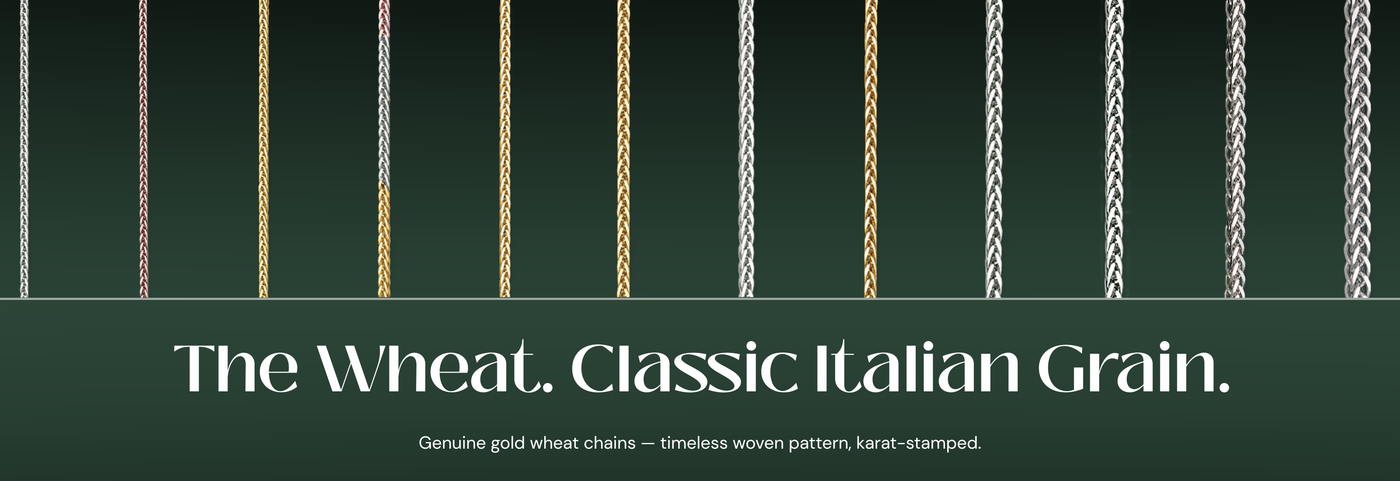
Wheat Gold Chains — Italy's Most Intricate Chain Weave.

The wheat chain — called spiga in Italian, meaning ear of wheat — is constructed from four strands of twisted oval links arranged in a repeating V-pattern. Unlike most chain styles built from identical repeating links, the wheat chain is assembled from a four-part pattern that requires precise alignment at every step. The result is a textured surface that looks braided and complex even at narrow widths.

How the Wheat Chain Is Woven

The four-strand V-weave gives it a rippled quality — the surface has a subtle texture to the touch that flat chains lack. The interlocking construction is also naturally resistant to kinking, because each link is supported by its neighbors in four directions. Well-made wheat chains move with a flowing quality that looser constructions can't match.

Why Wheat Chains Suit Certain Looks Better

The textured surface creates visual contrast with most pendant designs. Where a rope or box chain competes with a pendant's surface detail, the wheat chain's consistent texture provides a neutral base that makes pendant finishes — polished, hammered, engraved — read more clearly.

Ver como

What is a wheat gold chain?

A wheat gold chain (also called a spiga chain) is a gold necklace chain built from small oval links twisted at 45-degree angles and interlaced in pairs that create a textural, grain-like pattern resembling a stalk of wheat. The completed chain has a rope-like visual fullness and a distinctive surface texture that catches light along its entire length.

The wheat chain construction is one of the most technically precise Italian chain designs: each link is individually twisted and precisely oriented before interlacing with adjacent links. The result is a chain with a consistent, braided surface pattern that reads as complex up close but clean and unified at conversational distance. Italian chain manufacturers in Arezzo have produced wheat chain in standardized widths and weights for export since the mid-20th century, establishing it as one of the foundational Italian chain exports.

Wheat chains are most commonly produced in 14K and 18K yellow gold, with white gold and rose gold variants available in the finer widths. The chain's texture and visual richness make it an effective standalone necklace — it doesn't require a pendant to make a complete jewelry statement. Most wheat chains are sold in necklace lengths (16–24 inches) and bracelet lengths (7–8 inches).

What is a spiga chain?

A spiga chain is the Italian name for a wheat chain — 'spiga' means 'ear of grain' or 'wheat stalk' in Italian, and the name refers to the chain's visual resemblance to wheat stalks. The terms 'wheat chain' and 'spiga chain' are used interchangeably in gold jewelry retail, with 'spiga' more commonly used in Italian fine jewelry and European contexts.

The spiga designation distinguishes this construction from other braided or twisted chain types: a rope chain twists pairs of links in a continuous spiral without the diagonal interlacing that characterizes spiga construction; a singapore chain uses S-shaped links in a spiral arrangement; a wheat/spiga chain uses oval links twisted and interlaced in a specific diagonal pattern that creates the grain-like surface texture. The distinction matters for authentication and repair — each construction requires different tools and techniques.

When Italian jewelry manufacturers export spiga chains, they typically label them 'wheat chain' for the US market. A chain labeled 'spiga' on an Italian import is the same construction as a 'wheat chain' in American jewelry retail. Both terms appear on product certificates, appraisals, and insurance documentation — either is correct and both should be recognized by jewelers for service purposes.

How is a wheat chain made?

A wheat chain is machine-made in specialized Italian chain-manufacturing equipment that forms individual oval links, twists each link precisely to a 45-degree orientation, then interlaces adjacent twisted links to create the diagonal, grain-like surface pattern. The process requires precise calibration of link size, wire gauge, and twist angle to produce a consistent surface pattern across the chain's full length.

Italian wheat chain production in Arezzo uses continuous automated chain-making machines that produce finished chain in long spools, which are then cut to standard lengths, fitted with clasps, and quality-inspected before export. The precision of modern chain-making equipment means that quality Italian wheat chains have perfectly consistent link spacing, twist angles, and surface pattern along their entire length — visible inconsistency in any of these elements indicates lower manufacturing quality.

After machine production, Italian wheat chains undergo finishing: tumbling to smooth any sharp edges at link junctions, polishing to achieve the desired surface brightness, and quality inspection under magnification to verify link consistency and structural integrity. High-quality Italian wheat chains are then hallmarked — government-assayed for gold content and stamped with the manufacturer code, karat mark, and assay office symbol before export.

What does a wheat chain look like?

A wheat chain has a braided, textural surface that resembles a twisted rope, but with a more precise, grain-like pattern: small oval links twisted at diagonal angles create a chain surface where the link edges catch light at multiple angles simultaneously, giving the chain a consistently bright, sparkly appearance along its full length. The chain has a round or slightly oval cross-section in finer widths, becoming fuller and rounder in heavier widths.

The visual identity of a wheat chain sits between the clean simplicity of a cable chain and the more elaborate complexity of a byzantine or franco chain. At fine widths (1.5–2mm), a wheat chain reads as delicate and textural — the grain pattern is visible up close but the chain reads as a bright, sparkling line at conversational distance. At medium widths (3–5mm), the grain pattern is clearly visible and the chain has substantial visual presence. At heavier widths (6mm+), the wheat chain becomes a bold statement piece where the individual link orientation is visible and the braided surface has genuine architectural presence.

Color presentation: in 14K yellow gold, the wheat chain's textural surface creates warmth through the combination of bright (polished link faces) and slightly matte (link edges) surfaces across the chain's length. The gold color reads as rich and multi-dimensional rather than flat, which is one of the wheat chain's visual advantages over simpler flat-surface chains.

What gold karats are wheat chains available in?

Wheat chains are most widely available in 14K gold (58.5% pure gold), which represents the most common karat for Italian gold chain exports to the US market. 18K wheat chains (75% pure gold) are available from premium Italian manufacturers with a richer, deeper yellow gold color. 10K wheat chains (41.7% pure gold) are available at lower price points with a lighter, less saturated gold color.

The karat choice affects both the chain's color and its durability properties. 14K yellow gold wheat chains have the warm, classic gold color most associated with Italian fine jewelry and offer good durability for daily wear — the 41.5% alloy content (typically copper and silver) adds hardness to the pure gold. 18K wheat chains have a deeper, richer yellow gold color and higher intrinsic value, but the higher pure gold content makes the metal slightly softer, making them marginally less resistant to surface scratching over time.

White gold and rose gold wheat chains are available in finer widths (1.5–3mm) where the construction's visual appeal works across multiple metal colors. White gold wheat chains have the same braided texture in a cool silver tone; rose gold wheat chains carry the construction's warmth in a pink-gold color that is popular for women's fine chain necklaces. All karat designations should be confirmed by visible hallmark on the clasp.

How do you wear a wheat gold chain?

Wear a wheat chain as a standalone necklace at the length that positions it most flatteringly on your neckline — 16 inches sits at the collarbone, 18 inches falls just below, 20 inches hits the upper chest. The wheat chain's textural surface makes it effective as a solo piece: it provides visual interest without requiring a pendant. Wear it against bare skin or over a simple neckline.

The wheat chain's round cross-section and textural surface mean it performs differently depending on the neckline it's worn with: against a V-neck or scoop neck, the chain lies against the skin and its full textural character is visible; against a crew neck or turtleneck, the chain sits above the collar and its length becomes more important for proportional balance. A wheat chain at 16–18 inches is most effective with open necklines; 20–24 inch wheat chains work for layering above closed necklines.

Clasp placement: wheat chain clasps (typically lobster claw or spring ring) should sit at the back of the neck when worn. The chain's symmetrical, braided surface means there's no 'front' or 'back' to the chain itself — the clasp position determines orientation. For a polished look, ensure the clasp rests at the nape of the neck, centered, rather than sliding to the side.

Can you wear a wheat chain with a pendant?

Yes — wheat chains are excellent pendant chains. The round cross-section and consistent link construction of a wheat chain work with most pendant bails: the chain passes smoothly through standard bail openings, the round cross-section prevents the pendant from twisting sideways (a problem with flat chains), and the chain's textural surface provides visual interest above and below the pendant without competing with it.

The proportionality principle for wheat chains with pendants: match the chain's visual weight to the pendant's size. A fine 1.5–2mm wheat chain pairs well with delicate pendants (small crosses, fine initials, simple charms under 15mm); a medium 3–4mm wheat chain carries pendants up to 25mm; a heavier 5mm+ wheat chain needs substantial pendants (20mm+) to create proportional balance. A small pendant on a heavy wheat chain looks undersized; the chain's texture should complement, not overwhelm, the pendant.

The round cross-section advantage: unlike flat chains (herringbone, curb, figaro), a wheat chain doesn't present a flat face that restricts pendant bail width. The round cross-section means most standard bail openings — from fine jump rings to chunky bail fittings — slip onto the chain with minimal friction. This makes wheat chains among the most pendant-compatible chain constructions available.

What outfits work with a wheat gold chain?

Wheat chains are among the most versatile gold chain constructions for outfit pairing. Fine wheat chains (1.5–3mm) work in professional, casual, and formal contexts — the textural sparkle adds refinement without boldness, appropriate for office environments, casual social settings, and formal events. Medium and heavier wheat chains (4–6mm) make stronger fashion statements, best suited to casual and social contexts where bold gold jewelry is in register.

Neckline pairing: wheat chains look strongest against solid-color tops and dresses where the chain's surface texture and gold color read clearly against a simple background. Busy prints or heavily textured fabrics compete with the chain's own visual texture. V-necks, scoop necks, boat necks, and off-the-shoulder styles all showcase wheat chains effectively by providing clear skin surface for the chain to contrast against.

Seasonal context: wheat chains in yellow gold have particular warmth that reads especially well in autumn and winter contexts — the warm gold tone complements earth tones, rich colors, and the textures of heavier fabrics. In summer, fine wheat chains on bare skin have a clean, effortless quality that works with minimal summer styling. The wheat chain's year-round appropriateness is one of its primary advantages as a fine chain investment.

Can men wear wheat gold chains?

Yes — wheat gold chains are worn by men in a range of cultural and style contexts. Heavier wheat chains (5mm+ at 20–24 inches, 15+ grams) have a robust, substantial presence appropriate for men's gold jewelry aesthetics. The chain's braided, rope-like texture is masculine in heavier weights, reading as bold and crafted rather than delicate.

The size threshold for men's wheat chains: at widths below 4mm, wheat chains read as women's jewelry in most contexts; at 5–6mm and 20+ inch length with gram weights above 12–15 grams, wheat chains enter the range worn by men in Italian-American, Mediterranean, and Caribbean cultural contexts where substantial gold chain wearing is traditional. In contemporary fashion contexts, wheat chains of various widths are increasingly gender-fluid — the construction is worn by men and women across a wider range of widths.

Men's wheat chain wearing contexts: the chain works particularly well for men in Italian-American and Mediterranean jewelry traditions, where gold chain wearing carries cultural significance and heavier gram weights communicate the chain's value. A 6mm wheat chain at 22 inches with a lobster-claw clasp, in 14K yellow gold, is a classic men's Italian gold chain presentation.

How do you layer a wheat chain with other chains?

Layer a wheat chain with contrasting chain constructions: the wheat chain's textural, braided surface contrasts effectively with the smooth, clean surfaces of cable chains, the flat mirror-finish of herringbone, or the more open link structure of figaro. Pair chains at different lengths (at least 2 inches apart) so each chain occupies a distinct visual band on the chest.

Effective wheat chain layering combinations: a fine 2mm wheat chain (16 inches) layered with a flat 4mm cable chain (18 inches) creates a contrast between texture and simplicity at different chest levels; a medium wheat chain (18 inches) layered with a thinner rope chain (20 inches) creates contrast between construction types at similar visual weights; a fine wheat chain layered with a pendant chain creates a contrast between the textural standalone chain and the pendant-bearing plain chain.

The all-yellow-gold rule for layering: mix chain constructions but keep metal color unified. Multiple yellow gold chains of different constructions at different lengths creates cohesive layered look; mixing yellow and white gold in a layered set draws attention to metal color inconsistency rather than to chain construction variety. If mixing metals is intentional and stylistically deliberate, keep only two metal colors in a layered set rather than three.

About Wheat Gold Chains

The Four-Strand Weave Behind the Textured Look

The wheat chain — also called the spiga chain (spiga means ear of wheat in Italian) — is constructed from four strands of twisted oval links arranged in a V-pattern that repeats along the chain's length. The result is a continuous, textured surface that resembles a braided wheat stalk. Unlike most chain styles built from identical repeating links, the wheat chain is assembled from a four-part pattern that requires precise alignment at every step.

This construction creates a chain that is both visually complex and surprisingly flexible. The four-strand twist gives it a tactile quality — it has a subtle ripple to the touch and a slightly wider, flatter profile than a single-strand chain of the same visual width. The interlocking V-weave also makes wheat chains naturally resistant to kinking, because each link is supported by its neighbors in four directions rather than two.

Wheat chains are particularly effective for pendant wear because the textured surface creates visual contrast with most pendant designs. Where a box or rope chain can compete with a pendant's surface detail, the wheat chain's consistent texture provides a neutral base that makes pendant finishes — polished, hammered, engraved — read more clearly against it.

Comparar /3

A carregar...