FLASH SALE — Save 25% | Code: HAPPY25NOW

When it comes to gold, we guarantee the use of 100% real gold in all our gold products.

Italian gold wheat chains in 10K and 14K

Wheat Gold Chain

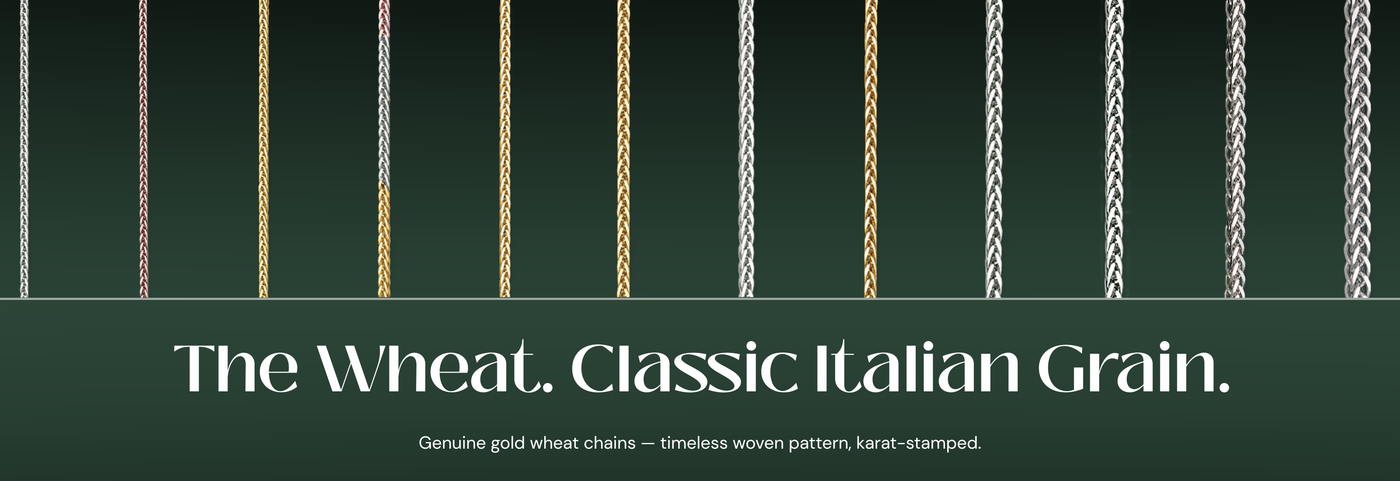
Wheat Gold Chains — Italy's Most Intricate Chain Weave.

The wheat chain — called spiga in Italian, meaning ear of wheat — is constructed from four strands of twisted oval links arranged in a repeating V-pattern. Unlike most chain styles built from identical repeating links, the wheat chain is assembled from a four-part pattern that requires precise alignment at every step. The result is a textured surface that looks braided and complex even at narrow widths.

How the Wheat Chain Is Woven

The four-strand V-weave gives it a rippled quality — the surface has a subtle texture to the touch that flat chains lack. The interlocking construction is also naturally resistant to kinking, because each link is supported by its neighbors in four directions. Well-made wheat chains move with a flowing quality that looser constructions can't match.

Why Wheat Chains Suit Certain Looks Better

The textured surface creates visual contrast with most pendant designs. Where a rope or box chain competes with a pendant's surface detail, the wheat chain's consistent texture provides a neutral base that makes pendant finishes — polished, hammered, engraved — read more clearly.

View as

Understanding the Wheat Link

What is a wheat chain?

A chain made by plaiting four strands of small twisted oval links into one cord. Because each link is twisted before it is woven in, every link along the finished chain leans the same way and overlaps the next, which is what gives the chain its resemblance to an ear of wheat.

The plait is tight and round in section, so the chain has no front or back and turns freely. Its surface looks textured but runs smoothly under a finger, because no link stands proud of the strands crossing over it.

It is made from very fine widths that carry a small pendant to substantial widths worn on their own, and listings distinguish open, round and square variants of the same plait.

How is a wheat chain braided?

Four separate runs of oval links are made first, and every link in them is twisted so that it sits at an angle. The four runs are then woven over and under one another in a repeating sequence, exactly as a four-strand plait of cord or hair is made.

As the plait is drawn tight, the twisted links of each strand drop into the spaces left by the other three, and the whole locks together. There is no wire or core through the middle; the interlocking of the links is what holds the plait.

Because the sequence is fixed, the surface is the same at every point along the chain, and the four rows of leaning links spiral slowly around the axis in a steady, unbroken pattern.

Why do the links of a wheat chain all point one way?

Because each link was twisted before it was plaited in, and the strands cross at a constant angle. The twist sets the lean of the link, and the plait carries that lean along the whole chain, so every link overlaps the one ahead of it in the same direction.

That is the grain of the chain. A finger drawn along it one way slides over the backs of the links; drawn the other way it meets their tips and feels a faint resistance, in the way a hand does on an ear of wheat.

The grain runs the same way from one end to the other, so it tells the ends apart, but the chain looks and wears the same whichever way round it is fastened.

Does a wheat chain have a right way up?

No. Four strands plaited evenly around an axis make a cord that is circular in section, and a circle has no face. However the chain settles on the neck it shows the same surface, and it does not need turning back after being put on.

A square wheat has four flat faces, but they are identical, so the same is true: whichever face is outward, the chain looks as it should.

The only asymmetry is the direction of the grain along the length, which distinguishes one end from the other. It makes no difference to how the chain hangs or wears, and a pendant hung from it sits the same either way.

Why does a wheat chain feel smoother than it looks?

Because the plait is tight. Every twisted link is held down by the strands crossing over it, so no link stands above its neighbours, and the surface is a run of gently leaning edges rather than a series of ridges.

Drawn along the grain the chain is almost slick. Drawn against it there is only a faint catch where the tips of the links meet the finger. Neither is enough to lift a thread from knitwear or to hold hair at the nape.

The same tightness is why the chain does not stretch or open under a pendant, and why it holds a smooth round curve around the neck without wanting to fold at any point.

What is the difference between open wheat, round wheat and square wheat?

They are the same four-strand plait worked three ways. Round wheat is the standard: the strands are drawn tight, the section is circular, and the surface is dense along its length with no gaps between the leaning links.

Open wheat is plaited with the strands spaced further apart, so small gaps show between the links and light passes through the chain. It reads lighter and a little wider for its weight than a round wheat of the same gauge.

Square wheat arranges the four strands so the section has four flat faces instead of a circle. The faces catch light as small planes, giving a crisper outline. All three are worn and altered in the same way.

What happens if one strand of a wheat chain breaks?

The chain does not fall apart. Three strands continue past the damage and keep carrying the load, so the failure shows as a small gap or a loose loop in the plaited surface rather than as a parted chain.

That is the advantage of four strands sharing the pull, and it is also why a wheat gives warning. A loose link in the plait is visible and can be felt, and the chain can be taken to a jeweller before anything worse happens.

The repair is not a matter of closing one link, since each link is interlocked with those of the other strands. The chain is cut across at the damage, the ends are capped, and either a short section is replaced or the chain is shortened.

How is a wheat chain shortened?

From the end, by cutting across the plait rather than by opening a link. The four strands are woven through one another, so no single link can be lifted out without loosening the links around it.

A jeweller cuts the chain cleanly at the required length, gathers the four strand ends into a small end cap, solders the cap, and refits the clasp. The cut has to land where the plait allows a square end, so the length is adjusted by a link or two to suit.

Because the work is done at one end, the plait along the rest of the chain is untouched, and the new end looks the same as the original. Lengthening is harder, since an added section has to match the plait exactly.

Does a pendant sit well on a wheat chain?

It does. The chain is round in section, so a bail passes over it easily and the pendant hangs square with no flat face to push it to one side. The dense plait does not stretch under the pendant's weight, and the four strands share the load wherever the bail sits.

The surface is smooth enough that a bail slides along it without catching, so the pendant settles at the lowest point of the curve and stays there.

The bail opening should clear the chain's full diameter. A bail that grips the plait tightly rides on the tips of the links and, over time, wears a bright band across the grain at the front of the chain.

What widths are wheat chains made in?

From around one millimetre, where the plait is too fine to read and the chain is a smooth bright cord under a small pendant, through two to three millimetres, where the grain becomes visible and the chain is worn on its own as a textured line.

At four and five millimetres the four rows of leaning links are individually distinct and the chain has real presence on the chest. Beyond that it is made less often, and hollow links are used to keep the weight comfortable.

The plait is the same at every size; only the links that form it grow. Each listing gives the width and states whether the chain is open, round or square, and whether it is solid or hollow.

About Wheat Gold Chains

How a Wheat Chain Is Built and How It Behaves

The wheat chain — also called the spiga chain (spiga means ear of wheat in Italian) — is constructed from four strands of twisted oval links arranged in a V-pattern that repeats along the chain's length. The result is a continuous, textured surface that resembles a braided wheat stalk. Unlike most chain styles built from identical repeating links, the wheat chain is assembled from a four-part pattern that requires precise alignment at every step.

This construction creates a chain that is both visually complex and surprisingly flexible. The four-strand twist gives it a tactile quality — it has a subtle ripple to the touch and a slightly wider, flatter profile than a single-strand chain of the same visual width. The interlocking V-weave also makes wheat chains naturally resistant to kinking, because each link is supported by its neighbors in four directions rather than two.

Wheat chains are particularly effective for pendant wear because the textured surface creates visual contrast with most pendant designs. Where a box or rope chain can compete with a pendant's surface detail, the wheat chain's consistent texture provides a neutral base that makes pendant finishes — polished, hammered, engraved — read more clearly against it.

Compare /3

Loading...