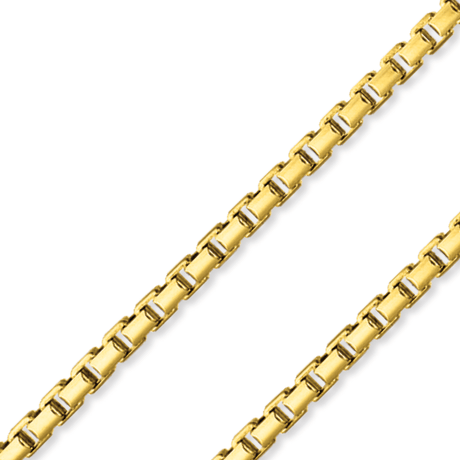
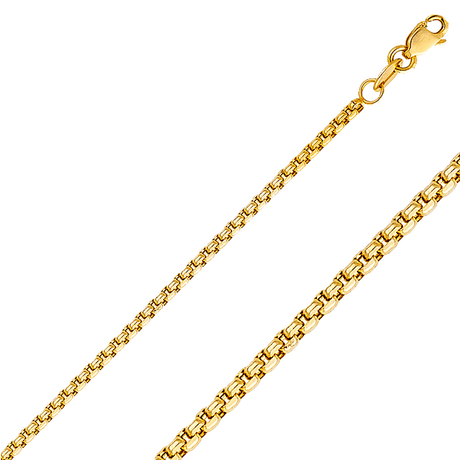
The box chain's flat-sided square links provide a non-rotating pendant display that keeps pendant faces consistently forward—unlike rope or Figaro chains where pendants can spin—and the geometric link structure creates a visually clean frame that doesn't compete with pendant design.
The rotation behavior of chain styles is determined by their cross-section. Round-link chains (cable, belcher, rolo) allow pendants to rotate freely because the round links provide minimal resistance to rotational forces. The box chain's square cross-section creates slight angular engagement with the pendant bail, resisting pendant rotation and keeping the pendant face consistently forward. This is particularly valuable for pendants with a 'front' that matters: religious medals, portrait pendants, initialed discs, directional artistic pendants. The pendant stays face-forward without constant repositioning. The secondary pendant advantage of box chains: the clean geometric link structure doesn't create the visual complexity of rope or Figaro chains that can make the chain compete with the pendant for visual attention. A box chain reads as a clean, orderly support structure that places the pendant as the clear focal point.
For pendant selection on a 14K hollow box chain: pendants with structured, geometric designs (crosses, stars, rectangles, compass shapes) have a natural affinity with the box chain's own geometric character—the angular qualities reinforce each other. Organic, curved pendants (hearts, floral designs, abstract forms) create a harmonious contrast against the box chain's geometric order.


 Recém-chegado
 Recém-chegado