Frete grátis para todos os pedidos acima de US$ 75 nos Estados Unidos

Quando se trata de ouro, garantimos a utilização de ouro 100% verdadeiro em todos os nossos produtos de ouro.

FLASH SALE— Save 25%

HAPPY25NOW
Italian hollow gold bracelets for men

Pulseiras ocas masculinas

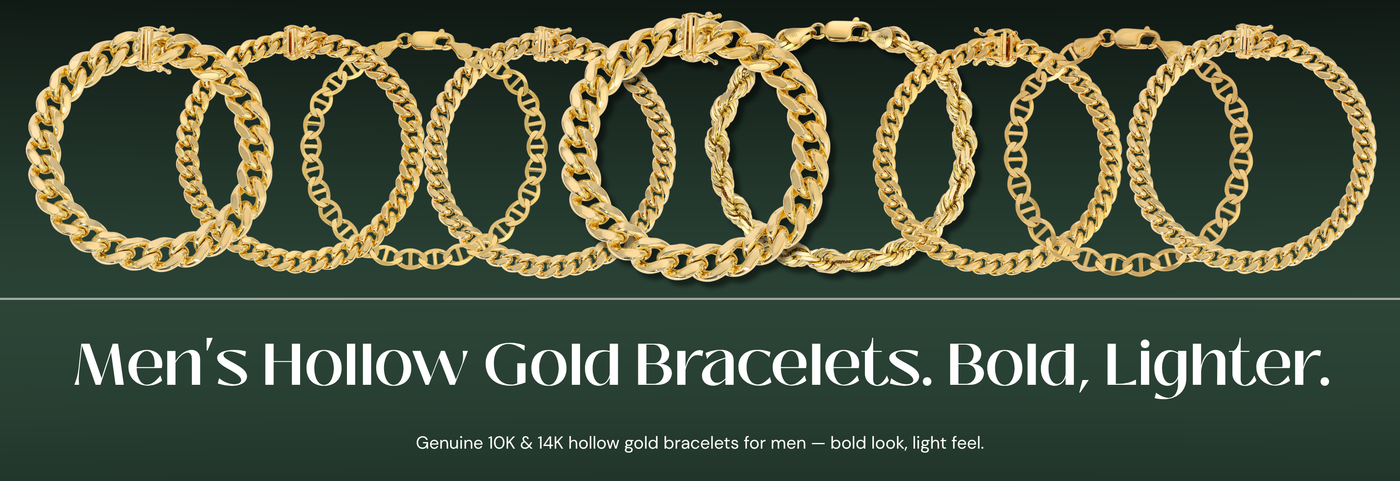
Men's hollow gold bracelets cover the same style range as solid men's bracelets — Cuban, Franco, Figaro, Miami Cuban, rope — in hollow link construction that provides the visual impact of wider widths at reduced weight and price. A men's hollow Cuban bracelet at 10mm has the visual presence of a solid Cuban at the same width while weighing and costing significantly less. For men whose priority is the look of a substantial gold bracelet at a practical cost, hollow construction is the direct path.

Hollow construction in men's bracelets carries specific wear considerations. Men's bracelets are more often worn during physical activity — manual work, sports, outdoor activities — than most fine jewelry. Hollow links are more susceptible to deformation from compression and impact than solid links. A hollow Cuban bracelet worn during construction work, heavy lifting, or contact sports is more likely to develop crushed or dented links than a solid equivalent. For men who will wear a bracelet continuously in physically active contexts, solid construction is the more durable investment.

Width is the primary sizing variable for men's bracelets. A 6–8mm Cuban reads as refined — present and clearly gold without being aggressive. A 10–12mm Cuban has significant visual weight — the choice when the bracelet is meant to make an impression. A 14mm+ bracelet is a statement piece, typically worn alone rather than in a wrist stack. Hollow construction makes wider sizes accessible in price; the trade-off is wear suitability for demanding environments. All bracelets here are genuine karat gold — the stamp on the clasp verifies the gold content.

Ver como

What is a hollow gold bracelet?

A hollow gold bracelet is a wrist jewelry piece made from karat gold tubing or shells formed into links or bands, with an empty air space inside each component — providing the color and appearance of solid gold at a fraction of the weight and cost.

Hollow gold bracelets are constructed from thin sheets of genuine karat gold — 10K, 14K, or 18K — that are formed into tubes, shaped into links, and sealed along the edges. The outer surface is real gold, so hollow bracelets carry the same karat hallmarks (585 for 14K, 750 for 18K) as solid gold bracelets. The key difference is the interior: where solid gold bracelets are dense throughout, hollow bracelets have an air-filled core that dramatically reduces the total gold content. This reduction makes hollow bracelets significantly lighter and less expensive than solid bracelets of the same visual dimensions.

Hollow gold bracelets are genuine fine jewelry — not costume jewelry or gold plating over base metal. They are a legitimate choice for men who want the look and feel of a bold gold bracelet at an accessible price, as long as they understand the trade-offs in durability and investment value compared to solid gold.

How is a hollow gold bracelet made?

A hollow gold bracelet is made by rolling thin karat gold sheet into tubing, cutting the tubing into link shapes, sealing the link edges by laser welding or soldering, and assembling the sealed links into a complete bracelet.

The manufacturing process begins with a gold alloy slab that is rolled to a precise thinness — typically 0.3 to 0.8mm, depending on the intended quality tier of the finished bracelet. This gold sheet is formed around a mandrel to create tubing of the desired cross-section (round, oval, square), then sealed along its length by laser weld or high-frequency induction soldering. The tubing is cut into link lengths, shaped into the target link geometry (Cuban oval, Figaro oval, rope spiral), and linked together on specialized Italian or Chinese chain-making machinery. The assembled bracelet is then tumbled, polished, and fitted with a clasp.

The wall thickness of the gold tubing is the most important quality variable in hollow bracelet production. Thicker walls (0.5mm and above) produce bracelets that resist denting better and have a more premium feel. Thinner walls (below 0.3mm) create very lightweight, inexpensive bracelets that are fragile. When evaluating hollow bracelets, wall thickness is a more meaningful quality indicator than width alone.

What are the benefits of a hollow gold bracelet for men?

The primary benefits of a hollow gold bracelet are its dramatically lower cost compared to solid gold, its significantly lighter weight for comfortable all-day wear, and its ability to achieve a bold, wide bracelet look at a price accessible to more buyers.

A solid 14K Cuban link bracelet at 8mm and 8.5 inches might weigh 35 to 45 grams and cost $1,200 to $2,000. A hollow version of the same bracelet might weigh 10 to 15 grams and cost $300 to $600 — visually identical from a normal viewing distance. This price difference makes hollow gold bracelets particularly attractive for men who want to wear wide, impressive bracelets without committing to the full investment cost of solid gold. The lighter weight is also a genuine comfort benefit: a 10mm hollow Cuban link bracelet can be worn all day without fatigue, while a 10mm solid version might feel heavy by afternoon.

Hollow gold bracelets are also a practical choice for men who change their jewelry style frequently. At a lower price point, experimenting with bold widths or styles carries less financial risk than buying solid gold. You can wear a hollow 8mm Cuban link bracelet today and upgrade to solid gold once you know that width and style suit your lifestyle.

Is a hollow gold bracelet real gold?

Yes — a hollow gold bracelet is made from genuine karat gold throughout its walls, and its karat hallmark (10K, 14K, 18K) is legally required to accurately reflect the gold purity of the alloy used.

The distinction between hollow gold and fake gold is critical. Hollow gold bracelets use real karat gold alloy — the same material as solid gold bracelets — in their construction. The difference is the amount of gold used (less) and its distribution (shell only, not throughout). A 14K hollow bracelet contains 58.5% pure gold in the walls of each link, just as a 14K solid bracelet does. The hallmark stamped on the clasp certifies this purity. This is fundamentally different from gold-plated jewelry (base metal with a microscopic gold coating) or gold-filled jewelry (a bonded gold layer over base metal), which are not karat gold throughout.

When a seller describes a bracelet as hollow gold with a stated karat and shows a visible hallmark stamp, the gold content claim is legally verifiable and accountable. If the hallmark is missing, the karat claim is unsupported. Always inspect the clasp for the hallmark before purchasing any gold bracelet, hollow or solid.

Are hollow gold bracelets durable enough for daily wear?

Hollow gold bracelets are durable enough for daily wear in low-contact settings — office work, casual outings, dining — but require more careful handling than solid gold bracelets to avoid the denting and crushing that hollow construction is susceptible to.

Bracelets endure more daily physical contact than necklaces: they knock against desks, doorknobs, steering wheels, and hard surfaces throughout the day. This additional contact is the key durability concern for hollow bracelets. In sedentary or low-impact environments, a quality hollow gold bracelet with adequate wall thickness holds up well over years of daily wear. The risks escalate with physical activity — weight training, outdoor labor, sports, and even vigorous hand gestures can dent hollow links that solid gold links would withstand without damage. The clasp also receives daily mechanical stress from opening and closing.

For men who primarily sit at desks, drive, socialize, and perform light daily activities, a hollow gold bracelet is a practical daily-wear choice. For men with physically active lifestyles or jobs that involve hand and wrist contact with hard or heavy objects, solid gold is the safer long-term investment in a daily bracelet.

Can hollow gold bracelets dent or crush?

Yes — hollow gold bracelets can dent or crush if subjected to concentrated pressure or direct impact, because the thin gold walls have no solid interior to resist inward deformation.

The most common denting scenarios for hollow bracelets are: being compressed between the wrist and a hard edge (like a desk corner), being caught under a briefcase handle or bag strap under load, being squeezed by a tight wristwatch clasp worn on the same wrist, or being sat or slept on. Wide, flat-linked hollow bracelets like Cuban links distribute pressure across a larger surface area, making them somewhat more dent-resistant than hollow rope bracelets where the rounded link surface presents a smaller contact area. Once a hollow link is dented, the deformation is typically permanent — thin gold walls cannot be bent back without risk of cracking at the stressed point.

Prevention is the only reliable strategy. Remove hollow bracelets before sleep, before sports and workouts, and before any task involving heavy objects or mechanical equipment. Store them in soft pouches where they cannot be compressed by other jewelry. When these habits become routine, denting is rarely an issue in typical daily wear.

Why are hollow gold bracelets less expensive than solid gold bracelets?

Hollow gold bracelets are less expensive because they use dramatically less gold — typically 60 to 75 percent less by weight than equivalent solid bracelets — and gold is priced by weight and purity.

Gold is a commodity valued by the troy ounce. A solid 14K Cuban link bracelet at 8mm and 8.5 inches might weigh 40 grams, containing approximately 23 grams of pure gold — worth roughly $2,200 at $3,000 per troy ounce. The same bracelet hollow might weigh only 12 grams, containing about 7 grams of pure gold — worth roughly $673. The hollow bracelet uses nearly 70 percent less gold, which directly translates to a dramatically lower material cost. Since manufacturing and finishing labor is similar for both hollow and solid versions of the same design, the savings come almost entirely from reduced gold consumption.

This is why a hollow 8mm Cuban link bracelet might retail for $350 to $600 while the solid equivalent costs $1,500 to $2,500. The appearance is similar; the gold content is not. Understanding this difference helps buyers make informed decisions about whether they are optimizing for visual impact (hollow is excellent) or long-term value (solid is superior).

What karat options are available in men's hollow gold bracelets?

Men's hollow gold bracelets are available in 10K (41.7% pure gold), 14K (58.5% pure gold), and 18K (75% pure gold) — with 14K being the most popular balance of gold richness, alloy hardness, and price.

10K hollow bracelets are the most affordable and benefit from the hardest alloy composition, which gives the gold walls somewhat better denting resistance than softer higher-karat alloys. 14K hollow bracelets are the most widely available in all styles and widths, offering a beautiful warm yellow color and a good balance of durability and gold content. 18K hollow bracelets are the richest in color and gold purity but use the softest gold alloy — softer walls are more susceptible to denting under pressure, making 18K hollow a somewhat counterintuitive choice for a bracelet that will take daily wrist contact. However, for occasional-wear or formal pieces, 18K hollow is a beautiful and legitimate option.

For everyday hollow gold bracelets, 14K is the recommended choice — it is harder than 18K (better for hollow wall integrity), richer in color than 10K, and available at a fair price. If skin sensitivity is a concern, note that 18K has the least base metal content and is the most hypoallergenic hollow gold option.

What hollow gold bracelet styles are most popular for men?

The most popular hollow gold bracelet styles for men are hollow Cuban link, hollow Miami Cuban, hollow Figaro, hollow rope, and hollow Franco bracelets — replicating all the classic solid gold looks at a fraction of the weight.

Hollow Cuban link bracelets are the most requested style by far, achieving the bold interlocking-link look of a solid Cuban at dramatically reduced weight and cost. Wide hollow Cuban links at 8mm to 12mm are especially popular because the hollow construction keeps even very wide bracelets light enough for comfortable daily wear. Hollow Miami Cuban bracelets offer the same tight-packed, convex-link look as the solid version and are popular in hip-hop and streetwear aesthetics. Hollow Figaro bracelets carry the classic Italian pattern in a lighter form. Hollow rope bracelets offer the twisted, light-catching texture of solid rope at reduced weight, though they require careful handling to avoid kinking.

When choosing a hollow bracelet style, prioritize designs with flat, wide links — Cuban, Miami Cuban, Figaro — over narrow twisted styles like rope. Wide flat links distribute any accidental pressure across more surface area and are more resistant to denting than the rounded surfaces of rope links.

Can I wear a hollow gold bracelet every day?

Yes, a hollow gold bracelet can be worn daily, but it demands more attentive habits than a solid gold bracelet — specifically, removing it before sleep, workouts, and tasks that involve wrist-level physical contact with hard surfaces.

Men who wear hollow gold bracelets to desk jobs, casual outings, restaurants, and light daily activities report years of reliable wear without damage. The critical difference from solid gold is the margin for error: a solid gold link might survive a moderate knock against a hard surface without denting; a hollow link may not. Building habits around removing the bracelet before high-risk activities — gym, yard work, moving furniture — preserves the bracelet's appearance indefinitely in low-risk daily settings.

The clasp is the most common failure point for daily-worn hollow bracelets. Check the clasp's security every few weeks by gently tugging the bracelet open without pressing the release mechanism — a clasp that opens under light tension should be replaced by a jeweler before the bracelet is lost. Proactive clasp maintenance is the single most cost-effective care habit for a daily-wear hollow gold bracelet.

About Men's Hollow Gold Bracelets

Men's Hollow Gold Bracelets: Wide Styles and the Right Contexts

Men's gold bracelets in hollow construction are most accurately understood as a price-and-weight trade-off, not a quality compromise. Hollow construction uses less gold to create the same visual result — the finished bracelet looks identical to a solid equivalent of the same width. For a man who wants a 10mm Cuban bracelet and finds the price of solid impractical, hollow construction delivers the exact aesthetic at a fraction of the cost. For a man who wants the bracelet to be a long-term, daily-wear investment piece that survives physical use without damage, solid is the appropriate choice.

Men's bracelets are worn in more physically demanding contexts than most fine jewelry. A necklace sits against the chest and rarely strikes anything. A bracelet on the wrist of a man who works with his hands contacts metal, concrete, wood, and machinery throughout the day. Hollow link walls — typically 0.5 to 1mm thick — can deform under compression loads that solid links of the same width absorb without visible effect. For desk workers, professionals, and men who remove the bracelet before physical activity, hollow construction lasts reliably.

Width and chain style selection for men's hollow bracelets should account for the longer wear life of certain styles under hollow construction. Cuban link, with its flat interlocking links, performs well in hollow at 8–10mm for standard daily wear. Franco, with its four-sided link structure, has a slightly stronger hollow link geometry. Rope, while visually active, has the thinnest walls in hollow construction because each twisted strand is hollow — rope bracelets are the most vulnerable construction for impact resistance and are best suited for light daily wear contexts.

Comparar /3

A carregar...