Frete grátis para todos os pedidos acima de US$ 75 nos Estados Unidos

Quando se trata de ouro, garantimos a utilização de ouro 100% verdadeiro em todos os nossos produtos de ouro.

Italian box gold chain

Corrente de caixa

Corrente de caixa
Ver como

Understanding the Box Link

What is a box chain?

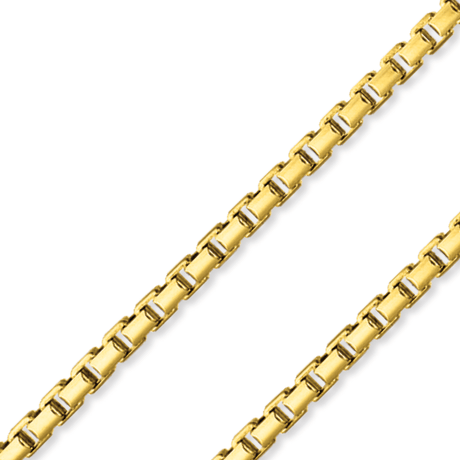
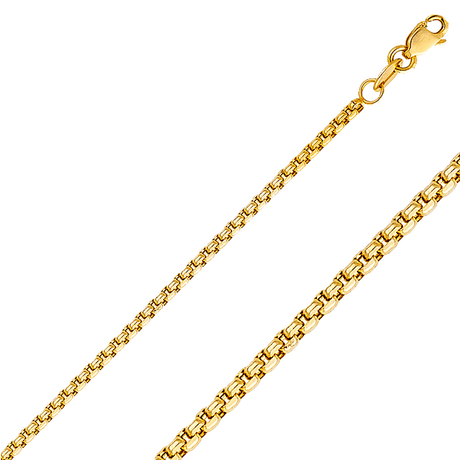
A chain made from small square links, each folded from a strip of flat gold into a short hollow cube open at two opposite faces. The links are threaded together and set square to one another, so the finished chain runs as a continuous four-sided line.

Because the links are short and sit close, the joints read only as fine lines across the faces, and the chain looks like a slender square rod rather than a run of separate links. It hangs straight and has a flat face on each of its four sides.

It is made from very fine widths, where it is a common pendant chain, up to heavy widths worn on their own. The finish is polished or diamond-cut, and the listing states the width and finish of each chain.

How is a box chain link made?

From flat wire rather than round. A strip of gold is creased along three lines so that it folds into four walls with the ends of the strip meeting along the fourth edge, producing a short square tube.

Each tube is passed through the open ends of the next, turned to sit square to it, and closed along its seam. Forming the link by folding rather than bending is what keeps the faces flat and the corners sharp.

The width of the strip sets the width of the finished chain, and its thickness sets how much metal each link carries. A hollow box uses a thinner strip, so a wide chain can be made light enough to wear comfortably.

Why does a box chain flash rather than sparkle?

Because its faces are flat. A flat surface returns light as one clean reflection across the whole plane, so a box chain shows a single bright band along whichever face is turned to the light, with the faces angled away reading darker.

As the chain moves the bright band jumps from one face to the next, which gives the box link its crisp, decisive flash. A rounded chain gives a soft continuous gleam instead, and a faceted one scatters light into many points.

A diamond-cut box has small angled planes cut across the flat faces, which breaks the single band into a row of smaller flashes. It reads considerably brighter at the same width, though the faces are no longer perfectly flat.

Does a box chain twist or turn while it is worn?

No more than any chain, and less than most. Each link is symmetrical, and the four faces are identical, so there is no face the chain prefers to lie on and no lean built into the links. Around the neck it settles into a curve and stays there.

A pendant hung on a box chain rests its bail on one flat face and has nothing to rotate against, so it stays square to the front instead of turning to show its edge.

Because the chain does not curl when it is slack, it is also easy to fasten: lifted by the clasp it hangs as a straight line, and the two ends meet without the chain having crossed itself.

Why is a box chain used so often as a pendant chain?

Three properties come together. It hangs straight, so the pendant sits at the lowest point; it has a flat face for the bail to rest on, so the pendant does not turn; and the square section is strong at fine widths, so a slender box will carry a pendant that would strain a fine round-link chain.

It is also visually quiet. A fine box reads as a clean bright line rather than a texture, which leaves a small stone, an initial or a medal as the subject of the piece.

The bail should have a smooth interior so it slides along the faces without catching on the joints. A bail with a sharp inside edge can wear a mark across the faces where it sits at the front.

Why has my box chain developed a bend that will not hang out?

A link has locked. When a box chain is folded sharply, one link can rotate in its joint until a corner catches against the face of the link beside it, and the chain then holds the bend instead of falling straight. It usually happens in a pocket or a bag.

Pulling the ends apart makes it worse, since that pushes the caught corner harder against the face. Hold the chain vertically so its own weight straightens it, and roll the bend gently between finger and thumb; the link generally turns back and the chain drops into line.

A kink that has been worn for a while, or pulled tight, may have bent a corner. A jeweller frees the link with fine pliers and, if it is damaged, cuts it out and closes the chain around a replacement.

How is a box chain shortened?

A jeweller cuts through one link, removes as many links as the new length requires, and rejoins the chain. Because the links are identical and there is no pattern to preserve, the cut can be made at the clasp end or at any point along the length.

On a solid box the cut link is closed with solder and the join, once polished, is difficult to find. On a hollow box the walls are thin, so the join is made with more care and may show a little more.

Shortening is straightforward; lengthening is less so, since an added section has to match the width and finish exactly or the join reads as a step in the line. A box chain is better bought close to the length that will be worn.

Why does a diamond-cut box chain look different from a polished one?

A polished box reflects from four flat faces, so it shows one bright band along the face turned to the light. A diamond-cut box has small angled planes cut across those faces after the chain is assembled, and each plane reflects separately.

The single band becomes a row of small flashes that switch on and off as the chain moves. The chain reads brighter and busier, and the clean drawn-line quality of a polished box is traded for sparkle.

The cut planes sit on the outermost surfaces of the chain, which are also the surfaces that touch everything. Over years their edges soften and the sparkle gentles; a polished box simply grows a finer sheen with the same wear.

What widths are box chains made in?

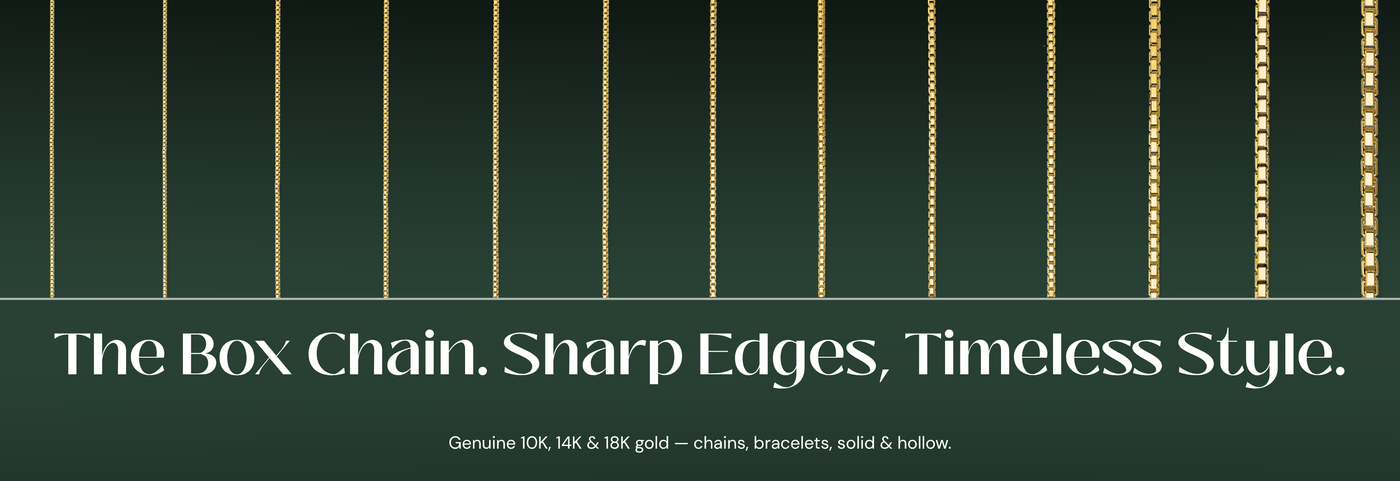
From well under a millimetre, at which size the box is one of the most common chains supplied with a small pendant, up through one to two millimetres, where it is worn on its own as a slim bright line with visible square faces.

At three, four and five millimetres the section reads as a solid bar, and the chain is chosen for its weight and presence. Hollow construction is usual at these widths to keep the piece comfortable on the neck.

The construction is identical at every size; only the strip that forms the link changes in width and thickness. Each listing states the width and whether the chain is solid or hollow.

Which part of a box chain gives way under a pull?

Usually the seam or the fittings. Each link is a folded strip whose ends meet along one edge, and under a hard pull that seam can open before the walls distort. The jump ring and the end caps at the clasp are the other points where load concentrates.

The walls of the link themselves rarely fail, because the four sides brace one another and the load is spread around the whole section. That bracing is the source of the box chain's strength for its weight.

A box chain that has parted is rejoined by cutting out the failed link and closing the chain around a replacement. On a hollow box the thin walls make that a more delicate job than on a solid one.

About Box Gold Chains

How a Box Chain Is Built and How It Behaves

Box chains are the most technically precise chain style to produce: each square link must be formed at exact right angles and connected to the next with perfect alignment. Any deviation in link angle or dimension breaks the chain's characteristic clean, flat appearance. This precision is why quality box chains are an accurate indicator of a manufacturer's technical capabilities — a well-made box chain is a demonstration of craftsmanship.

The practical benefit of box chain construction is its suitability for pendant wear. The chain's smooth, consistent surface means a pendant bail slides freely to center without catching. The flat-lying geometry ensures the pendant hangs straight. The pivot movement of the square links is uniform in all directions — the chain doesn't restrict or redirect pendant movement the way stiffer chain styles do.

At narrow widths (1–2mm), a box chain is almost invisible — it functions as a pendant carrier rather than a visual statement. At 3–5mm, the chain itself becomes part of the look. The same clean, geometric quality that makes it a great pendant base makes it a strong standalone chain at medium widths.

Comparar /3

A carregar...