Frete grátis para todos os pedidos acima de US$ 75 nos Estados Unidos

Quando se trata de ouro, garantimos a utilização de ouro 100% verdadeiro em todos os nossos produtos de ouro.

Italian rope gold chain

Corrente de corda

Corrente de corda
Ver como

Understanding the Rope Link

How is a rope chain made to twist?

The twist comes from the way the links are threaded, not from winding the finished chain. Each small oval link is passed through several of the links before it and set at a slight, consistent tilt. Repeated along the length, that tilt carries the links around a central axis.

After a handful of links the offsets add up to a complete turn, and the links that began the turn lie next to the ones that finish it. Seen together they look like separate strands wound around one another, though in fact there is only one continuous chain.

The spacing of the links sets how tight the spiral is. Closer spacing gives a dense, rounded rope with a short pitch; wider spacing gives a longer pitch and a more open, ribbed appearance, which is where the open rope variant comes from.

Why does a rope chain have a left-hand or right-hand twist?

Every link in a rope is offset from its neighbour in the same rotational direction, and that direction is fixed when the chain is assembled. Offsetting to one side produces a spiral that climbs to the right; offsetting to the other side produces its mirror image.

The two hands look and behave the same, but they cannot be joined to each other. A repair section of the opposite hand shows as a visible reversal in the pattern, so a jeweller matches the hand before soldering in new links.

In wear the hand decides how the chain responds to being twisted. Turning it with its spiral tightens it slightly; turning it against its spiral opens the links, and repeated handling that way is what leaves a rope looking uneven in places.

What gives a diamond-cut rope its sparkle?

A diamond-cut rope has small flat planes cut into the crests of the twist after the chain is assembled. Each plane is a tiny mirror, and because the crests follow the spiral, the mirrors face in slightly different directions all along the chain.

As the chain moves, each facet catches the light in turn, so the rope flashes rather than glows. An uncut rope reflects softly along the rounded surface of every link; a cut rope breaks that reflection into distinct points.

The facets sit on the outermost parts of the chain, which is also where everything the chain touches makes contact. Over years the sharp edges of the facets soften, and the sparkle becomes gentler than it was when new.

Why has my rope chain developed a kink?

A rope kinks when it is folded sharply against the direction of its own spiral, usually while it is off the neck, in a pocket or a bag. The links on the outside of the fold open and those on the inside close over them, and the chain locks at an angle.

The instinct is to pull the ends apart, and that is the wrong instinct, because pulling tightens the links that have caught on one another. Let the chain hang under its own weight and turn it slowly in the direction of the twist, and the caught links usually release.

A kink that has been pulled tight or worn for some time may not release by hand. A jeweller can free the locked links with fine pliers and settle the spiral back into line, and a rope that has kinked once is worth checking for loosened links afterwards.

Can a hollow rope chain be dented?

Yes. A hollow rope is assembled from links that are tubes rather than solid wire, which is what lets a wide rope stay light enough to wear comfortably. The wall of each tube is thin, and a hard knock or a pinch between two surfaces can press it in.

The twist offers no help here, since the dent happens to an individual link rather than to the spiral as a whole. A dented link on a rope shows as a dull flat spot on one crest, and because the crests are what catch the light, it is noticeable.

A solid rope of the same width is markedly heavier, and the same knock leaves at most a small mark that a polish removes. Choosing between the two is a question of the width wanted and the weight the wearer is willing to carry for it.

Will a rope chain carry a pendant?

A rope carries a pendant well, and the reason is the same one that makes it feel substantial: the pendant's pull is shared among several links wherever the bail sits, rather than resting on a single link. A pendant of some mass sits comfortably on a rope of moderate width.

The round section of a rope means a bail passes over it easily and the pendant hangs square, with no flat face to make the chain turn one way or the other. A bail with a smooth interior slides along the twist without catching on the crests.

The one thing to watch is a bail that is narrow relative to the rope's width, since a tight bail rides on the crests of the spiral and wears a bright band into them at the front. Matching the bail opening to the rope's diameter avoids this.

How does a jeweller shorten a rope chain?

Not by opening a link. A single link in a rope passes through several others and cannot be removed without disturbing all of them, so the jeweller instead unpicks the spiral from one end, freeing links in sequence until the required length is reached.

The cut has to land where the twist allows. Stopped at the wrong point in the turn, the loose end flares and will not enter the end cap squarely, so the jeweller works to the nearest clean point rather than to an exact measurement.

The freed end is then gathered, fitted into a new cap or back into the original one, and soldered. Because this is slow, careful work, a rope is normally shortened from the clasp end only, and the amount taken out is usually rounded to a whole turn of the spiral.

Why does a rope chain feel so substantial for its weight?

Two things are happening. First, a rope packs a great deal of metal into a short length, since every turn of the spiral contains several overlapping links. Second, the links brace one another, so the chain does not stretch or deform under a pull the way a loosely linked chain does.

In the hand the effect is of a dense, firm cord that holds its shape when it is lifted, rather than a chain that pours through the fingers. That firmness comes from the geometry, not from the alloy, and it is present in fine ropes as well as heavy ones.

The consequence is that a rope of a given width weighs more than a single-link chain of the same width. Hollow rope exists precisely to keep that weight manageable at the wider sizes, at the cost of links that can be dented.

What is an open rope chain?

An open rope is assembled with its links spaced further apart along the axis, so the spiral has a longer pitch and visible gaps between the strands. Held up to the light, an open rope shows daylight through the twist; a standard rope does not.

The construction is the same as any other rope, and the chain behaves in the same way. The difference is visual: the twist reads as distinct strands rather than a dense braid, and the chain looks wider and lighter than a closed rope of the same weight.

Because the links have more room to move, an open rope is slightly more flexible and slightly more willing to kink if it is folded against its twist. It is worth handling by the ends rather than wrapping it around the fingers.

Does a rope chain catch hair?

It can, at the nape of the neck, and the cause is the twist itself. The crests of the spiral lift slightly away from the surface, and fine hair worked between them is held there when the chain rotates. This is more likely on a wider rope with a longer pitch.

Diamond-cut ropes are a little more prone to it than plain ones, since the edges of the facets give hair something to catch against. A rope that is turned deliberately with its twist while it is being adjusted releases caught hair; turned against the twist, it tightens on it.

Wearing a rope over a collar rather than against the skin removes the problem entirely, and at narrower widths the crests are too small for hair to lodge between them in the first place.

About Rope Gold Chains

How a Rope Chain Is Built and How It Behaves

The rope chain achieves its distinctive sparkle through a specific construction: two parallel series of oval links are twisted together in opposite directions, creating a double-helix structure. This twist means the chain's surface is always presenting angled faces to incoming light — rather than a flat surface that only reflects when correctly oriented, the rope chain reflects continuously as it moves. The effect is more constant and more intense than flat chain styles.

The same helical construction also creates structural strength. Each link supports its neighbors in multiple directions rather than at a single hinge point. A rope chain of the same weight as a Cuban or Figaro chain is typically more resistant to lateral stress — the helical architecture distributes force along the twist rather than concentrating it at individual link joints.

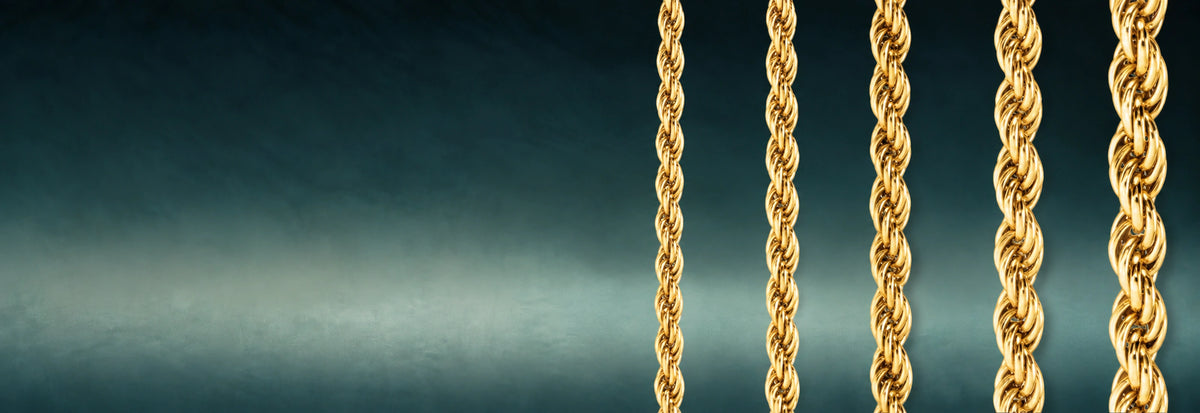
Width affects rope chains differently than link-based styles. At 1–2mm, the individual links are barely visible and the chain reads as a fine gold cord. At 3–5mm the twist becomes clearly apparent and the chain has significant visual presence. At 6mm+ it becomes a statement piece. The sparkle intensifies with width — a wider rope chain in the same light will draw more reflection than a wider Cuban of the same dimension because of the additional angled link surfaces.

Comparar /3

A carregar...