Frete grátis para todos os pedidos acima de US$ 75 nos Estados Unidos

Quando se trata de ouro, garantimos a utilização de ouro 100% verdadeiro em todos os nossos produtos de ouro.

Italian Mariner gold chain

Corrente Mariner

Corrente Mariner
Ver como

Understanding the Mariner Link

What is a mariner chain?

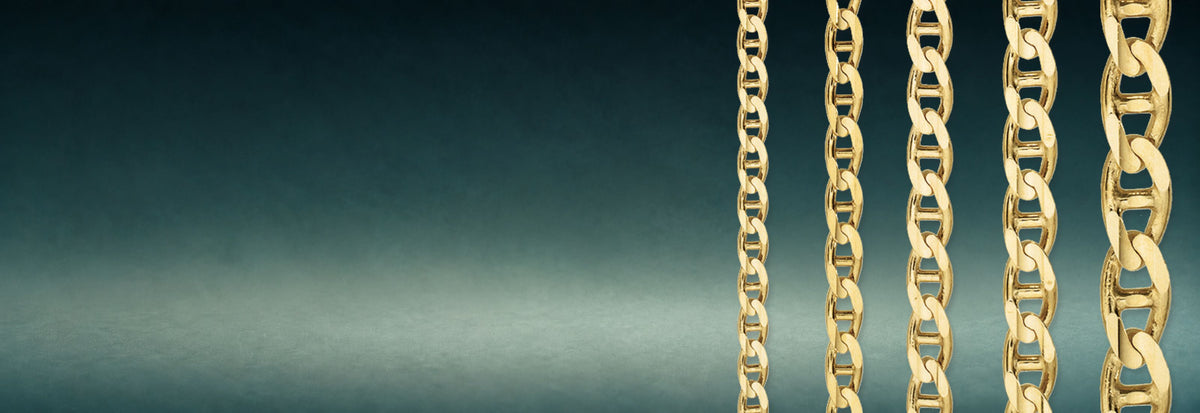
A chain of oval links, each with a bar across its middle that divides the oval into two windows. The links join end to end through those windows, so the chain is a row of open frames crossed by bars, lying flat and in line.

The form comes from the stud-link chain of a ship's anchor cable, where the bar stops each link from being pulled narrow under load and keeps the links from twisting inside one another. The necklace link keeps both jobs at a smaller scale.

It is made flat, with a broad polished face, or puffed, with rounded hollow links that stand up from the chest. Width, form and finish are stated on each listing.

Where does the mariner link come from?

From anchor chain. The cable that holds a ship to its anchor is made of large oval links, and each has a stud across its middle. The stud braces the sides of the oval apart so it keeps its shape under a heavy pull, and it fills the centre of the link so the next link cannot rotate inside it.

Both jobs matter at sea, where a cable that twisted as it ran out would foul, and a link that stretched under load would weaken. The barred oval was the answer, and it has been the standard anchor link for a very long time.

The jewellery link is a direct reduction of it. The bar still keeps the oval from being pulled narrow, and it still keeps each link in the same plane as its neighbour, which is why a mariner necklace lies flat and does not twist.

What does the bar in a mariner link do?

Two things. It braces the two long sides of the oval apart, so that a pull along the chain cannot draw the link narrow and long, and it fills the middle of the oval so that the adjoining links have only the two windows at the ends to sit in.

Seated in a window, a link is held between the bar on one side and the end of the oval on the other, and it cannot swing round. That is what holds every link in the same plane as the next and keeps the whole chain lying flat.

The bar is also what the eye picks out. On a flat mariner it reads as a line across the flash of each link; on a puffed mariner it carries its own small highlight on the crest of the ridge. Without the bar the chain would be a plain oval chain.

Why does a mariner chain stay flat while it is worn?

Because no link can turn inside its neighbour. In a plain oval chain each link is free to rotate within the one it passes through, and the chain twists and rolls as it moves. In a mariner the bar occupies the middle of every oval and leaves only the end windows for the next link.

A link seated in an end window is confined between the bar and the end of the oval, so it holds the orientation it was given when the chain was made, and every link in the row holds the same orientation. Lifted, laid down or worn, the chain stays face up throughout.

On the neck this means the chain lies against the chest with every bar showing, does not roll over at the front, and does not develop the twists that a plain chain picks up in handling.

What is a puffed mariner chain?

A mariner made from links that are hollow or domed rather than flat, so that each oval is rounded in section and stands up from the chest, and the bar across it is a rounded ridge rather than a flat strip.

The puffed form gives the chain visible depth and a bold outline at a distance while keeping the weight low, since the links are formed from thin metal around a hollow. It is the usual construction for the wider mariners for exactly that reason.

Because the links are hollow they can be dented by a hard knock, and a dent shows as a flat spot on a curved ring. A flat mariner of the same width is heavier, sits closer to the skin, and takes a knock as a mark that polishes out.

How does a mariner chain catch the light?

Around and across two windows. The link is open, so whatever is behind it shows through, and the frame and bar take the light while the windows stay dark. The chain reads as a bright lattice over a darker ground, with a bright stroke across each dark pair.

On a flat mariner the face is a single polished plane and each link flashes as a whole, with the bar as a line through the flash. On a puffed mariner the highlight runs round the curve of the ring and a smaller one sits on the crest of the bar.

A diamond-cut mariner has facets cut on the ring and on the bar, which turns the highlights into sharp points. The bar carries a facet of its own, so it sparkles separately from the ring around it.

Does a mariner chain twist while it is worn?

No. The bar in each link prevents the next link from rotating inside it, so the chain cannot twist along its length in the way a plain oval chain does. Every link stays in the plane it was made in.

This holds during handling as well as wear. A mariner taken off and set down lies flat; a mariner picked up by one end hangs with all its links facing the same way. It does not need to be straightened before it is put on.

What a mariner can do is fold, since it bends readily across its face like any flat chain. A sharp fold can force one link over the back of the next, and that is worked out by a jeweller rather than pulled straight.

Where does a pendant sit on a mariner chain?

On a bar, usually. A pendant slides to the lowest point of the chain, and at the lowest point the bail either rests across the bar of a link, where it sits square and still, or falls into one of the windows, where it can rock against the frame.

A bail that spans the width of the link rests on the bar and the frame together and hangs straight. A bail narrow enough to drop into a window will do so, and the pendant then tilts slightly and shifts as the wearer moves.

Because the chain does not twist, a pendant on a mariner is not turned by the chain and faces forward as it was placed. The open links also let a pendant's own jump ring be attached directly to a window, which some designs use.

How is a mariner chain shortened?

By opening a link at the end of its oval, never at its bar. The jeweller opens the last link at the clasp end where it passes through its neighbour, slides out as many links as are needed, and closes the opened link again by bringing the ends of the oval together and soldering them.

The bar is left alone because it is what gives the link its shape. A link cut at the bar collapses inward and cannot be closed cleanly. Opened at the narrow end of the oval, the join is hidden inside the adjoining link once the chain is closed.

Because every link is the same, any number can be removed and the pattern along the chain is unchanged. The clasp is reattached to the reclosed link and the row of bars stays even from end to end.

What widths are mariner chains made in?

From fine flat mariners of two millimetres or so, in which the windows are barely visible and the chain reads as a bright textured line, through the four to six millimetre range where the barred oval becomes clearly legible, up to wide puffed mariners of ten millimetres and more.

Wide mariners are almost always puffed, because a flat link of that size would be heavy and would flex like a plate rather than a chain. The hollow form keeps a bold outline at a weight that can be worn.

The width on a listing is measured across the oval at its widest point. The length of each link is greater than its width, and the bar runs across the width, so the bar is a little shorter than the stated figure.

About Mariner Gold Chains

How a Mariner Link Is Built and Why the Chain Lies Flat

The mariner chain — also called the anchor chain — takes its design directly from the steel chain links used in actual maritime anchors: oval links with a vertical bar crossing the center. That center bar isn't decorative. In anchor chains, it prevents the link from collapsing under the extreme lateral forces of a ship at anchor. In gold jewelry, the bar provides the same structural benefit at jewelry scale, making mariner chains among the most structurally stable link designs in fine jewelry.

The center bar also changes the chain's visual character compared to other oval-link styles. Because each link has an internal cross-member, light reflects from the bar and the link face simultaneously, creating a layered reflection pattern rather than a single flat flash. Wider mariner chains at 6mm+ make this effect particularly visible — the chain has a depth and complexity that smooth-link styles don't have.

Compared to a Cuban chain of the same width, a mariner chain has a slightly more textured, articulated appearance. The Cuban link reads as continuous and smooth — a unified mirror surface. The mariner reads as a sequence of distinct, recognizable links with visible internal structure. The choice is whether you want the chain's construction to be part of the look or to recede into a single surface.

Comparar /3

A carregar...