Frete grátis para todos os pedidos acima de US$ 75 nos Estados Unidos

Quando se trata de ouro, garantimos a utilização de ouro 100% verdadeiro em todos os nossos produtos de ouro.

FLASH SALE— Save 25%

HAPPY25NOW
Italian hollow gold chain

Corrente oca

Corrente oca
Ver como

What is a hollow gold chain?

A hollow gold chain is a necklace where the links are formed from thin gold sheet that has been stamped, bent, or drawn into the link shape, leaving the interior of each link empty rather than filled with solid gold. The result is a chain that looks identical to a solid gold chain from the outside but weighs substantially less and contains far less gold than a solid equivalent.

The hollow construction is used across virtually every gold chain style — you can find hollow rope chains, hollow Cuban link chains, hollow Figaro chains, hollow herringbone chains, and more. The exterior appearance of a hollow chain is essentially indistinguishable from a solid equivalent by visual inspection alone; the distinguishing factors are gram weight (dramatically lower for hollow) and price (which should reflect the lower gold content).

Hollow gold chains are a legitimate product category in fine jewelry — they are made of genuine gold, properly hallmarked, and serve buyers who want the visual presence of a larger gold chain at a fraction of the cost and weight of solid construction. Understanding hollow construction clearly is essential for making an informed gold chain purchase decision.

How is a hollow gold chain constructed?

Hollow gold chains are manufactured by working with thin gold alloy sheet rather than solid gold wire or rod. For most hollow chain styles, the process involves stamping or rolling thin gold sheet into the shape of a chain link profile — the stamped sheet forms the exterior surface of the link while leaving the interior cavity empty. The edges of the stamped sheet are joined (typically laser-welded) to seal the link.

For hollow rope and box chain styles, the hollow construction is often achieved through a tube-drawing process: a thin-walled gold tube is drawn through successively smaller dies to create a thin-walled gold wire, which is then cut, bent, and assembled into chain links using conventional chain assembly techniques. The resulting links have the correct exterior profile but a hollow interior.

The wall thickness of hollow gold chain links varies by quality tier: premium hollow chains use thicker walls that provide more durability and more gold content than economy hollow chains with paper-thin walls. Wall thickness is not typically disclosed in product listings, making gram weight the most reliable proxy for hollow chain quality — thicker-walled hollow chains will weigh more than thinner-walled examples at equal dimensions.

What is the difference between hollow and solid gold chains?

The core difference is that solid gold chains have links formed from solid gold alloy throughout — same gold material from surface to center — while hollow gold chains have links formed from thin gold sheet with empty interiors. This construction difference creates cascading differences in weight, gold content, price, durability, and feel.

A solid 6mm Cuban link chain at 22 inches might weigh 55 to 70 grams; a hollow 6mm Cuban link chain at identical dimensions might weigh 8 to 15 grams. This 4x to 8x weight difference represents a proportional difference in gold content and gold content value. At 14K and $3,000/troy oz, those 55 grams of solid chain contain approximately $3,032 in gold; the 10 grams of hollow chain contain approximately $551 — a dramatic value difference at visually identical appearances.

Durability also differs significantly: solid chain links resist bending, denting, and crushing under normal wear forces because the solid gold core provides structural support throughout the link body. Hollow links — especially thin-walled hollow links — can be permanently dented by relatively modest pressure, such as a hard impact or significant compression. This durability gap is the most important practical consideration for buyers choosing between solid and hollow construction.

Why do people choose hollow gold chains?

Buyers choose hollow gold chains primarily for three reasons: lower price, lighter weight, and the ability to wear visually larger chains than solid construction would allow at the same budget. A hollow 8mm chain costs a fraction of a solid 8mm chain at equal lengths, making bold statement chains accessible to buyers whose budgets would not accommodate solid construction at the same visual size.

Weight is a genuine advantage for some buyers. A solid wide-link gold chain can feel heavy and restricting, particularly at longer lengths or larger widths. Hollow construction dramatically reduces the wearing weight — a hollow 8mm rope chain at 24 inches might weigh 12 to 18 grams versus 60 to 80 grams for solid equivalent construction. For buyers who want a bold visual statement without the weight of solid gold, hollow construction delivers the look they want in a wearable weight range.

Some buyers knowingly choose hollow because they prefer to allocate budget to visual variety — owning multiple hollow chains in different styles — rather than concentrating investment in a single solid chain. Both approaches are valid; what matters is that the choice is made with full understanding of what hollow construction is, what it costs in gold content terms, and what its durability trade-offs are.

What are the advantages of hollow gold chains?

The primary advantages of hollow gold chains are lower price and lighter weight at equivalent visual size. A hollow chain allows buyers to wear the visual presence of a large, bold gold chain at a cost that solid construction at the same dimensions would not permit. At 8mm width and 24 inches in 14K, a hollow chain might retail for $400 to $900 while a solid equivalent could retail for $4,000 to $8,000.

The lighter weight of hollow chains also means greater wearing comfort for buyers who are sensitive to jewelry weight. Hollow chains are appropriate for wearing during more active contexts where the weight of solid gold jewelry would be uncomfortable or distracting. The reduced weight also reduces stress on the clasp and the neckline skin contact points.

For buyers who enjoy changing their chain styles seasonally or who want to match chains to different outfits, hollow chains make it financially accessible to own a wardrobe of different gold chain styles. The tradeoff — less gold content value per chain — is an acceptable one for buyers who prioritize variety and visual expression over gold investment concentration in a single piece.

What are the disadvantages of hollow gold chains?

The primary disadvantage is durability: hollow gold chain links can be permanently dented, crushed, or deformed by forces that solid links would resist without damage. A hard impact to a hollow rope chain or hollow Cuban link can permanently collapse the affected section, and repair — while possible — may not fully restore the original shape. Thin-walled hollow chains are especially vulnerable to this kind of damage.

The second major disadvantage is gold content value. A hollow chain contains dramatically less gold than a solid equivalent at the same stated dimensions, meaning its intrinsic value — and its resale or scrap value — is a fraction of what a solid chain's would be. Hollow chains should not be purchased as gold investments; their value is primarily in the wearing experience, not in recoverable gold content.

A subtler disadvantage is feel: hollow chains drape and lie against the skin differently than solid chains. Solid chains have a weighted, authoritative presence at the neckline; hollow chains feel lighter and sometimes less substantial. For buyers who want the full physical experience of wearing heavy gold — the weight on the chest, the confident drape — hollow construction does not fully replicate the experience of equivalent solid construction.
Is a hollow gold chain real gold?

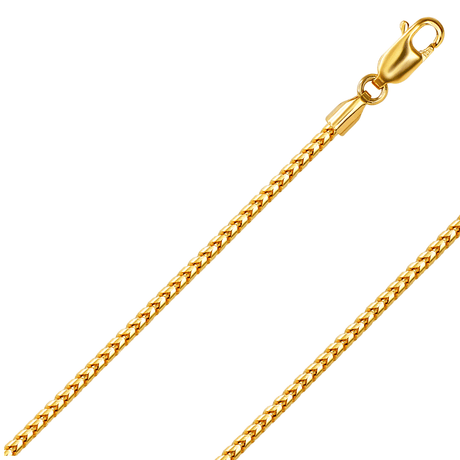
Yes — a properly hallmarked hollow gold chain is genuine gold. The gold alloy used for the chain's exterior surfaces is the same quality (10K, 14K, or 18K) as stated in the hallmark; the hollow construction describes the internal structure of the links, not the material quality of the gold used. A 14K hollow gold chain uses genuine 14K gold alloy (58.3% pure gold) for its link surfaces.

The confusion arises because hollow chains sometimes get conflated with gold-plated, gold-filled, or gold-vermeil jewelry — these are categorically different products. Gold-plated jewelry has a thin surface coating of gold over a base metal core; gold-filled has a bonded layer of gold over brass; gold-vermeil has gold plating over silver. These are base-metal jewelry with gold surfaces, not solid gold. Hollow gold chains, by contrast, are made entirely of gold alloy — just in thin-sheet form rather than solid form.

The hallmark is the definitive verification: a genuine hollow gold chain will bear the same karat hallmark (10K/417, 14K/585, 18K/750) as a solid chain of the same karat. The hallmark attests to the gold alloy quality of the chain's actual material, regardless of whether the construction is solid or hollow. XRF testing and acid testing verify the gold content of the actual metal surfaces.

What karats are hollow gold chains available in?

Hollow gold chains are available in 10K (41.7% gold), 14K (58.3% gold), and 18K (75% gold), in yellow, white, and rose gold. 10K and 14K are the most commonly stocked for hollow chains because the lower gold content makes the per-chain price more accessible — which aligns with hollow construction's primary buyer appeal of visual presence at lower cost.

14K yellow gold hollow chains are the most widely available and the recommended choice for buyers who want genuine quality gold with visible warmth at accessible pricing. 10K hollow chains are the most affordable option with real gold content. 18K hollow chains exist but are less common — the premium gold price somewhat undermines the hollow construction's cost-advantage, though 18K hollow still costs far less than 18K solid at the same dimensions.

Karat selection for hollow chains should weight durability more heavily than for solid chains: 10K is the hardest gold alloy, making it the most resistant to the denting that hollow construction is susceptible to; 18K is softest, most vulnerable to deformation in thin-walled hollow form. For daily-wear hollow chains, 10K or 14K is preferable to 18K.

What chain styles come in hollow construction?

Virtually every gold chain style is produced in hollow construction: Cuban link, rope, Figaro, box, herringbone, Singapore, Franco, cable, Byzantine, bead, and many others. The hollow construction is applied to the manufacturing process of whatever link style is being produced — it is a construction method that affects weight and gold content without changing the chain's visual design.

The most commonly available hollow chain styles are hollow Cuban link (where the bold, wide link design benefits most from the visual impact vs. cost trade-off), hollow rope chain, and hollow herringbone. These three styles offer the most dramatic visual statements and would be most financially inaccessible to most buyers in solid construction at comparable widths.

The ItalianFashions.com hollow gold chain collection may include multiple styles within a single hollow-construction focus. Buyers browsing this collection should identify the specific chain style they want (Cuban link, rope, Figaro, etc.) and evaluate that style's specific hollow construction characteristics rather than treating all hollow chains as identical. Different hollow chain styles have different wall thickness norms, different durability profiles, and different optimal width ranges.

How can I tell if a chain is hollow or solid?

The most reliable method for determining solid vs. hollow construction is gram weight compared against expected solid weight for the stated dimensions. A solid 6mm rope chain at 20 inches in 14K should weigh approximately 25 to 35 grams; a hollow equivalent at the same dimensions should weigh approximately 5 to 12 grams. Ask for the gram weight in writing and compare against known solid-weight benchmarks for the style.

Visual inspection and physical manipulation can sometimes reveal hollow construction: hollow chain links may feel slightly springy when gentle pressure is applied (the thin gold walls flex), while solid links do not flex under the same pressure. Very thin-walled hollow links may produce a subtle hollow sound if tapped against a hard surface, unlike solid links. These tests require experience to interpret reliably and are not as definitive as gram weight comparison.

Price is a useful secondary indicator: solid gold chains should retail at 1.5 to 2.5 times their melt value, and melt value is directly proportional to gram weight. A 6mm, 20-inch chain priced at $300 to $500 is almost certainly not solid — the melt value of solid construction at those dimensions would far exceed a retail price in that range. Dramatically below-melt pricing is one of the clearest signals of hollow construction.

About Hollow Gold Chains

The Engineering Behind the Look

Hollow gold chain construction uses a tube-drawing technique: gold alloy is drawn into a seamless tube, cut and formed into link shapes. The resulting links are genuine karat gold — stamped and verified — but hollow in cross-section rather than solid. This isn't a shortcut or compromise; it's a deliberate manufacturing approach that produces a specific result: chains that achieve bold visual proportions at gold weights that genuine solid chains of the same size couldn't match in price.

The practical difference between hollow and solid shows up in two ways: weight and price. A hollow 8mm Cuban chain feels lighter on the neck than a solid 8mm Cuban chain. The lower gold weight also directly affects price — you pay for the gold you're actually getting, not for the appearance of a heavier piece. Some buyers prefer the lighter feel, especially for longer chains worn daily.

Hollow chains require one care consideration that solid chains don't: they're more susceptible to deformation if links are compressed or the chain is caught and pulled sharply. The tube construction means there's no solid core to resist crushing force. In practice, daily wear presents no issue — the relevant scenario is aggressive mishandling: pulling a heavy pendant off by yanking, or catching the chain on a fixed object. The same handling care that protects any quality chain applies here.

Comparar /3

A carregar...