Envío gratis en todos los pedidos superiores a $75 en los Estados Unidos

Cuando se trata de oro, garantizamos el uso de oro 100% real en todos nuestros productos de oro.

FLASH SALE— Save 25%

HAPPY25NOW
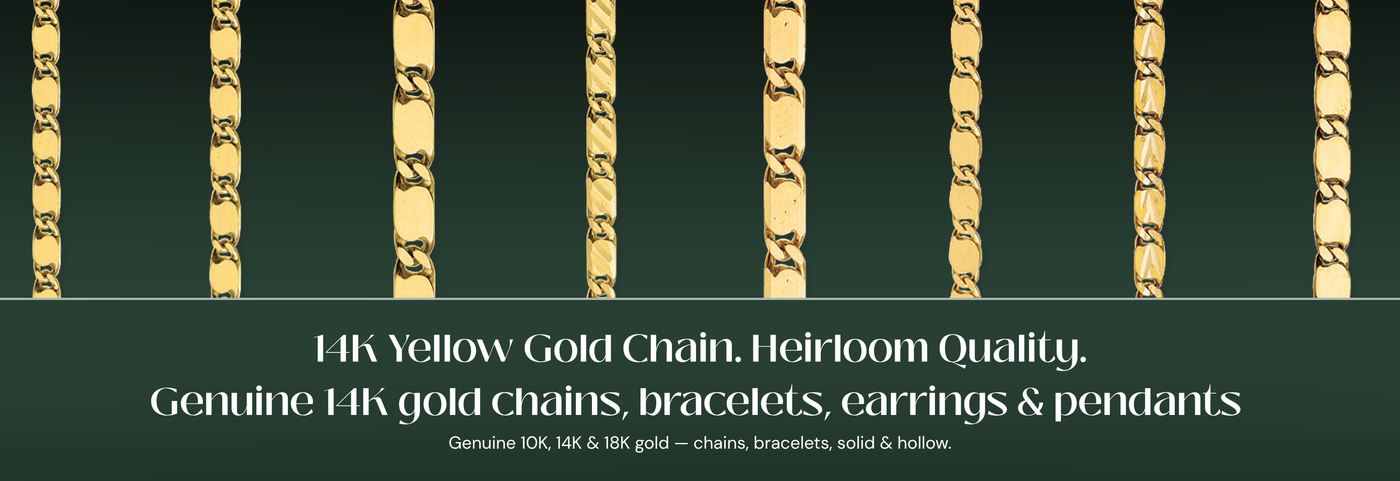
Italian 14K yellow gold jewelry collection

Oro amarillo de 14 quilates.

Oro amarillo de 14 quilates.
Ver como

What is 14K yellow gold?

14K yellow gold is a gold alloy containing 58.3% pure gold (14 parts out of 24) and 41.7% other metals — typically copper, silver, and zinc — mixed in to increase hardness and durability. The '14K' stamp (or '585' in European and Italian hallmarking systems) is the most widely purchased gold karat in the United States for fine jewelry.

The yellow color of 14K gold comes from the dominant presence of pure gold in the alloy, tempered slightly by the copper and silver content. Compared to 24K pure gold, 14K has a warm, rich yellow tone that is slightly less vivid — but this subtler color is often preferred for jewelry because it reads as classic gold without the overly bright yellow of high-karat pieces.

14K yellow gold strikes the optimal balance between the beauty and value of gold and the practical durability needed for daily wear. It is the standard karat for fine jewelry in the US and the recommended choice for rings, bracelets, necklaces, and earrings that will be worn regularly over many years.

What does '14K' mean on a piece of jewelry?

The '14K' stamp on jewelry indicates that the piece contains 14 parts pure gold out of a possible 24 parts — equal to 58.3% gold content by weight. The remaining 41.7% consists of other metals added to the alloy for structural strength. This karat designation is a legal purity standard required on all gold jewelry sold in the United States.

The '585' stamp found on Italian and European gold jewelry means the same thing: 585 parts per thousand of pure gold content, which equals 58.3%. Both '14K' and '585' are legally equivalent designations. Italian fine jewelry almost universally uses the 585 hallmark alongside a maker's mark and assay office stamp.

If a piece of jewelry has no karat stamp, it is not legally permitted to be sold as 'gold' in the US. The absence of a hallmark is a significant red flag — always verify the stamp under magnification before purchasing any piece represented as 14K gold. Reputable jewelers stamp their pieces clearly and include the karat designation on purchase receipts.

How is 14K yellow gold different from pure gold?

Pure gold — also called 24K gold — is 99.9% elemental gold. It has a brilliantly deep yellow color and is extremely malleable: so soft that it can be scratched with a fingernail and deformed by hand pressure alone. Pure gold cannot maintain the sharp edges, link geometry, or structural integrity required for functional jewelry under normal wear conditions.

14K yellow gold solves this problem by alloying the pure gold with copper (for hardness and warm tone), silver (for brightness and workability), and sometimes zinc (for strength). The result is a metal that preserves most of gold's visual character and all of its chemical inertness — while being hard enough to hold fine details and withstand years of daily wear without deforming.

For practical purposes, 14K gold behaves like an engineered metal optimized for jewelry: it cuts and casts precisely, holds prong settings securely, polishes to a high luster, and resists the tarnishing and corrosion that affect base metals. The 41.7% alloy content is not a compromise — it is what makes 14K yellow gold the industry standard for fine jewelry worldwide.

What is the difference between 14K and 18K yellow gold?

14K yellow gold contains 58.3% pure gold; 18K contains 75% pure gold. The higher gold content in 18K produces a richer, more saturated yellow color — visibly deeper than 14K under natural light. 18K is also slightly denser and carries more gold value per gram. However, 18K is significantly softer than 14K, making it more susceptible to surface scratching and link deformation under daily wear.

The price difference is proportional to gold content: an 18K piece contains 28.5% more gold than an equivalent 14K piece by weight, which translates directly to higher cost. At current gold prices, 18K pieces typically retail at a 20–35% premium over comparable 14K pieces of the same style and gram weight.

For most daily wear jewelry — chains, bracelets, rings — 14K is the recommendation because durability matters more than the marginal color difference between karats. For pieces worn occasionally, for special occasions, or when you want the richest possible gold color, 18K is worth the premium. Most Italian fine jewelry is produced in both 14K (for the US market) and 18K (for European markets).

What is the difference between 14K and 10K yellow gold?

14K yellow gold contains 58.3% pure gold; 10K contains only 41.7% pure gold — the minimum gold content legally permitted to be sold as 'gold' in the United States. 10K is the most affordable entry point into solid gold jewelry, and it is the hardest of the three common karats due to its higher alloy content.

The color difference between 10K and 14K is visible and significant. 10K yellow gold is noticeably paler — some buyers describe it as appearing yellowish-white or champagne-colored compared to the warm, classic yellow of 14K. Side by side, the difference is immediately apparent. Under some lighting conditions, 10K can look more similar to white gold than to the traditional gold color most buyers expect.

10K is appropriate for buyers who prioritize price above all other considerations, or for pieces that will experience extreme wear. For buyers who want jewelry that looks like gold and holds its color and value over time, 14K is the right minimum standard. The price difference between 10K and 14K is smaller than most buyers expect, and the quality difference is significant.

Is 14K yellow gold better than 18K for everyday jewelry?

For everyday jewelry — rings, bracelets, necklaces worn continuously throughout normal daily activities — 14K yellow gold is the better choice due to its superior hardness. At 58.3% gold content, 14K contains enough alloy to resist the surface scratching and microscopic deformation that accumulate quickly on 18K pieces worn daily.

An 18K chain or bracelet worn every day will develop a frosted, scratched appearance at high-contact points within months. The same piece in 14K will maintain its polished surface significantly longer under equivalent wear conditions. This difference is most pronounced on textured surfaces like rope chains, herringbone bracelets, and diamond-cut links, where the surface finish is a key part of the visual appeal.

The practical guideline used by most jewelry professionals: wear 14K for daily-wear pieces, reserve 18K for occasion pieces or items that won't experience daily friction. A 14K piece worn daily will look better, hold its finish longer, and require less professional polishing than an 18K equivalent.

Does 14K yellow gold tarnish?

14K yellow gold does not tarnish in the way that silver or copper tarnish — it will not develop a black or green oxide layer under normal conditions. Gold is chemically inert and does not react with oxygen or water. However, the 41.7% alloy content in 14K gold includes copper and silver, which can very slowly oxidize and contribute a subtle darkening over time, particularly at friction points.

The most common cause of apparent 'tarnishing' on 14K gold jewelry is not metal oxidation but surface residue — buildup of skin oils, lotion, soap, and environmental dust in link crevices and textured surfaces. This buildup creates a gray or dull film that looks like tarnish but wipes away easily with a soft cloth and dish soap wash.

To keep 14K yellow gold looking its best: clean it monthly if worn daily using warm water and mild soap with a soft toothbrush, rinse thoroughly, and dry completely. Remove 14K jewelry before using chlorine bleach, applying chemical-based beauty products, or swimming in chlorinated water. With this simple maintenance, 14K yellow gold maintains its appearance indefinitely.

Is 14K yellow gold hypoallergenic?

14K yellow gold in its standard alloy composition is generally well-tolerated but is not considered fully hypoallergenic. The alloy contains copper, which rarely causes reactions, and some formulations include nickel, which is the most common cause of metal jewelry allergies. If you have a known nickel sensitivity, verify with the seller that the 14K alloy used does not contain nickel.

Italian and many European 14K yellow gold formulations typically use a copper-silver-zinc alloy without nickel, which is better tolerated by most people with metal sensitivities. This is one reason Italian gold is often recommended for buyers with skin sensitivities — not just for quality, but for the alloy composition used in its production.

If you experience redness, itching, or irritation from 14K yellow gold, the reaction may be to the nickel content in a specific alloy. Try a different piece of 14K gold from a different manufacturer — if the reaction resolves, the first piece likely contained nickel. For guaranteed nickel-free gold, 18K and 22K yellow gold contain high enough pure gold percentages that less alloy is needed, reducing nickel exposure.

Does 14K yellow gold fade or lose its color?

14K yellow gold does not fade — the yellow color is intrinsic to the metal itself, not a surface coating that can wear away. Unlike gold-plated or gold-filled jewelry, which eventually expose the base metal beneath as the surface layer wears through, solid 14K gold maintains its color throughout the entire piece indefinitely.

What buyers sometimes observe is a gradual change in surface appearance — not color fading but surface patina. High-contact areas develop micro-scratches that create a frosted appearance compared to the original polished shine. This is a surface texture change, not color change. Professional polishing by a jeweler removes this patina and restores the original mirror finish.

Some buyers actually prefer the warm patina that develops on 14K gold over years of wear — it creates a subtly antique appearance with depth and character that new pieces lack. Whether to polish or preserve this natural aging is entirely personal preference. The gold color itself — the 58.3% pure gold content — does not change, fade, or diminish regardless of how long the piece is worn.

Can 14K yellow gold be resized or repaired?

Yes — 14K yellow gold is an excellent candidate for resizing and repair. Goldsmiths work with 14K gold routinely because its alloy composition makes it highly workable: it solders cleanly, takes solder joints without porosity, can be laser-welded for precision repairs, and responds well to polishing and finishing after work is completed.

Ring resizing is the most common repair. A 14K yellow gold ring can typically be sized up or down by 1–3 sizes in either direction by a skilled jeweler. Going up in size requires adding a small gold section to the shank; going down requires removing metal and closing the gap. Both operations are routine and do not affect the structural integrity of the ring when performed correctly.

Chain and bracelet repairs — reattaching clasps, soldering broken links, replacing worn spring mechanisms — are equally straightforward with 14K gold. The key is using a jeweler who matches the repair solder to 14K yellow gold alloy; mismatched solder shows as a color difference at the repair site. Reputable jewelers stock karat-matched solder for exactly this reason.

About 14K Yellow Gold Jewelry

14K Yellow Gold: Why 58.5% Pure Gold Became the Fine Jewelry Standard

The 14K designation means 14 parts gold out of 24 total parts — 58.5% pure gold by weight. The alloy metals making up the remaining 41.5% serve specific functions: copper adds hardness and contributes warm reddish tones; silver adjusts the color toward green-yellow; zinc and other trace elements fine-tune the working properties for the manufacturing process. The result is a metal that is measurably harder than 18K gold, which allows 14K pieces to maintain their shape and surface detail under the mechanical stress of daily wear far better than softer, higher-karat equivalents.

The color of 14K yellow gold is the reference color for what most people mean when they say 'gold' in a jewelry context. 18K yellow gold is visibly richer and warmer — the higher gold content produces a deeper, more saturated yellow. 10K yellow gold is measurably paler — the lower gold content and higher alloy proportion creates a cooler, lighter tone. 14K sits at the center: clearly gold in color, warm without being heavy, and the standard against which other karats are typically compared. When buyers say 'that doesn't look like gold,' they are usually describing a piece that is either plated or 10K.

14K yellow gold's dominance in the fine jewelry market reflects a practical consensus built over generations: the karat is hard enough for daily wear, gold-rich enough to carry real value, and warm enough in color to look like the gold people expect. For chains worn daily, bracelets that contact hard surfaces, and earrings worn through years of use, 14K is the professional jeweler's standard recommendation. The pieces in this collection are available in 10K as a more affordable alternative — the difference is hardness, color, and gold content, not quality of craftsmanship.Our Italian gold chains are crafted with the attention to detail that has made Italian jewelry famous worldwide.

Comparar /3

Cargando...