Envío gratis en todos los pedidos superiores a $75 en los Estados Unidos

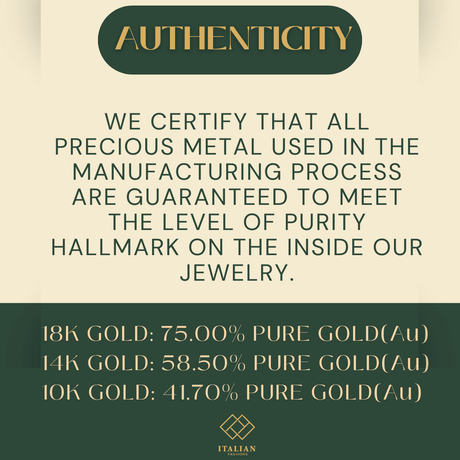
Cuando se trata de oro, garantizamos el uso de oro 100% real en todos nuestros productos de oro.

FLASH SALE— Save 25%

HAPPY25NOW
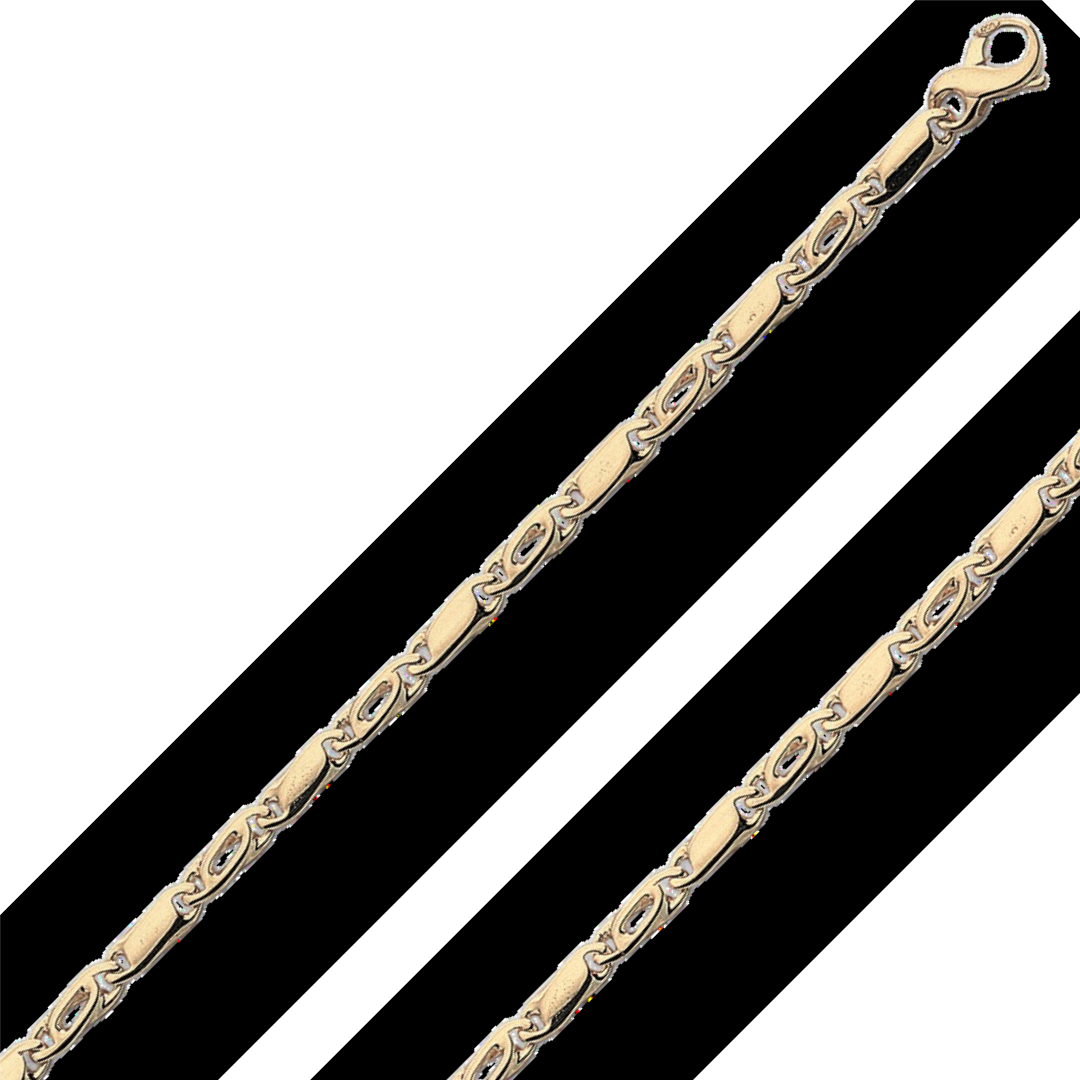
Italian 18K gold chain

Cadena de Oro 18k

18K Gold Chains: The Highest Gold Content in Standard Fine Jewelry

18K gold contains 75% pure gold — significantly more than the 58.5% in 14K or the 41.7% in 10K. The result is a deeper, more saturated yellow color that is noticeably richer than lower-karat alternatives. For buyers who want the closest achievable look to pure gold while still owning a chain with enough structural integrity for everyday wear, 18K is the standard choice.

How the Higher Gold Content Affects Wearability

The trade-off of 18K gold is reduced hardness compared to 14K or 10K. Pure gold is a soft metal, and the higher the gold percentage, the softer the piece. An 18K chain accumulates surface scratches more readily than a 14K chain of identical construction. The practical difference is small for a chain worn through normal daily activity, but buyers who work with their hands or exercise frequently should consider 14K for durability. 18K is best suited to jewelry worn for occasions or by careful wearers.

Selecting the Right 18K Chain Style and Width

18K gold chains are available in the full range of Italian link styles — Cuban, rope, Figaro, box, and others — with the same construction standards applied at every karat. Width selection follows the same logic as other karats: chains under 3mm function as refined pendant carriers, 3mm to 5mm is the everyday statement range, and 6mm and above produces bold impact. An 18K chain at a given weight will cost more than a 14K chain of the same dimensions, reflecting the higher gold content per gram.

Ver como

What is an 18K gold chain?

An 18K gold chain is a necklace or bracelet crafted from 18-karat gold alloy — an alloy composed of 75% pure gold and 25% other metals. The '18K' designation comes from the karat system where 24 parts equals pure gold; 18 karat means 18 of those 24 parts are pure gold. This 75% gold content places 18K gold at the upper tier of commercial fine jewelry, above the more common 14K (58.5% gold) and 10K (41.7% gold) grades, and just below the rarely used 22K and 24K purities that are too soft for most jewelry applications.

The 25% non-gold alloy content in 18K gold serves two purposes: providing structural hardness that pure gold lacks, and enabling the production of different gold colors. 18K yellow gold uses silver and copper as primary alloying metals, producing the classic warm yellow color that appears more deeply saturated than lower-karat yellow golds. 18K white gold uses palladium or nickel alongside silver to neutralize the gold's yellow color. 18K rose gold uses a higher copper ratio to produce the warm pinkish-gold tone. Each color is a distinct alloy formulation at the same 75% gold purity.

18K gold chains are the preferred choice in European fine jewelry traditions and among buyers who prioritize gold richness and color depth over budget considerations. Italian-manufactured 18K gold chains — stamped '750' on the clasp, the European numeric designation for 18K — are the gold standard for commercial chain quality. The '750' stamp indicates 750 parts per thousand pure gold content, certified by Italy's mandatory government assay system.

What does '18K' mean on a gold chain?

'18K' on a gold chain is the karat designation indicating the chain's gold purity — 18 parts pure gold out of 24 parts total alloy, equaling 75% pure gold content. The karat system is the U.S. and traditional British standard for expressing gold purity in fractional 24ths. An 18K gold chain is 75% pure gold by weight; the remaining 25% consists of alloying metals added to provide hardness and, in the case of colored gold, to produce the desired color. The '18K' stamp on the clasp is legally required for jewelry sold as 18K gold under U.S. Federal Trade Commission regulations.

European and internationally manufactured chains — particularly Italian-made chains — more commonly display '750' rather than '18K' on the clasp. The '750' is the European numeric purity system equivalent of 18K: 750 parts per thousand pure gold equals exactly 75% gold content, which is exactly what 18K means. Both designations are legally valid and interchangeable. Italian fine jewelry hallmarking typically displays '750' alongside a manufacturer identification code and a government assay mark, constituting the full Italian three-mark hallmarking system.

The karat grade is the single most important specification on any gold chain because it directly determines the piece's gold content and intrinsic value. An 18K chain contains 28.2% more pure gold per gram than a 14K chain of identical gram weight. At mid-2026 gold prices of approximately $106 per gram of pure gold, a 10-gram 18K chain contains $795 in gold content versus $621 for a 10-gram 14K chain — a $174 difference per 10 grams. Always verify the karat stamp before purchase and request the chain's gram weight to calculate gold content value.

What does '750' mean on a gold chain?

The stamp '750' on a gold chain clasp is the European and international numeric purity designation for 18-karat gold. It indicates the gold content is 750 parts per thousand of pure gold — equivalent to 75%, which is exactly what '18K' means in the karat system. The numeric system was developed as an international standard for gold purity expression, now used across Europe, Asia, and most international jewelry manufacturing centers. The karat system ('18K') is the domestic U.S. standard; the numeric system ('750') is the international standard — both are legally valid.

On Italian-manufactured gold chains, '750' is the primary purity stamp you will find on the clasp. Italian hallmarking law requires the numeric designation, and '750' appears alongside the manufacturer's unique government-registered identification code and the Italian government assay mark — together constituting the full Italian three-mark hallmark that authenticates both the chain's gold purity (independently tested and certified by a government assay office) and its Italian manufacturing origin. A '750' stamp with the manufacturer code and assay mark is the strongest possible authentication of 18K gold purity.

When examining a chain for the '750' stamp, use a jeweler's loupe or phone camera zoom — the stamps on gold chain clasps are very small and require magnification to read clearly. A genuine 18K gold chain will have a sharp, deeply struck '750' (or '18K') stamp. Faint or illegible stamps require further verification. If purchasing a chain described as 18K online, request high-resolution photos of the clasp stamps specifically, or request third-party acid test documentation from the seller before finalizing the purchase.

Is 18K gold better than 14K gold for chains?

Whether 18K gold is 'better' than 14K for chains depends on what the buyer prioritizes. 18K gold contains more gold (75% vs. 58.5%), has a richer, more deeply saturated yellow color, and carries more intrinsic gold content value per gram. For buyers who prioritize gold richness, the deepest possible yellow color, and maximum gold content in their chain, 18K is the superior choice. For buyers who prioritize daily wearability, scratch resistance, and the most gold content per dollar spent, 14K provides meaningful advantages.

Durability favors 14K: the 14K alloy's higher non-gold content (41.5% vs. 25%) provides more alloying metal to harden the structure, making 14K chains more resistant to surface scratching and wear than 18K chains of identical construction. For a chain worn daily under active conditions — physical work, athletics, frequent contact with hard surfaces — 14K maintains its surface finish longer. 18K chains worn in the same conditions will develop a light patina of micro-scratches faster, dulling the surface polish over months of heavy use.

Price per gram favors 14K: 18K chains cost 25–30% more per gram than 14K chains of identical construction, reflecting the higher gold content. For buyers purchasing a chain primarily for its appearance and are budget-conscious, 14K delivers visually very similar results (especially in yellow gold, where the color difference between 14K and 18K is visible but not dramatic) at meaningfully lower cost. 18K is the right choice for buyers who specifically want the richest possible gold color, the highest gold content, or who are matching existing 18K jewelry.

Who should buy an 18K gold chain?

18K gold chains are the right choice for buyers in several specific situations. First, buyers who prioritize gold color richness: 18K yellow gold has a noticeably deeper, more intensely warm yellow color than 14K yellow gold. If you have compared both side by side and prefer the 18K color depth, the premium is justified. Second, buyers matching existing 18K jewelry: mixing karat grades in layered or coordinated jewelry looks creates visible color mismatches that become apparent under direct light. If your other fine jewelry is 18K, matching with 18K maintains color consistency.

Third, buyers purchasing for gifting occasions where quality is the primary signal: an 18K gold chain communicates a higher level of investment than a 14K equivalent. The difference in gold content (75% vs. 58.5%) is a tangible quality differentiator that knowledgeable recipients recognize and appreciate. Fourth, buyers investing in fine jewelry for long-term ownership and value retention: 18K contains 28% more gold per gram than 14K, meaning more intrinsic gold value is preserved in the piece over time as gold prices change.

18K chains are less appropriate for buyers who prioritize maximum durability for heavy active use, for first-time fine gold jewelry buyers who are price-sensitive, or for buyers who plan to purchase and sell frequently (14K chains are more actively traded in the U.S. secondary market because they are more common and familiar to buyers). Italian-made 18K gold chains with full '750' hallmarking and manufacturer/assay stamps represent the combination of maximum gold content and maximum construction quality — the ideal choice for buyers who want the best fine gold chain available.

What is 18K yellow gold made of?

18K yellow gold is a gold alloy composed of 75% pure gold (18 parts gold per 24 parts total) with the remaining 25% consisting of silver and copper in proportions formulated to produce the classic warm yellow color. The specific silver-to-copper ratio within that 25% varies slightly between manufacturers and alloy formulations — a slightly higher silver ratio produces a slightly lighter, more greenish-yellow; a slightly higher copper ratio produces a slightly warmer, more orange-inflected yellow. Standard commercial 18K yellow gold alloys are balanced to produce the deepest, most recognizable warm yellow color.

The color of 18K yellow gold is distinctly richer and more deeply saturated than 14K yellow gold. This color difference is attributable to the higher gold content — pure gold has an intensely warm yellow color, and at 75% gold content, 18K yellow gold retains more of that pure gold character than 14K (58.5% gold). Side by side, 18K yellow gold appears noticeably more 'golden' — more intensely warm and saturated — than 14K yellow gold. This color richness is the primary reason buyers choose 18K over 14K for yellow gold pieces.

The trade-off for higher gold content is lower hardness. Pure gold rates approximately 2.5 on the Mohs hardness scale — very soft. The silver and copper alloying metals in 18K raise this to approximately 3–3.5 Mohs (14K rates approximately 3.5–4 Mohs with its higher alloy content). This means 18K yellow gold chains are slightly softer than 14K equivalents and will develop surface micro-scratches from daily wear somewhat faster. For chains worn daily, this is a practical consideration; for chains worn occasionally, it is largely irrelevant.

What is 18K white gold?

18K white gold is an 18-karat gold alloy formulated to produce a white or light silver-gray color rather than the yellow color of standard gold alloys. At 18K purity (75% gold), achieving a white color requires alloying metals that effectively neutralize the gold's intrinsic yellow color. The primary alloying metals used in 18K white gold are palladium (a platinum-group metal) and silver, sometimes combined with small amounts of nickel. These metals counteract the gold's yellow tone, producing an alloy that appears white or slightly off-white.

Most commercially sold 18K white gold jewelry — including chains — receives a rhodium plating after manufacture. Rhodium is a platinum-group metal with an extremely bright, reflective white surface that produces the bright silver-white appearance consumers associate with white gold. The rhodium plating is thin (typically 0.5–1 micron) and is the outermost surface layer the buyer sees and touches. Over time (typically 1–3 years of regular wear), the rhodium plating wears through in high-contact areas, revealing the slightly yellowish or grayish underlying 18K white gold alloy — a process called 'rhodium wear.'

18K white gold chains require periodic rhodium re-plating (every 1–3 years depending on wear frequency) to maintain their bright white appearance. This replating is a standard jewelry service performed by any qualified jeweler — the chain is cleaned, polished, and rhodium-plated in a process taking 1–2 hours. The cost is typically $40–$80 per chain. For buyers who want a permanently white metal chain without rhodium maintenance, platinum chains (pure platinum alloy) are an alternative — more expensive but permanently white without plating.

What is 18K rose gold?

18K rose gold is an 18-karat gold alloy formulated to produce a warm pinkish-gold color by using a higher proportion of copper relative to silver in the alloying composition. At 18K purity (75% gold, 25% alloy), the 25% alloying component is predominantly copper — typically 20–22% copper with 3–5% silver. Copper produces a warm reddish-pink color that, blended with the gold's yellow color, creates the characteristic rose gold tone. Higher copper content produces a deeper, more intense rose color; lower copper content produces a lighter, more golden rose.

The color of 18K rose gold is distinctive and unmistakably warm — a blend of gold's yellow with copper's reddish warmth that produces the signature rose-gold tone. This color has experienced significant popularity cycles in commercial jewelry markets. 18K rose gold has a slightly different look than 14K rose gold: with more gold (75% vs. 58.5%), the 18K version has a slightly more golden, less intensely pink undertone than 14K rose gold, which has higher copper content relative to gold and therefore appears slightly more intensely pink-red. The difference is subtle but visible side by side.

Rose gold is the most tarnish-resistant of the three gold colors because copper — its primary alloying metal — is more chemically stable in air and against skin chemistry than silver. The higher copper ratio in rose gold also makes it harder than yellow gold at the same karat, providing better scratch resistance. 18K rose gold chains do not require rhodium plating and maintain their color indefinitely without special treatment. For buyers wanting a distinctive warm color without maintenance concerns, 18K rose gold is an excellent choice.

How does 18K gold compare to pure gold (24K)?

24K gold is pure gold — 999.9 parts per thousand pure gold, or essentially 100% gold content. 18K gold is 75% pure gold with 25% alloying metals. The difference between them has profound practical implications for chain use. Pure 24K gold is extraordinarily soft — it scratches with minimal force, bends under light stress, and cannot hold a chain link's shape under the mechanical stresses of daily wear. A 24K gold rope chain worn daily would deform within days or weeks. For this reason, 24K gold is rarely used for fine chain jewelry in Western markets.

18K gold, with 25% alloying metals, achieves sufficient hardness for practical fine jewelry use while retaining 75% of pure gold's distinctive color richness and intrinsic value. The alloying metals (silver and copper for yellow gold) harden the structure to approximately 3–3.5 Mohs hardness — sufficient to hold link shapes under normal daily wear stresses while maintaining the surface finish for months to years before requiring polishing. This is the practical threshold where gold content richness and structural utility converge at a commercially sustainable point.

From an investment perspective: 24K gold has the highest gold content and therefore the highest intrinsic value per gram, but is impractical for wearable jewelry. 18K gold is the highest practical karat for everyday wearable gold chains, carrying the maximum gold content compatible with daily use durability. For buyers who want to maximize gold content in a chain they can actually wear, 18K is the practical ceiling. Chains marketed as '22K gold' exist in South Asian jewelry traditions but are too soft for Western active-wear chain use.

How hard-wearing is an 18K gold chain?

An 18K gold chain is suitable for regular fine jewelry wear — social occasions, professional environments, casual daily wear, and events — but requires more care than a 14K chain under identical conditions. The lower alloy content of 18K gold (25% non-gold vs. 41.5% for 14K) means a slightly softer metal that develops micro-surface scratches from contact with clothing, skin, and incidental hard surfaces somewhat faster than 14K. Under conditions of light to moderate daily wear, this difference is manageable with occasional polishing.

For active daily wear under demanding conditions — regular exercise, physical work, frequent contact with hard surfaces, sports — 14K gold is the more practical choice. Under these conditions, an 18K chain will require professional polishing more frequently (perhaps once a year) to maintain its surface brilliance, while a 14K chain in similar use might need polishing every two to three years. The 18K chain is not fragile — it will not break or deform under normal wear — it simply shows surface wear faster than 14K.

Best practices for maximizing 18K chain longevity: remove the chain before physical exercise, contact sports, manual labor, and pool swimming. Store it individually in a soft pouch rather than loose with other jewelry that can scratch its surface. Clean it gently with warm water and mild soap monthly to prevent buildup in link joints. Professional polishing annually maintains the surface brilliance that makes 18K gold's richer color most visible. With appropriate care, a quality Italian-made 18K gold chain can maintain its appearance for decades.

About 18K Gold Chains

18K Gold Chains: The Highest Gold Content in Standard Fine Jewelry

18K gold contains 75% pure gold, producing the deepest, most saturated yellow color of any standard karat sold in the US. The color difference between 14K and 18K is most apparent on wider chains where the metal surface area is greatest — the richer 18K hue creates a distinctly more luxurious impression.

The higher gold content also means slightly reduced hardness compared to 14K. 18K chains accumulate fine surface scratches more quickly under identical wear conditions, though structural integrity is not affected. Periodic professional polishing restores the mirror-bright surface.

18K gold chains are available in the full range of Italian styles — rope, Cuban, Figaro, box, and others — with the same construction standards at every karat level. The price premium over 14K reflects higher gold content per gram, not a difference in construction quality.

Comparar /3

Cargando...