Envío gratis en todos los pedidos superiores a $75 en los Estados Unidos

Cuando se trata de oro, garantizamos el uso de oro 100% real en todos nuestros productos de oro.

Italian Rolo gold chain

Cadena Rolo

Cadena Rolo
Ver como

Understanding the Rolo Link

What is a rolo chain?

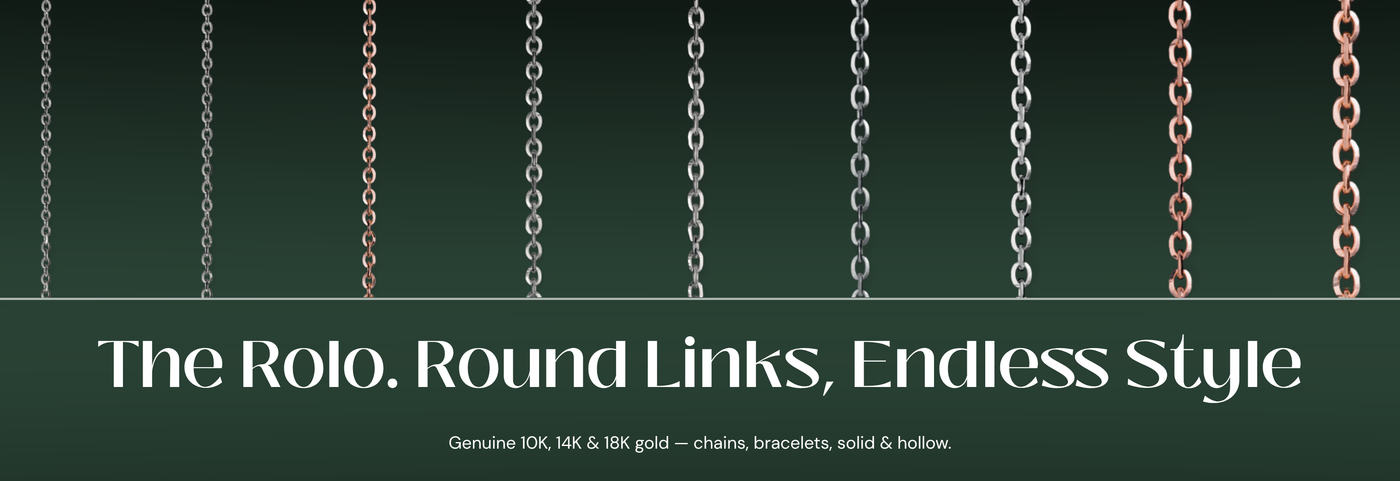
A chain made from identical round or slightly oval links, each threaded through the next so that it stands across its neighbour. Along the chain the links alternate between being seen face-on, as an open circle, and edge-on, as a short bright bar.

The links are usually made from wire that is flat on the inside and domed on the outside, which lets them seat neatly where they cross. Fully round wire gives a softer ring, and some listings note which is used.

Because every link is the same and every centre is open, the rolo has no pattern to count and no flat side to turn. It is the plain open-ring chain, worn on its own or as a carrier for charms and pendants.

Why does a rolo chain look lighter than it feels?

The links are rings, so most of the area inside each one is empty. When the chain is worn, skin or fabric shows through every link that faces outward, and the eye reads the outline of the ring rather than a solid band of metal.

A rolo of a given width therefore takes up the space of that width on the neck while carrying only the metal of the rims. Beside a chain whose links are solid across their face, it appears open and airy.

In the hand the difference is smaller than it looks. A rolo made from reasonably heavy wire has real weight, and a wide one is often made hollow for that reason; the listing states whether the links are solid or hollow.

Does a rolo chain lie flat against the skin?

No. It sits as a rounded cord rather than a ribbon. The edge-on links hold the face-on links slightly proud of the skin, and because the links are circular in outline there is no flat face for the chain to settle onto.

That is different from a chain built from flattened links, which lies on one face and has to be turned back if it rolls over. A rolo looks the same however it rotates, so it does not need turning.

The practical consequence is even wear. There is no front that takes all the contact and no back that is protected, and an older rolo tends to soften uniformly rather than developing a worn side.

Why is a rolo chain so often used for charms?

Because each link is an open ring big enough for a jump ring or a charm loop to pass through, and stout enough at the rim to carry what hangs from it. A charm can be attached to any link along the length, not only at the ends.

That lets a bracelet or necklace start with one charm and take more over time without the chain being altered. Charms can be spaced along the chain, grouped, or moved by opening their rings and closing them elsewhere.

The rolo is also visually neutral. Its plain repeated rings do not compete with what is hung from them, so a row of varied charms reads as the design and the chain reads as the thread that holds it.

Can a charm be attached anywhere along a rolo chain?

Yes, at any link. A jump ring is opened, passed through the chosen rolo link and through the charm's loop, and closed again. On a fine rolo the jump ring needs to be small enough to pass the link's opening; on a wider rolo almost any jump ring will do.

A charm attached this way hangs from the rolo link it encloses and moves with it. If the charm is later wanted elsewhere, the jump ring is opened and re-closed on a different link, and no trace remains on the chain.

Soldering the jump ring closed makes the attachment permanent and is usual on a piece that will be worn daily, since an unsoldered ring can be sprung open by a snag. The rolo link itself is left untouched either way.

How does a jeweller shorten a rolo chain?

By opening one link. The jeweller cuts through a single ring, slides it out from between its neighbours, removes as many further rings as the new length requires, and then solders the cut ring closed again around its new neighbour.

Nothing about the pattern changes, because every link is identical and there is no sequence to preserve. The chain can be shortened at either end or, if the clasp is to stay where it is, at any point along the length.

On a hollow rolo the ring is a thin tube rather than solid wire, so the join is made with more care and may be a little more visible. Solid rolo closes with a join that is hard to find once polished.

Where does a rolo chain wear first?

At the crossings. Each link touches its neighbours at two points, where the rim of one ring passes through the centre of the next, and those points rub together with every movement. Over years the wire thins slightly there and the openings of the links grow a little.

The clasp end takes the most handling and usually shows it first, since the links near the fastening are the ones pulled and twisted each time the chain is put on.

A rolo whose links have thinned at the crossings looks slightly looser and longer than it did. A jeweller can replace the worn links at the clasp end, or, on a chain that has worn along its whole length, refit it with a new section.

What does flat rolo mean on a listing?

That the links are made from wire flattened on the inside face, so each ring has a flat inner surface and a domed outer one. It is the more common way of making a rolo, and it gives the chain a crisp, geometric look.

The flat face lets neighbouring rings seat against one another where they cross, which keeps the chain from stretching under a pull and gives the crossings their neat, tight appearance.

A rolo made from fully round wire has plumper, softer rings and a slightly more open look. The two are the same construction; the filter describes the section of the wire rather than a different style of link.

What widths are rolo chains made in?

From around one and a half millimetres, where the rolo is a fine pendant chain whose rings are too small to read individually, up through two and three millimetres, which is the range most often chosen for charms and for pendants that will be joined by others.

At four, five and six millimetres the rings are clearly visible as circles and the chain is worn on its own as a bold open texture. Wider rolos are often made hollow, which keeps a large ring wearable at the neck.

A double rolo, with two rings side by side at every step, reads as a broader ladder-like version of the same link and appears as its own filter on some listings. Each listing states the width of that specific chain.

Will a rolo chain tangle or kink?

It rarely kinks, because the links are round and cannot lock against one another the way flattened links can. A rolo folded sharply simply bends, and when it is lifted the rings fall back into line under their own weight.

It can tangle if stored loose with other chains, as any open-link chain can, since a fine chain will thread itself through the open centres of a rolo's rings. Kept on its own with the clasp fastened, it stays clear.

A rolo carrying charms is more prone to catching, because the charms and their jump rings give other pieces something to hook onto. Hanging a charm rolo rather than laying it in a box keeps it untangled.

About Rolo Gold Chains

How a Rolo Chain Is Built and How It Behaves

The rolo chain is one of the oldest and most elemental chain designs: uniform circular or slightly oval links connected at 90-degree angles, each link identical to the next. There is no pattern, no alternation, no twist — just the clean repetition of a single well-made link. This simplicity means the quality of the individual links is fully exposed. The roundness of each ring, the consistency of the metal gauge, the finish on the inner and outer surfaces — all of it is visible in a way that more complex patterns can partially obscure.

The circular link also creates a distinctive movement quality. Each rolo link rotates freely in two directions relative to its neighbors, giving the chain a smooth, rolling drape that settles naturally against the body. At thinner gauges (2–3mm) this produces a chain with excellent flexibility and very comfortable wear. At heavier gauges (5mm+) the links become substantial enough that the chain has real weight and presence while maintaining that characteristic smooth movement.

Rolo chains are particularly well-suited for charm and pendant wear because the open circular links at any point in the chain can hold a charm ring or pendant bail directly, without requiring a separate jump ring. Many charm bracelets use rolo construction specifically for this reason. The chain is also one of the most repairable styles in fine jewelry — because every link is identical, a broken link can be replaced with an exact match without disturbing the rest of the chain.

Comparar /3

Cargando...