Envío gratis en todos los pedidos superiores a $75 en los Estados Unidos

Cuando se trata de oro, garantizamos el uso de oro 100% real en todos nuestros productos de oro.

FLASH SALE— Save 25%

HAPPY25NOW
Italian gold cable chain

Cadena portacables

Cadena portacables
Ver como

What is a gold cable chain?

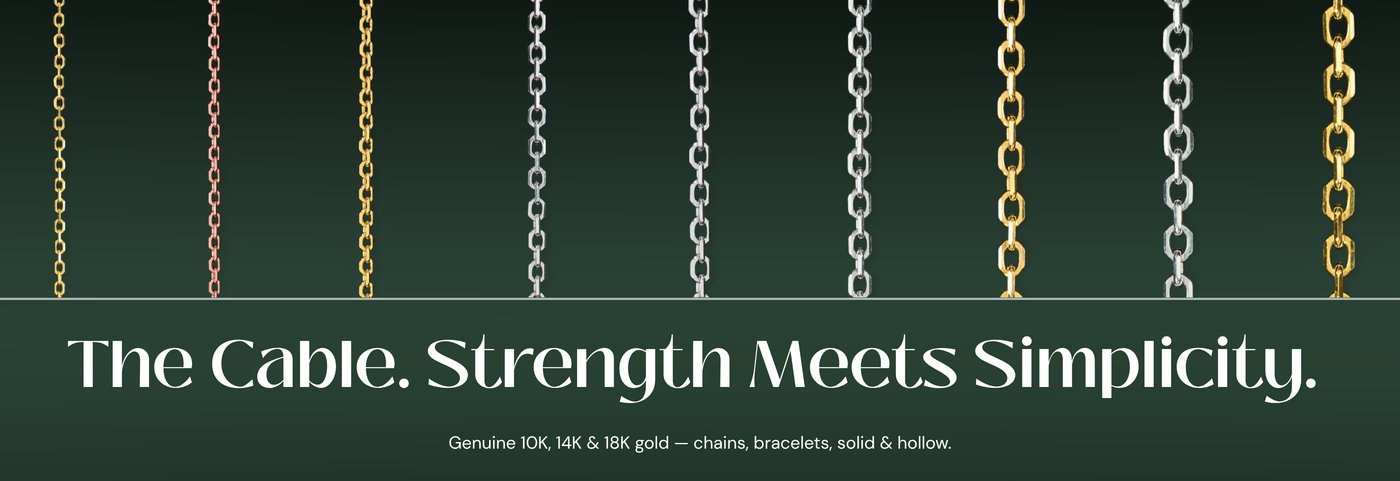
A gold cable chain is the most classic and widely recognized chain style in fine jewelry — a series of identical oval or round links connected in alternating directions, creating a smooth, fluid chain with a clean, minimal appearance. Every other link is rotated 90 degrees relative to its neighbors, giving the chain its characteristic ability to drape naturally and uniformly.

The cable chain's beauty is in its fundamental simplicity: each link is a perfect, smooth oval or circle, and the alternating 90-degree rotation of adjacent links creates the chain's flowing drape without any additional mechanical complexity. This alternating link orientation is not just aesthetic — it is what allows the chain to flex in any direction while maintaining a consistent, elegant form. The cable chain is the foundational chain style from which many other designs (Figaro, Rolo, anchor) derive their basic link construction, making it the ancestral chain of fine jewelry. Its origins trace to ancient Rome and Greece, where artisans discovered that alternating oval link orientations created chains with superior drape and durability.

Gold cable chains are available in 10K, 14K, and 18K in yellow, white, and rose gold, in widths from 1mm to 8mm and lengths from 14 to 30 inches. Their combination of timeless elegance, universal versatility, and broad availability makes them the most popular chain style in fine jewelry worldwide — the reliable foundation for any jewelry wardrobe.

How is a gold cable chain constructed?

A cable chain is constructed from individual oval or round links that are stamped or formed from gold wire or sheet, opened, interlocked with adjacent links, and then closed. The critical construction step is that each link is oriented perpendicular to both its neighbors — rotated 90 degrees — before closing, which creates the cable chain's characteristic alternating-direction pattern.

The manufacturing process for cable chains in modern fine jewelry production uses specialized machine tools: a wire is coiled around a mandrel to create a series of loops, these loops are cut to create individual jump rings, each jump ring is opened slightly, threaded through the previous link, and closed. The closing method determines quality: machine-soldered closures create a seamless, fully closed joint that cannot open under normal wear; unsoldered closures rely on the ring's spring tension to stay closed and can open under force. High-quality cable chains have soldered links throughout their length. Italian-made cable chains use precision machinery that achieves both uniform link dimensions and reliable soldered closures.

Link uniformity is the primary quality indicator for cable chains: all links should be identical in size and thickness throughout the chain's length, and all links should be fully closed with no visible seam or gap at the joint. Irregular link sizes or visible unsoldered joints indicate lower manufacturing quality. Examine the chain under a loupe — a high-quality cable chain's links should all appear identical and fully sealed.

Why is it called a cable chain?

The cable chain takes its name from its visual resemblance to steel or nautical cable — a series of interconnected oval links in alternating orientations that echo the look of thick rope or cable construction. Like the braided wires in a steel cable, the cable chain's alternating link orientations create a visually layered, uniform structure with a similar aesthetic rhythm to engineered cable.

The cable chain's name may also reflect its historical use as an actual utility chain construction before fine jewelry adoption — chain link patterns similar to the cable design were used in functional chains for tools, anchors, and mechanisms long before their miniaturization into fine jewelry. The Italian fine jewelry industry, which standardized and named most modern chain styles in the 20th century, adopted 'cable chain' (catena a cavo in Italian) as the standard designation for this foundational link construction, and the name has been universally adopted throughout the industry.

Different regional jewelry traditions use different names for the same construction: the cable chain is also known as the 'belcher chain' in British jewelry terminology (after a style popularized by prizefighter Jem Belcher), the 'rolo chain' (in some markets the rolo refers to round links specifically, while cable refers to oval links), and the 'anchor chain' in some European markets. All of these refer to the same fundamental alternating-link construction.

What makes a cable chain unique compared to other chain styles?

A cable chain is unique for its perfect balance of simplicity and elegance — a clean, minimal construction that creates a beautifully proportioned, smoothly draping chain without ornamentation or visual complexity. The cable chain's design philosophy is restraint: every element serves the chain's essential function, and the result is a timeless aesthetic that has never gone out of style.

Where other chain styles add visual complexity through twisted links (rope chain), varied link lengths (Figaro), geometric profiles (box), flat surfaces (herringbone), or three-dimensional weaves (Byzantine), the cable chain achieves its character through perfect execution of a single simple idea. The alternating-link construction creates just enough visual rhythm to be interesting without being complex — the eye moves smoothly along the chain and appreciates its uniformity rather than stopping to analyze individual elements. This visual restraint is the cable chain's greatest strength as a pendant chain: it frames and directs attention toward the pendant without competing.

The cable chain's universality also distinguishes it from all other chain styles: it is appropriate for every gender, age, occasion, and fashion context. No other chain style shares this universal applicability — the Franco chain skews masculine, the herringbone skews feminine, the box chain is modern-minimal, the rope chain is brilliant and conspicuous. The cable chain works in all of these contexts simultaneously, making it the one chain style that belongs in every jewelry wardrobe.

How does a gold cable chain compare to a rope chain?

A cable chain has uniform oval links in alternating orientations with a clean, minimal appearance and smooth drape. A rope chain has twisted flat links in a helical arrangement that creates brilliant, multi-directional sparkle. Cable chains are more minimal and universal; rope chains are more brilliant and eye-catching as standalone pieces.

The rope chain's helical surface scatters light in many directions simultaneously, creating a visual brilliance that the cable chain's smoother link surfaces cannot match as a standalone statement piece. However, the rope chain's visual complexity makes it a more dominant presence when paired with pendants — the brilliant, light-catching surface can compete with all but the most substantial pendants. The cable chain's minimal link surfaces reflect light more quietly and consistently, making it an ideal pendant chain that enhances rather than competes with the pendant. For pure standalone wear, the rope chain creates more visual impact; for pendant chains, the cable chain is the more versatile and effective choice.

Durability comparison: cable chains with soldered links are structurally sound for everyday use, though individual links can open if unsoldered and subjected to force. Rope chains in fine gold can kink if subjected to sharp bending. For active daily wear with a pendant, a cable chain in 14K with soldered links is often a more practical choice than a rope chain of equivalent price, combining elegant simplicity with reliable daily-wear performance.

How does a gold cable chain compare to a box chain?

A cable chain has oval links in alternating orientations with a slightly flexible, organic drape. A box chain has square links in sequential connection creating a flat, rigid, precise appearance. Cable chains are slightly more fluid and flexible; box chains are crisper and more linear.

Both cable and box chains occupy the 'minimal and clean' aesthetic territory of fine chain styles, making their comparison particularly relevant for buyers who want simple elegance. The cable chain has a slightly warmer, more organic character due to its oval links and fluid drape; the box chain has a crisper, more architectural character due to its square links and rigid geometry. For pendant chains, the box chain's flat surface creates a clean, invisible line from which the pendant hangs; the cable chain's oval links create a slightly more textured line that adds subtle visual interest while still deferring to the pendant.

Durability comparison: box chains are structurally sound for everyday pendant use, though their flat square links can crack if subjected to sharp kinks. Cable chains with soldered links are also sound for everyday use. In a direct practical comparison, soldered cable chains may be slightly more forgiving of the kink stresses that pendants create through their swinging weight, making them the more durable everyday pendant chain at comparable quality levels.

How does a gold cable chain compare to a Figaro chain?

A cable chain has all identical oval links in alternating orientations. A Figaro chain has a pattern of one long oval link alternating with two or three short round or oval links, all in the same plane. Cable chains are more minimal and uniform; Figaro chains have a more rhythmic visual pattern.

The Figaro chain's mixed-link pattern creates a chain with more visual rhythm and interest than the cable chain's perfect uniformity — the eye follows the long-short-short sequence as it repeats along the Figaro's length. This makes the Figaro chain a slightly more visually engaging standalone piece than the cable chain, while still being simple enough to work as a pendant chain. The cable chain's perfect uniformity makes it the more invisible pendant chain — it disappears visually and lets the pendant speak completely. For buyers choosing between these two classic Italian chain styles, the question is whether they want a pendant chain that participates subtly (Figaro) or one that disappears entirely (cable).

Both cable and Figaro chains are classic Italian chain styles with a long manufacturing heritage in Arezzo, Italy. Both are appropriate for everyday wear in 14K or 18K with soldered links. Both are available in widths suited for pendant chains (1.5mm to 4mm) as well as widths appropriate for standalone wear (4mm and above). The Figaro chain's two-link type pattern makes it more recognizably a 'designed' chain; the cable chain's single link type makes it more recognizably a 'pure' chain.

How does a gold cable chain compare to a Singapore chain?

A cable chain has flat oval links in alternating orientations with a simple, clean appearance. A Singapore chain has twisted links arranged in a double-diagonal pattern that creates brilliant sparkle and a complex visual texture. Cable chains are more minimal and pendant-friendly; Singapore chains are more brilliant and complex.

The Singapore chain occupies a similar niche to the rope chain — it creates brilliant light-catching properties through its twisted link orientation, making it an excellent standalone chain but a potentially competing pendant chain. The cable chain is intentionally more minimal, making it a better pendant chain companion. In terms of construction, the Singapore chain is substantially more complex than the cable chain, using twisted links arranged in a specific geometric pattern that requires more manufacturing steps. This complexity justifies a higher manufacturing cost but also means more points of potential wear over time.

For buyers who want a standalone chain with brilliant light-play, the Singapore chain is the better choice. For buyers who want a reliable, beautiful pendant chain that pairs with any pendant style, the cable chain is the better choice. Both are classic fine jewelry chain styles with appropriate quality available in 10K, 14K, and 18K from Italian manufacturers.

What metals are available for gold cable chains?

Gold cable chains are available in 10K (41.7% gold), 14K (58.3% gold), and 18K (75% gold) in yellow, white, and rose gold. Sterling silver cable chains are also widely available. Yellow, white, and rose gold cable chains each have distinct visual characters: yellow gold is warm and classic; white gold (rhodium-plated) is bright and modern; rose gold is warm and romantic.

Yellow gold cable chains are the traditional standard — the warm amber color complements the chain's clean oval links without visual distraction. White gold cable chains (rhodium-plated yellow gold with palladium or nickel whitening alloy) deliver a bright, silver-toned finish that is very popular for modern, minimalist jewelry contexts. Rose gold cable chains use a copper-enriched alloy that produces a warm, pinkish-gold tone — particularly popular for delicate, feminine chain sizes (1mm to 3mm). The rhodium plating on white gold cable chains may wear over time at the highest-friction contact points, revealing the warmer yellow gold underneath; replating is a routine jeweler service.

Karat choice for cable chains affects both color richness and link quality: 18K yellow gold produces the richest, most saturated gold color in the links; 14K is the warm standard; 10K is the most affordable with a slightly cooler color. For white gold, the rhodium plating standardizes the appearance across karats, making the karat choice for white gold cable chains primarily a value consideration rather than an aesthetic one.

What karat options are available for gold cable chains?

Gold cable chains are available in 10K (41.7% gold), 14K (58.3% gold), and 18K (75% gold). For the simple oval link construction of the cable chain, karat affects color warmth, gold content value, and alloy hardness — with 10K being hardest and most affordable, 14K balanced and most popular, and 18K richest in color and gold content.

The cable chain's simple link construction is not particularly sensitive to alloy hardness in the way that complex weave constructions (Byzantine, Franco) are. This means the karat choice for cable chains is primarily driven by color preference and budget rather than manufacturing quality considerations. 14K is the most widely recommended karat for cable chains: its warm yellow color is beautiful in the cable chain's clean oval links, its alloy hardness provides excellent durability for everyday wear, and its gold content represents meaningful intrinsic value. 18K cable chains are beautiful and appropriate for fine jewelry contexts where maximum color richness and gold content are priorities.

10K cable chains are an entirely appropriate choice for buyers who prioritize durability and affordability — the harder 10K alloy provides excellent scratch and wear resistance for everyday use. At finer chain widths (1mm to 2mm) where breakage resistance is relevant, 10K's higher alloy content may actually provide better wire strength than 14K for the same wire diameter, making 10K a legitimate practical choice beyond simple budget consideration.

About Gold Cable Chains

Cable Chain Gold: The Universal Pendant Chain Explained

The cable chain's claim to being the universal pendant chain is structural. When a pendant is attached to a cable chain bail, the round link at the bail point can rotate freely in all directions — the pendant centers itself by gravity regardless of how the chain moves. Flat-link chains (Cuban, Figaro) have links that preferentially lie flat; a pendant on a flat-link chain tends to twist as the chain moves, requiring periodic manual recentering. For any pendant worn consistently — a cross, an initial, a medallion — a cable chain provides the most reliable forward-facing pendant presentation.

Cable chain widths span a wider practical range than most other chain styles because the round link geometry scales cleanly from very fine to very substantial. At 0.8–1mm, a cable chain is almost invisible — a thread of gold that adds warmth to the neck without registering as a chain in its own right. At 1.5–2.5mm, it reads as a fine chain with clear identity. At 3–4mm, the cable becomes a visible piece of jewelry independent of any pendant. At 5mm+, it's a statement chain with real weight and presence.

Cable chains age better than most chain styles because the round link geometry is easy to inspect and maintain. A damaged link in a cable chain is visible — the round shape becomes slightly oval or shows a stress crack — and easy to isolate for repair. A jeweler can cut out the damaged link, add a replacement, and solder both joins cleanly in a repair that is invisible from the outside. This repairability over a long life is one reason cable chains are recommended as the base chain for heirloom pendants: the pendant may be irreplaceable, but the chain can always be renewed.

Comparar /3

Cargando...