Frete grátis para todos os pedidos acima de US$ 75 nos Estados Unidos

Quando se trata de ouro, garantimos a utilização de ouro 100% verdadeiro em todos os nossos produtos de ouro.

Italian fancy gold chains

Corrente Feminina

Fancy Gold Chains — Italian-Made with Distinctive Link Patterns

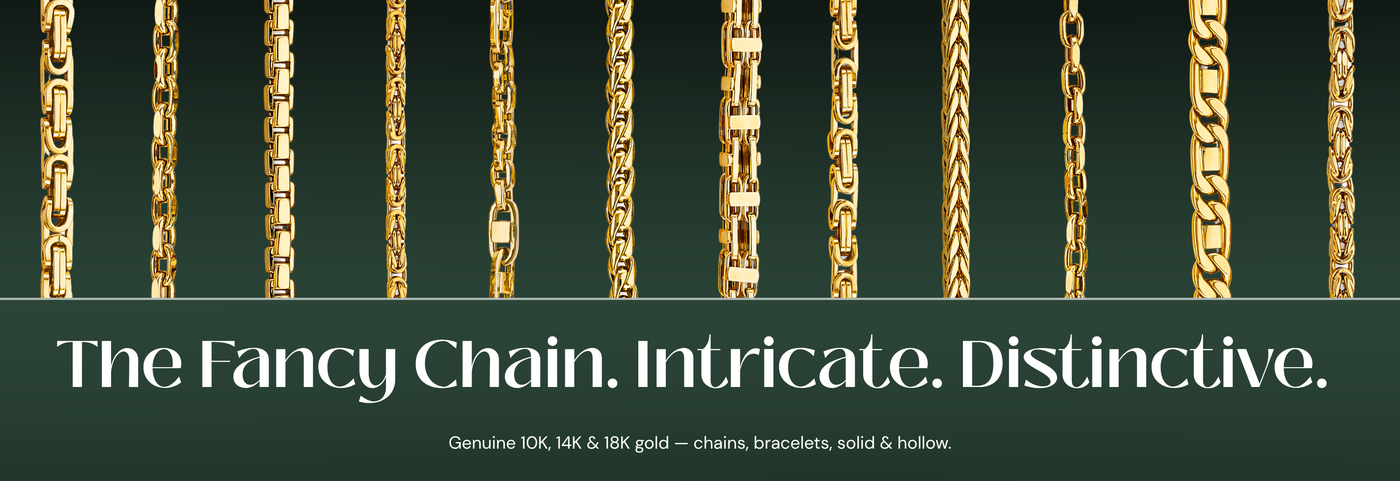
Fancy chains occupy a unique place in Italian gold jewelry: they combine structural complexity with visual elegance, producing pieces that catch light from multiple angles and move fluidly with the wearer. Unlike simple round-link chains, fancy chain constructions feature interlocking link geometries — twisted, faceted, or layered — that create distinctive texture unavailable in basic styles.

The Most Recognized Fancy Chain Patterns

The most recognized fancy chain patterns include the figaro (alternating long and short oval links), the valentino (small square links forming a delicate pattern), and the figarope (a hybrid combining rope and figaro characteristics). Italian artisans have refined these constructions for generations, and the craftsmanship shows in the consistency of link alignment, the smoothness of the clasp, and the way the chain drapes.

How to Wear Fancy Chains

Our fancy chain collection covers multiple karat options and widths, suitable for wearing solo as a statement or layered with simpler styles. Fancy chains work equally well for men and women and pair naturally with pendants when a chain with visual interest is desired even without adding a pendant.

Ver como

Understanding Fancy Chains

What makes a gold chain a fancy chain?

The term is a trade classification. A chain is fancy when its interest comes from design rather than from one repeated structural link: it combines link types, changes texture along its length, carries decorative elements, or uses links that are themselves ornamental.

It says nothing about karat, width or quality, and a fancy chain can be fine or substantial. What the term records is that the chain was designed as a whole rather than run off continuously in a single pattern.

The practical consequence is that a fancy chain has to be looked at rather than named. A listing describes its elements individually, and the photograph shows where they fall, because no style name conveys the appearance.

Is a fancy chain a particular link style?

No. The named link styles each describe one way of forming and repeating a single link. Fancy is the category for chains that do not fit any one of them, either because they mix several or because their links are decorative forms rather than structural ones.

A fancy chain may include sections of a named style within it, alternated with something else or interrupted by ornaments. In that case the named style is one ingredient of the design and not a description of the whole chain.

This is why the collection is organised as a theme. The chains on this page share a purpose, which is ornament, rather than a construction, and each one is described on its own listing.

How is a chain made from more than one link type held together?

Links of different form have different eyes, and often one cannot be threaded directly into the other. The maker either selects two links whose eyes happen to match or introduces a connector between sections: a plain ring, a short bar with an eye at each end, or a cap that closes one section and offers a loop to the next.

The connectors are made to be inconspicuous, and on a chain that has been thought through they read as part of the pattern. They are structural, though, and they carry the full load of the chain at each change of link.

For that reason they are the first places a jeweller inspects when a combination chain is brought in, and the usual site of a repair. A chain with many changes of link has correspondingly more connectors to check.

Why do fancy chains catch the light so differently from plain chains?

A plain chain reflects in one way along its whole length, because every link is the same. A fancy chain puts several kinds of surface side by side, and each kind responds to light differently.

Polished metal returns a hard flash and then goes dark as the angle changes. Brushed metal holds a diffuse glow. Faceted metal throws small distinct points. Pierced metal lets the skin behind it show and reads as a lace.

When those sit together in one chain, movement makes them respond in turn rather than together, and the chain seems to change as it is watched. That changeability, rather than any single brightness, is the effect a fancy chain is chosen for.

Should a pendant be worn on a fancy chain?

Usually not. The chain's design supplies the interest a pendant would otherwise add, and its decorative elements are placed to be seen at the centre of the chest, which is where a pendant would hang and cover them.

A pendant can also disturb the balance of a chain with stations or changes of texture, since its weight pulls the chain so that the heaviest section drops to the centre whether or not that is where the design put it.

The exception is a fancy chain built around a central element that is itself a setting, where a pendant or a drop is part of the design. The listing will say so, and the photograph will show the element in place.

Can a fancy chain be shortened?

It can, but not by counting links. A fancy chain has no regular repeat, so the jeweller chooses where to take length out so that the design still balances afterwards, which usually means the plain sections nearest the clasp, removed equally from each side.

Where the chain alternates two link types, length is removed in whole sections so the alternation is preserved at the join. Where it carries stations, the spacing between stations is left as designed and the shortening is taken from the ends.

How much can come out is set by the design rather than by the metal. A chain whose ornament runs all the way to the clasp may allow only a small adjustment before something has to be lost.

What happens if a link on a fancy chain breaks?

A plain link in a plain section is replaced with a matching one, as on any chain. A connector between two link types is replaced with a new connector of the same form, since that is where combination chains most often part.

A damaged decorative link is harder. If the maker can supply a matching one, it is swapped in. If not, the jeweller repairs the link in place where possible, or replaces it with a plain connector that matches its neighbours.

Before quoting, a jeweller will want to see the whole chain, so as to judge how the repair will read against the rest of the design. A fancy chain repaired well shows no sign; one repaired hastily shows the substitute at once.

Do fancy chains lie flat?

Some do and some do not, depending on the links used. A fancy chain built from flat sections and flat stations lies on the chest as a ribbon; one built from round or twisted sections drapes as a cord, and a chain that combines both does each in turn.

Stations tend to lie flat whatever the chain between them does, since they are usually broader than the chain and settle face-up under their own weight. The chain sections then take the curve between them.

The listing photograph, taken on a flat surface, shows how the chain lies at rest. A chain that shows its faces there will show them on the body; one that shows a rounded profile will hang as a cord.

Are fancy chains worn alone or layered?

Alone, for the most part. The design of a fancy chain is complete in itself and its elements are placed to be seen; a second chain lying across it hides some of them and confuses the line of the rest.

A fancy chain does combine with a very fine plain chain at a different length, worn well above or well below it, where the plain chain reads as a line and the fancy chain keeps its own space.

Two fancy chains together are difficult. Each has its own rhythm of texture and ornament, and side by side the two rhythms compete. If both are to be worn, the one with the quieter design usually goes further from the face.

Does a textured link wear differently from a polished one?

It shows wear differently. A polished surface takes fine marks from anything it touches, and over time those marks soften the mirror into a haze that a jeweller's polish restores. A brushed or hammered surface already carries a pattern of marks, so new ones disappear into it.

The high points of a textured or faceted link wear first, since they meet the world before the rest of the surface. On a faceted link the edges of the facets soften; on a hammered one the peaks flatten slightly.

On a chain that mixes finishes, the polished sections will therefore look older sooner than the textured ones beside them. A re-finish treats each section in its own way: a polish for the bright links, a re-brushing for the matte ones.

Intricate Construction, Lasting Beauty

How Fancy Chains Are Built, Worn and Repaired

Fancy chains combine structural complexity with visual elegance, producing pieces that catch light from multiple angles and move fluidly with the wearer. Unlike simple round-link chains, fancy chain constructions feature interlocking link geometries — twisted, faceted, or layered — that create distinctive texture unavailable in basic styles.

The most recognized fancy chain patterns include the figaro (alternating long and short oval links), the valentino (small square links forming a delicate pattern), and the figarope (a hybrid combining rope and figaro characteristics). Italian artisans have refined these constructions for generations — the craftsmanship shows in link alignment consistency, clasp smoothness, and the way the chain drapes.

Our fancy chain collection covers multiple karat options and widths, suitable for wearing solo as a statement or layered with simpler styles. Fancy chains work equally well for men and women and pair naturally with pendants when a chain with visual interest is desired.

Comparar /3

A carregar...