Frete grátis para todos os pedidos acima de US$ 75 nos Estados Unidos

Quando se trata de ouro, garantimos a utilização de ouro 100% verdadeiro em todos os nossos produtos de ouro.

Italian herringbone gold bracelets

Pulseiras em espinha

Pulseiras em espinha
Ver como

Herringbone on the Wrist

Why is a herringbone bracelet firmer than a herringbone chain?

Partly because it is deliberately built that way. A bracelet is subjected to far more bending and twisting than a necklace, so the plates are usually made a little thicker for a bracelet of the same width, and thicker plates hold their fit more firmly against the wrist's movement.

Partly because it is short. A long strip has enough length to fall into a soft curve and feels flexible in the hand. A bracelet is a few inches of the same strip held in one tight circle, and it reads as a firm band even when the plates are the same thickness.

The firmness is the point. A herringbone that flexes easily on the wrist is one that folds easily, and a slightly rigid band that keeps its shape is far less likely to crease over a desk edge.

Why does a loose herringbone bracelet crease sooner than a snug one?

Because a loose band moves. It slides down towards the hand, where the wrist is narrowest and where the edge of a desk catches it, and it rotates so that the strip lies under the joint when the hand bends. Both put the band exactly where it will be folded.

A snug band stays on the forearm side of the wrist, above the joint, and cannot turn under. When the hand bends, the band curves with the arm rather than being pinched in the crease of the wrist, and it clears a desk edge instead of being trapped against it.

This is why herringbone bracelets are sized closer to the wrist than linked bracelets are, and why a bracelet that has stretched or was bought with too much slack is more at risk than one that fits properly.

What happens if a herringbone bracelet folds at the wrist?

The plates on the outside of the fold pull apart from one another and the plates on the inside are forced to ride over their neighbours. The strip takes a sharp line across its full width at that point, and the mirror surface is interrupted by a visible crease.

Unlike a kink in a linked chain, this does not settle out. The plates that were bent stay bent, and although a jeweller can flatten the band and work the plates back towards their positions, the crease remains as a line where the highlight breaks.

If the fold is severe the usual repair is to cut out the damaged section, which shortens the bracelet, or to replace the band and reuse the clasp. A single mild crease is often lived with, since it is only visible when the light crosses it.
How is a herringbone bracelet sized?

Closely. The band should sit on the forearm side of the wrist bone with little slack, so that it cannot slide down to the joint or turn so that the flat lies under the wrist. Most linked bracelets are worn with a finger's width of room; a herringbone is worn with less.

Because the band is a continuous strip rather than a chain of links, it is shortened by cutting the strip square and refitting the end cap, which is straightforward at the bench but leaves no easy way to lengthen it again.

The safer course is to buy to the length wanted rather than to buy long and adjust, since a bracelet with slack in it is the one most likely to be folded, and once folded it cannot be made as it was.

How is the clasp attached to a herringbone bracelet?

The two ends of the strip are set into flat metal caps that match the band's width and thickness. The caps are soldered to the strip, and the clasp is built into them rather than hung from them, so nothing projects beyond the flat surface of the bracelet.

The usual clasp is a box clasp: a sprung tongue on one cap that pushes into a slot in the other and locks. Closed, the surface runs unbroken across the join, and the clasp reads as a short plain section of the band rather than as a separate fitting.

A small hinged safety catch on one edge holds the caps together if the tongue is released by accident. The plates beside the caps are the ones under most strain, since the band flexes and the caps do not, and that is where a loose plate first appears.

Does a herringbone bracelet catch on shirt cuffs?

Rarely, and that is one of the reasons the style suits a sleeve. The surface is flat and polished with no raised edges, so a cuff passes over it without snagging, and the box clasp closes flush rather than projecting.

The difficulty is not snagging but folding. A cuff that is pushed up the forearm can carry the bracelet with it and then drop it down again onto the joint, where it is more likely to be bent, so it is better worn above a cuff than under a tight one.

Under a loose sleeve a herringbone is well protected, since the fabric keeps it clear of desk edges. Under a knitted sleeve it is safe from snagging but should still be worn close to the arm so it cannot turn.

Why does the underside of my herringbone bracelet look scuffed?

Because the underside is what meets the desk. A polished flat strip shows every mark, and the underside of a bracelet is dragged across tables, keyboards and the arms of chairs many times a day, so it develops a haze of fine scratches while the upper surface stays bright.

This is surface wear, not damage to the fit of the plates, and it is normal on any flat polished bracelet. It is more visible on a herringbone because the surface is a mirror, and a scratched mirror shows its scratches wherever the light crosses them.

A jeweller's polish restores the surface in a few minutes. Between polishes the marks do no harm, and if the bracelet is worn close to the arm rather than at the wrist joint the underside meets the desk far less often.

Can a herringbone bracelet be worn in a stack?

It can, but it gives up the thing it does well. The style reads as a single band of light, and a bracelet beside it interrupts that band. It also has the hardest surface to protect: any bracelet with an edge will mark the mirror where the two meet.

If it is stacked, the safest neighbour is a smooth round bangle or a soft cord, which has no edge to score the plates and will not push the band around. A linked bracelet with square edges will scuff the herringbone's face and edges over time.

A watch beside a herringbone is not a good combination. The case and buckle are harder than gold, and the band will be pressed against them every time the wrist bends, leaving marks on the polished face within weeks.

How does a herringbone bracelet sit when the hand turns over?

It turns with the arm, since a close-fitting band cannot rotate independently of the wrist. The polished face stays on the outside of the arm and the highlight slides across it as the forearm rotates, which is the movement that makes the style look as though it is flowing.

Rotation is the one wrist movement that puts a twisting load on the strip, because the band is being asked to follow a surface that is turning along its length. A snug bracelet turns as one piece and feels nothing; a loose one lags and is twisted.

This is another reason for the close fit. A herringbone that moves with the wrist rather than after it is never twisted, and the plates keep their fit through years of ordinary use.

Which widths do herringbone bracelets come in?

From narrow bands of around three millimetres, which read as a bright line and are the least demanding to wear, through the five to seven millimetre range that gives the band the presence of a fine bangle, up to broad flat bands of ten millimetres or so.

Bracelets are generally offered in a narrower range of widths than herringbone chains, because a very wide flat band has to curve tightly around a wrist, and the plates at the inside of the curve are pushed together harder the wider the band is.

Width changes the character of the piece. A narrow herringbone bracelet is a fine strip of highlight; a wide one is close to a flexible cuff and shows the chevron pattern more clearly. Each listing states the width of the band.

About Herringbone Gold Bracelets

How a Herringbone Bracelet Sits and Survives the Wrist

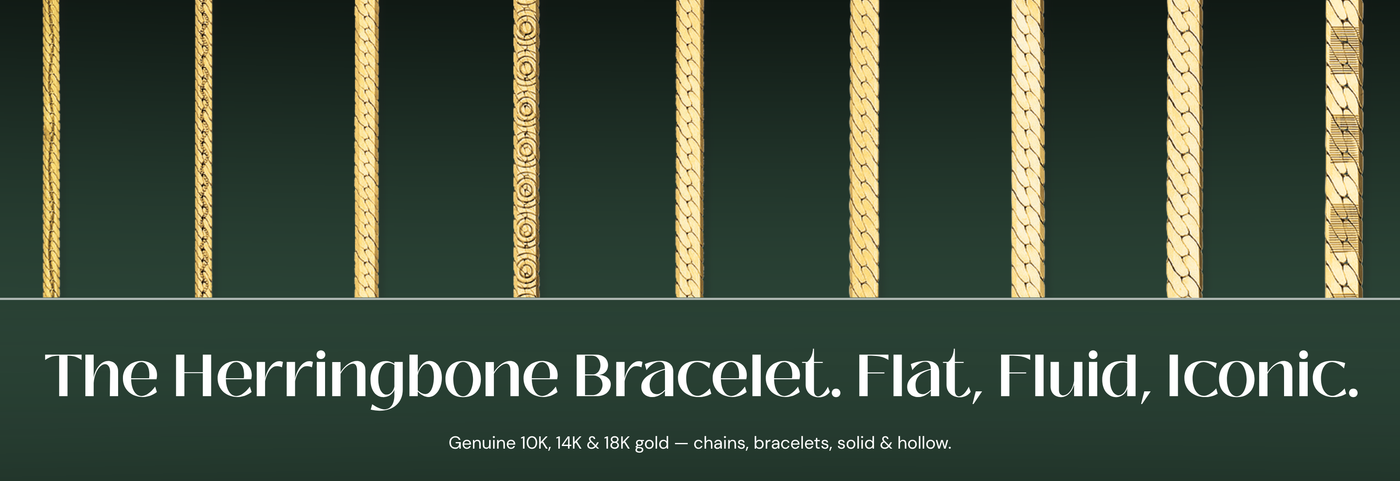
The herringbone bracelet uses a flat woven construction of angled links in a V-shaped zigzag pattern, producing a smooth, flat, wide surface that lies flush against the wrist. The flat surface reflects gold's warm color as a continuous even plane — one of the most mirror-like and color-expressive constructions in the gold bracelet catalog.

The flat woven surface drapes naturally and lies flush without raised link edges. Trade-off: herringbone links are more susceptible to kinking from sharp bending than rigid-link constructions. Do not fold or allow to kink — straightening a kinked herringbone can cause link damage. Store flat; avoid tight bending during wear.

Available from 7mm to 18mm. At 7mm to 10mm: confident statement appropriate for daily wear. At 12mm to 18mm: bold flat statement where the reflecting surface dominates. The flat construction makes wider herringbone bracelets more wearable than measurements alone suggest. Yellow and white gold available.

Comparar /3

A carregar...