FLASH SALE — Save 25% | Code: HAPPY25NOW

When it comes to gold, we guarantee the use of 100% real gold in all our gold products.

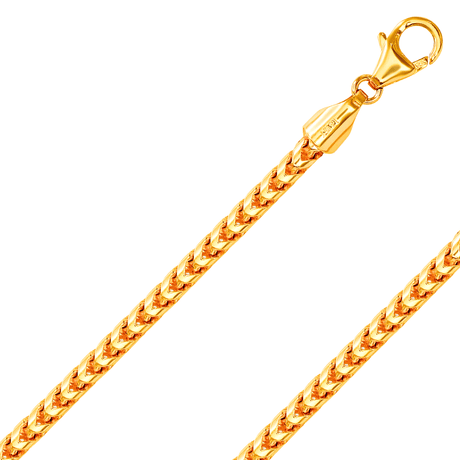
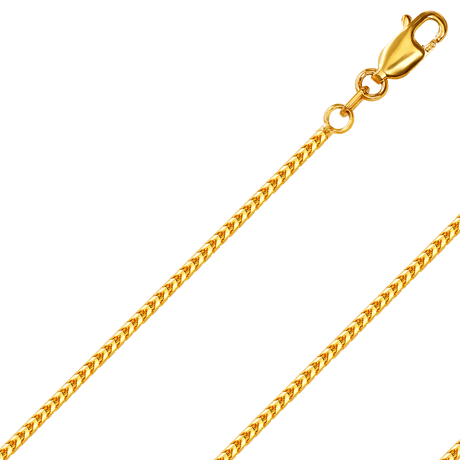
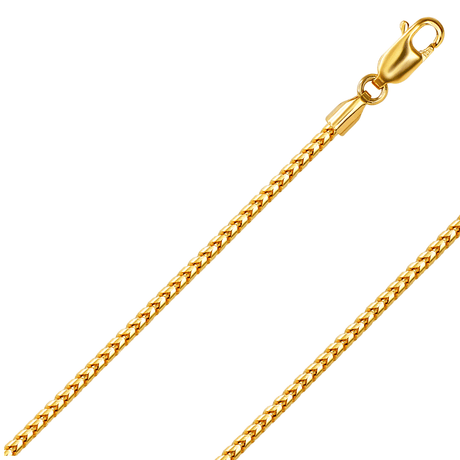
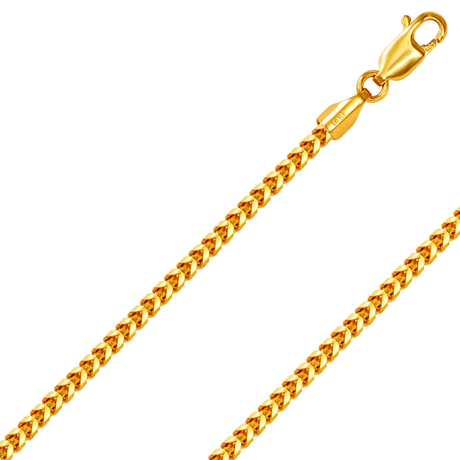
Italian Franco gold chain

Franco Gold Chain

Franco Gold Chains — The Strongest Chain Construction Available.

The Franco chain's V-shaped links are woven together in a four-sided pattern that distributes tension across all four sides of each link simultaneously. Standard oval-link chains have a single hinge point per link where stress concentrates — the Franco eliminates that weakness. At heavier widths where other chains have breaking points, the Franco holds.

Why the V-Link Structure Matters

A Cuban or Figaro chain carries the load through one contact point per link. The Franco's four-sided construction spreads that same load across four surfaces — making it structurally the most break-resistant chain style for daily wear at any width above 4mm.

How Franco Chains Wear Over Time

The squared profile means minor surface scratches diffuse into the chain's texture rather than marking a flat surface clearly. A well-worn Franco retains its appearance longer than flat chain styles under the same daily wear conditions.

View as

Understanding the Franco

What is a franco chain?

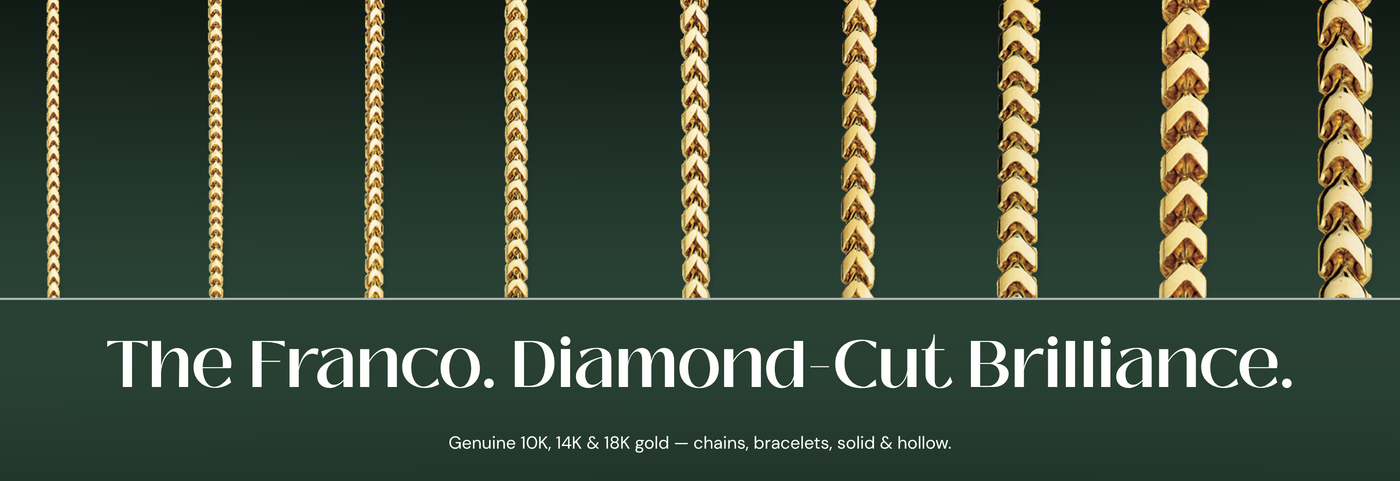
A chain built from small V-shaped links hooked together on four sides, so that the finished chain is square in section and carries a row of chevrons down each face. It belongs to the curb family, being made by locking two curb-type runs together at right angles.

Its distinguishing habits are a square section, a flexibility that is the same in every direction, and an inability to lock itself into a kink, since it has no flat face to fold across. In the hand it runs like a dense cord.

It is worn on its own, where its four faces give a double highlight, and as a pendant chain, where its square section keeps a pendant hanging straight. The listing states width, finish and construction.

How are the links of a franco chain joined?

By hooking. Each link is a length of wire bent into a V and closed at the top, and the point of each V passes through the opening of the one before it. A single run of such links makes a flat zigzag chain.

A franco takes two of those runs and weaves them together at a right angle, so that the Vs of the second run pass through the openings that the first run leaves at top and bottom. Every link ends up held by four neighbours, two in its own run and two in the other.

Nothing is soldered between links. The interlock is what holds the chain together, and it is tight enough that the links cannot rotate freely, which is why a franco looks rigid in a photograph and flexes freely on the neck.

Why is a franco chain square rather than flat?

Because it is built from two flat chains crossed at ninety degrees. Each run of V-links on its own would lie flat, with a wide face and a thin edge. Weaving a second run through the first at a right angle gives the chain a second wide face across its former edge.

The result has four equal faces, each carrying a row of chevrons, and a section that is a small square. There is no wide side and no narrow side, so the chain has no preferred orientation and shows the same surface from every angle.

The square section is the source of nearly everything else the style does: the double highlight, the even flexibility, the refusal to kink, and the way a pendant hangs square on it.

Does a franco chain kink?

Not in the way a flat chain does. A kink is a fold in which one link is forced over the back of another and held there by the pull of the chain, and it needs a flat chain with a broad face to ride over and a thin edge to catch on.

A franco has four equal faces and no edge. A fold in any direction opens the joints on the outside of the bend and closes them on the inside, and when the fold is released the joints settle back. The chain comes out of a pocket straight.

What a franco can suffer is a crush, where a hard blow bends individual links out of the square. That shows as a flat or twisted patch on one face, and it is a repair rather than something that can be shaken out.

Why is a franco chain so flexible for a chain of its weight?

Because it flexes at every joint and in every direction. A franco of ordinary width contains a great many small links, and each one moves a little against its four neighbours whenever the chain bends. The sum of all those small movements is a chain that pours through the fingers like a cord.

A flat chain of the same weight flexes only across its face, so half of the movements a wearer makes are resisted rather than absorbed, and the chain feels stiffer than its weight suggests. A franco resists nothing.

The interlock also spreads the weight evenly along the chain, so no part of it feels heavier than another. On the neck it settles into the curve of the collarbone and stays there without pulling to one side.

Does a franco chain turn over while it is worn?

No, and the reason is that it has nothing to turn over to. A flat chain lies face-out at the front and has to roll edge-on at the sides of the neck, so it turns twice on its way round. A franco is the same on all four faces.

Wherever the chain bends, it simply bends, and the surface presented to the viewer is the same before and after. The chevrons run continuously from the clasp round to the front and back again with no visible twist at the shoulders.

This also means a pendant on a franco is not turned by the chain. The bail rests on a face or a corner and stays there, and the pendant hangs as it was placed.

What is the difference between a diamond-cut franco and a plain one?

The surface, not the construction. Both are woven from the same V-links in the same way. A plain franco is polished after assembly, so each chevron on each face is a small rounded bright surface, and the chain gives a soft double highlight along the two faces that are turned to the light.

A diamond-cut franco is passed under a cutter after assembly, which slices a flat facet across the outer surface of every link on each face. The rounded highlights become sharp points, and the chain sparkles as those points catch the light one after another.

The facets sit on the outermost surfaces, which are also the surfaces that meet skin and clothing, so with years of wear they soften and the sparkle quietens. A plain franco changes less with wear because it had no edges to lose.

Will a pendant hang straight on a franco chain?

It will, and more reliably than on most chains, because the chain does not roll. A bail on a flat chain is turned whenever the chain turns edge-on; a bail on a franco rests on a face or a corner of the square and stays as it was placed.

The bail must clear the chain across its diagonal, which is a little more than the width stated on the listing. Once over, it slides freely along the chevrons, and the pendant finds the lowest point of the curve and sits square there.

The interlocked links share the pendant's pull among several joints rather than loading one, so a franco carries a pendant of some weight without strain. The chevrons beneath the bail take the wear over time, particularly if the bail is a close fit.

How does a jeweller shorten a franco chain?

By cutting, not by unhooking. Each link in a franco is held by four others, so no single link can be removed without freeing the ones around it. The jeweller cuts square across the chain at the required point, which releases the last complete set of links on each side of the cut.

Any partial links left loose at the cut are removed until both ends present a clean square face that will enter an end cap. The caps are then soldered on, or the original caps refitted, and the clasp attached.

Because the cut has to land on whole links, the length removed is rounded to the nearest complete set rather than to an exact measurement. The chain is normally shortened at the clasp end only, so the pattern along the rest of it is untouched.

What widths are franco chains made in?

From fine chains of around a millimetre and a half, which are almost always bought as pendant chains and read as a bright square thread, through the two and a half to four millimetre range that is worn on its own, up to heavy chains of six millimetres and more.

Wide francos are dense, because the square section packs a great deal of metal into the chain's length, and they are among the heaviest chains for their width. Hollow construction is sometimes used at the wider sizes to keep the weight wearable, and the listing states which.

The width on a listing is measured across one face of the square. Across the diagonal, which is the dimension a bail has to clear, the chain is a little wider than the stated figure.

About Franco Gold Chains

How a Franco Is Built and Why It Does Not Kink

The Franco chain's V-shaped link construction was developed specifically to handle heavier widths without the structural weakness that affects other chain patterns. Standard oval-link chains — Cuban, Figaro, Rope — all have a single hinge point per link where stress concentrates. At heavier widths, this creates a predictable breaking point. The Franco's four-sided construction distributes tension across all four sides of each link simultaneously, making it structurally resistant to the lateral forces that break other chains.

This is why the Franco became the preferred construction for chains in the 6mm+ range. At those widths, a Cuban or Figaro chain has enough weight that the hinge points are under constant stress. A Franco at the same width carries the load through four contact surfaces rather than one — genuinely more durable, not just visually bolder.

The Franco's squared profile also wears differently over time. Because it doesn't have flat surfaces the way a Cuban or herringbone does, minor surface scratches diffuse into the chain's texture and become less visible. A well-worn Franco retains its appearance longer than flatter chain styles under the same conditions.

Compare /3

Loading...