Free shipping on all orders over $75 in the United States

When it comes to gold, we guarantee the use of 100% real gold in all our gold products.

FLASH SALE— Save 25%

HAPPY25NOW
Italian 14K yellow gold bracelet

14K Yellow Gold Bracelet

14K Yellow Gold Bracelets — Cuban, Rope, Figaro, and More

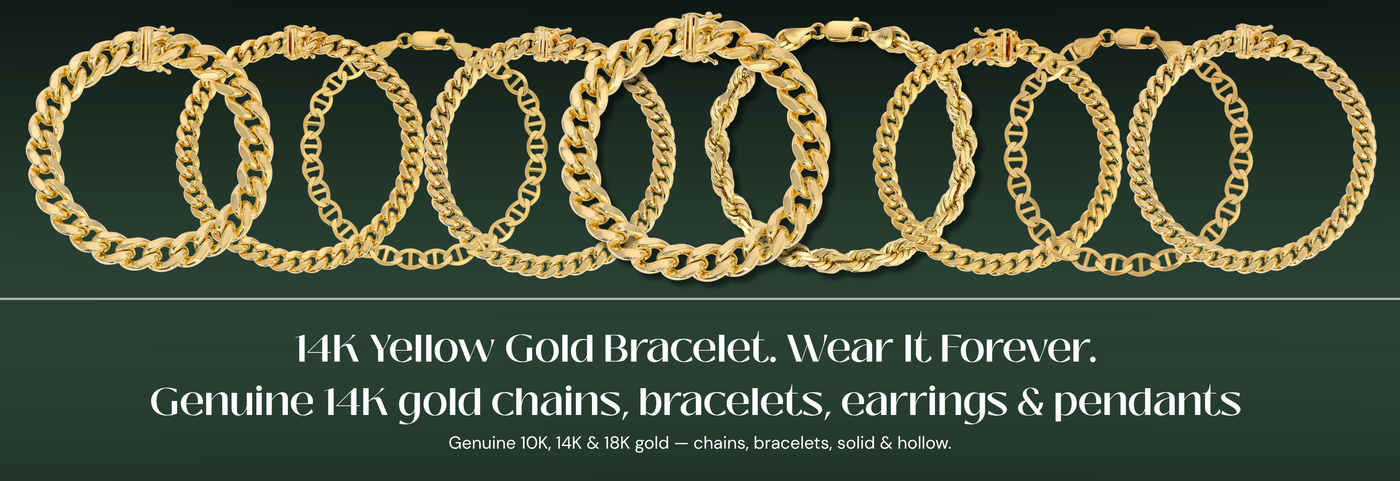
14K yellow gold bracelets in every major chain style — Cuban link, rope, Franco, Figaro, mariner, and more. 58.5% pure gold, made in Italy, karat-stamped, ships from the U.S. in 1–3 business days.

Why 14K for Bracelets

14K gold is the standard for fine gold bracelets in the U.S. for a practical reason: the alloy hardness (58.5% gold, 41.5% alloy metals) balances rich gold color with the durability that bracelet wear requires. Bracelets experience more friction against surfaces than necklaces. 18K is beautiful but slightly softer; 10K is harder but paler in color. 14K sits at the optimal point for both appearance and wearability.

Comparing Value

Every listing includes gram weight — the most reliable metric for comparing value across different 14K bracelet styles. Two bracelets that look similar in photographs can have substantially different prices based on whether they're hollow or solid, and how much gold they contain by weight.

View as

What does 14K mean in 14K yellow gold jewelry?

14K means the gold alloy is 14 parts pure gold out of 24 total parts — 58.3% pure gold by weight. The remaining 41.7% consists of alloying metals (copper, silver, zinc) that provide hardness, durability, and color characteristics. 14K is the most widely sold gold purity in the United States and represents the optimal balance between gold content, durability, and cost for everyday fine jewelry.

The karat system measures gold purity in 24ths: 24K is pure gold (too soft for most jewelry); 18K is 75% gold (excellent quality, used in fine European jewelry); 14K is 58.3% gold (the American standard for fine jewelry); 10K is 41.7% gold (minimum legal gold content in the US). Each karat level represents a different balance of gold richness versus durability — higher karat means more gold color and value, lower karat means greater hardness for detailed work.

The '14K' mark on a bracelet is your primary quality assurance: it confirms the piece meets the legal definition of gold jewelry in the United States. Look for '14K', '585', or '14KT' stamped on the clasp or a tag soldered to the bracelet. '585' is the European equivalent hallmark — it appears on Italian gold bracelets and means the same 58.5% gold purity as 14K.

What makes 14K yellow gold yellow in color?

The warm yellow color of 14K yellow gold comes from the specific combination of alloying metals used alongside pure gold. Pure gold is naturally a rich yellow color; 14K yellow gold maintains this yellow character by alloying pure gold primarily with silver and copper in proportions that preserve the warm yellow hue. The precise shade varies between manufacturers — Italian 14K yellow gold has a particularly rich, warm yellow tone associated with the copper-forward alloy formulations used in Arezzo and Vicenza.

Pure gold's natural yellow color is what makes it distinctive among metals — most metals are gray or white. The alloying process for 14K yellow gold requires careful proportioning: too much copper shifts the color toward rose gold; too much silver shifts it toward a cooler, paler yellow; the right balance produces the classic warm yellow associated with fine gold jewelry. Italian goldsmithing tradition has historically emphasized the richest possible yellow tone, which is why Italian 14K yellow gold has a distinctly warm, deep color.

The color permanence of 14K yellow gold is absolute — the yellow color is inherent to the alloy, not a surface treatment. Unlike gold-plated jewelry (which loses color when the plating wears) or white gold (which requires rhodium plating to maintain its white appearance), 14K yellow gold requires no surface treatment to maintain its color and will remain the same warm yellow regardless of age or wear.

What is the difference between 14K and 18K yellow gold?

14K yellow gold contains 58.3% pure gold; 18K yellow gold contains 75% pure gold. Both are genuine fine gold. The practical differences: 18K has a richer, deeper yellow color due to higher gold content; 14K is harder and more scratch-resistant due to higher alloy content; 18K is more expensive per gram due to higher gold content; 14K is the more practical choice for daily-wear bracelets; 18K is preferred for fine jewelry worn occasionally.

The durability difference matters most for bracelets, which contact surfaces constantly. 14K's higher alloy content makes it harder on the Vickers scale than 18K — 14K resists scratching better during the daily activities a bracelet is exposed to. 18K's higher gold content makes it richer in color and feel, and it has a softer quality that goldsmiths consider more workable for intricate detailing. For a bracelet worn daily, 14K's durability advantage is meaningful; for a fine bracelet worn for special occasions, 18K's richness is the preference.

Value consideration: 18K gold contains approximately 28% more pure gold per gram than 14K. At any gold spot price, an 18K bracelet of equivalent weight contains proportionally more gold value. However, 14K bracelets are typically built to equivalent or heavier gram weights for equivalent visual size, so the actual gold content difference per bracelet can vary. When comparing bracelets, compare gram weight and karat together to understand the relative gold content of each piece.

Is 14K yellow gold real gold?

Yes — 14K yellow gold is genuine gold by every legal, scientific, and commercial standard. It contains 58.3% pure gold (the element Au, atomic number 79) as part of a gold alloy. The United States Federal Trade Commission defines gold jewelry as any piece containing at least 10 parts per 24 of gold — 14K exceeds this standard significantly. The '14K' stamp is a legally required disclosure of gold content, not a marketing claim.

The confusion about whether karat gold is 'real' gold comes from unfamiliarity with alloys. An alloy is a metallic mixture — steel is an alloy of iron, carbon, and other elements, but no one questions whether steel is 'real iron.' Similarly, 14K yellow gold is a gold alloy — the gold is real, and the alloying metals improve its durability for practical jewelry use. The pure gold within 14K yellow gold is chemically identical to pure 24K gold.

What is NOT real gold: gold-plated jewelry (thin gold surface over a base metal core); gold-filled jewelry (heavier gold layer over a base metal, but still not solid gold throughout); gold-tone or gold-colored jewelry (no gold content); vermeil (gold plating over sterling silver). Real gold jewelry — 10K, 14K, 18K, 24K — is solid gold alloy throughout, with no base metal core. 14K yellow gold bracelets are solid 14K alloy throughout the entire piece.

Why is 14K yellow gold the most popular gold for bracelets in the US?

14K yellow gold dominates the US bracelet market because it optimally balances five consumer priorities: it's genuine fine gold (meeting the cultural and intrinsic value expectations associated with gold jewelry); it's durable (hard enough for daily bracelet wear); it's affordable relative to 18K (lower gold content = lower price per piece); it's widely available (most American jewelers stock primarily 14K); and it maintains its yellow color permanently without any replating or maintenance.

The bracelet-specific case for 14K: bracelets experience the highest mechanical stress of any jewelry form — they flex with every wrist movement, contact hard surfaces constantly, and are subjected to the chemicals of everyday life (soaps, lotions, cleaning products). 14K's alloying provides the hardness to resist the scratching and deformation that would affect softer, higher-karat gold more readily in this demanding wearing context.

The global comparison: the US standard is 14K; the European standard leans toward 18K; the Middle Eastern and Asian markets favor 22K and 24K. These preferences reflect different cultural valuations of gold purity versus practicality. Italian 14K yellow gold bracelets are specifically designed and manufactured for the American market — Italian goldsmithing quality applied to the 14K standard most American buyers prefer.

What styles of 14K yellow gold bracelets are available?

Major 14K yellow gold bracelet style categories: chain bracelets (link-based designs — curb, figaro, rope, cable, box chains in bracelet form); bangle bracelets (rigid, circular bracelets that slip over the wrist); tennis bracelets (continuous line of gemstones in individual settings); charm bracelets (chain with attached pendants/charms); cuff bracelets (open-ended rigid bracelets); and ID bracelets (rectangular plate with engraving surface, typically with a curb chain).

Each bracelet style has distinct wearing characteristics: chain bracelets flex freely and move with the wrist; bangles are rigid and can be stacked; tennis bracelets lie flat against the wrist with their stone line visible from above; charm bracelets jingle with movement and grow over time with added charms; cuffs are open-ended and adjustable; ID bracelets make a statement with the engraved plate as the design focus.

The Italian gold bracelet tradition is strongest in chain and bangle design: Italian chain manufacturing — centered in Arezzo — produces the world's finest gold chain bracelets, with the curb link, figaro, and rope styles refined over decades. Italian bangles in 14K yellow gold, particularly hollow tube bangles and diamond-cut bangles, represent another area of Italian goldsmithing excellence.

What is a 14K yellow gold bangle bracelet?

A bangle is a rigid, circular bracelet in a fixed diameter that is placed on the wrist by sliding it over the hand. Unlike chain bracelets with clasps, bangles have no opening mechanism — they're a complete circle sized to pass over the knuckles. 14K yellow gold bangles come in several constructions: solid (full 14K gold throughout, maximum durability and weight); hollow (14K gold shell over an empty interior, lightweight and larger-looking at lower gold cost); and diamond-cut (surface faceted to create maximum light reflection).

Bangle sizing works differently from chain bracelet sizing: a bangle must be large enough in diameter to slide over the wearer's widest knuckle, but small enough to sit comfortably on the wrist without sliding off constantly. Measure the widest part of your hand (across all four knuckles) and add approximately 3/8 inch to find the minimum bangle interior diameter. Most adult women wear bangles in 2.5 to 2.75 inch diameter; most adult men in 2.75 to 3 inch diameter.

Bangle stacking is one of the most popular bracelet-wearing styles: multiple bangles on one arm, worn together as a group, creating movement sound and layered visual impact. Stackable bangles are typically thinner (2–4mm width) to allow comfortable multiple-bangle wear. Italian 14K yellow gold bangles are particularly well-suited for stacking due to their precise circular form and consistent sizing.

What is a 14K yellow gold tennis bracelet?

A tennis bracelet is a flexible bracelet consisting of a continuous line of individually set gemstones (most commonly diamonds, but also sapphires, emeralds, or other stones) linked together by a delicate gold setting structure. Each stone is separately set in a prong, bezel, or channel setting and connected to the next stone by a small gold link. The entire bracelet lies flat against the wrist with the stones facing upward, creating a continuous shimmer around the wrist.

The name 'tennis bracelet' comes from a 1987 incident in which tennis player Chris Evert's diamond bracelet broke and fell off her wrist during a US Open match, causing the match to be paused while it was recovered. The incident popularized the bracelet style's common name. Before this, the style was called an 'eternity bracelet' or 'in-line bracelet.' 14K yellow gold tennis bracelets set with diamonds combine the warm yellow gold with the brilliance of white diamonds in a classic, timeless combination.

Tennis bracelet quality factors: stone quality (diamond color and clarity most important); setting security (each stone's prongs must be intact — inspect regularly); clasp security (tennis bracelets need box clasps with safety catches because the bracelet's flexibility means loss is possible if the clasp fails); and bracelet weight (heavier gold settings hold stones more securely long-term).

What is a 14K yellow gold charm bracelet?

A charm bracelet is a chain bracelet designed to carry small decorative pendants (charms) attached via jump rings or lobster-claw clips to the chain links. The charm bracelet serves as both jewelry and a personal collection — charms are accumulated over time to mark milestones, express interests, and receive as gifts. 14K yellow gold charm bracelets use a heavy enough curb or cable chain to support the combined weight of multiple charms without the chain links fatiguing.

The charm bracelet's distinctive appeal is its narrative quality: unlike other bracelet styles, the charm bracelet grows and changes over time. Each charm marks a moment — a graduation, a birth, a travel destination, a personal passion. A charm bracelet accumulated over 10 or 20 years tells the story of the wearer's life in miniature gold. This narrative quality makes charm bracelets among the most personally meaningful jewelry pieces.

Charm bracelet specifications for 14K yellow gold: the chain should be at least 1.5–2mm width to support charm weight; 7–7.5 inches is standard adult length for a charm bracelet (slightly looser than a fine chain bracelet to accommodate charm weight and movement); the chain should use a sturdy lobster claw or toggle clasp rated for the expected total weight of accumulated charms.

What is a 14K yellow gold ID bracelet?

An ID bracelet (identification bracelet) consists of a flat, rectangular plate — the ID plate — connected at each end to a chain or mesh bracelet. The plate's flat surface provides space for engraving: a name, initials, a significant date, a meaningful phrase, or a medical ID information. The ID bracelet has been a significant jewelry category since WWII, when soldiers wore ID bracelets with their service information, and the form transitioned into civilian wear as a personalized jewelry staple.

The engraving options for a 14K yellow gold ID bracelet: block letters (maximum clarity for medical ID use); script engraving (elegant, classic appearance for name or monogram); diamond-cut engraving (using a sharp tool to cut facets into the engraved letters, creating sparkle); and laser engraving (precise, highly detailed text and imagery). The plate's metal thickness determines how deeply the engraving can cut — thicker plates support deeper, more durable engraving.

ID bracelet sizing: the plate length determines the visual prominence of the bracelet. Standard adult ID plates range from 1.5 to 2 inches in length. Men's ID bracelets typically use wider, heavier plates (7–10mm wide) on heavier chain; women's ID bracelets use narrower plates (5–7mm wide) on finer chain. The total bracelet length should be measured to include the plate — an ID bracelet with a 1.5-inch plate requires a shorter chain length than a standard bracelet to achieve the same overall wrist circumference.

About 14K Yellow Gold Bracelets

Why 14K Is the Standard for Gold Bracelets

14K gold (58.5% pure gold) has become the standard for fine gold bracelets in the United States for a practical reason: it balances gold content with the durability requirements of daily bracelet wear. Pure gold (24K) is too soft for bracelets — the metal deforms under the friction and impact of regular wear against surfaces. 18K gold is beautiful but slightly softer than 14K and more susceptible to surface scratching with daily wear. 10K gold is harder and more durable but has a noticeably paler color. At 14K, the gold content is high enough for rich color and meaningful value, and the alloy content is high enough for the hardness that bracelets require.

The color of 14K yellow gold is what most people picture when they think of gold jewelry: warm, clearly gold-toned, distinct from the paler appearance of 10K. It's the standard reference point in American fine jewelry. 18K yellow gold is measurably richer and deeper in color — the difference is visible side-by-side but may not be immediately apparent in isolation. For bracelets, where color consistency matters less than for statement necklaces, 14K provides excellent visual quality at a lower price point than 18K.

Pricing in 14K gold bracelets reflects the actual gold content by weight. Two bracelets that look nearly identical in photographs can have substantially different prices if one is hollow and one is solid, or if one has significantly more gold weight per inch. When comparing prices between 14K bracelets, weight is the most reliable indicator of comparative value — a heavier bracelet at the same price point has more gold content. Most reputable gold jewelry listings include gram weight, which is the clearest metric for comparing value across different bracelet styles.

Compare /3

Loading...