Free shipping on all orders over $75 in the United States

When it comes to gold, we guarantee the use of 100% real gold in all our gold products.

FLASH SALE— Save 25%

HAPPY25NOW
Italian Singapore gold chain

Singapore Gold Chain

Singapore Gold Chains — Twisted Links, Constant Sparkle.

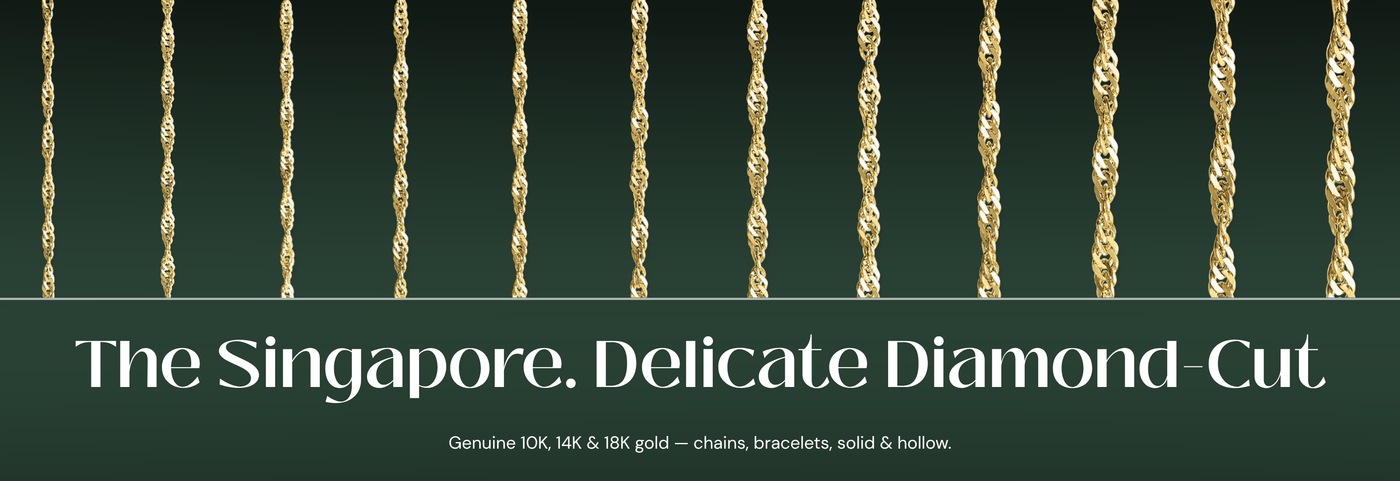
The Singapore chain is constructed from small twisted links arranged in a repeating diamond pattern. Each individual link is twisted before being connected, meaning every link presents multiple angled surfaces to incoming light simultaneously. The result is a chain that sparkles more continuously than most styles — the twisted construction minimizes the flat-face-dull positions that affect many chain styles.

How Singapore Links Are Formed

The diamond pattern formed by the twisted links gives the Singapore a distinctive texture that's clearly visible at medium widths (3–5mm). At narrower widths, the pattern reads as a fine, glittering cord. At wider widths, the individual link arrangement becomes clearly visible and the chain has a more structured, architectural appearance.

Singapore vs. Rope — Which Sparkles More?

Rope chains create a steady, rich shine from the continuous helix. Singapore chains create flash-points that move and shift with the chain's movement. Rope reads as richer; Singapore reads as livelier and more light-active. Which is preferable is a matter of taste.

View as

What is a Singapore gold chain?

A Singapore gold chain is a fine, delicate necklace made of small, twisted oval links woven in a distinctive interlocking pattern that creates a flat, ribbon-like surface with a brilliant, multi-directional shimmer. Its intricate woven construction gives it a texture unlike any other chain style.

The Singapore chain is constructed from pairs of oval links that are alternately twisted and connected in a flat weave pattern, creating a chain that is both visually complex and surprisingly lightweight. Unlike rope chains — which twist round links into a helical structure — or box chains — which connect square links end-to-end — the Singapore chain's links are flattened and woven so that the chain lies with a natural flat drape while still catching light from multiple angles. The result is a chain that has the sparkle of a rope chain but the flat drape of a box or herringbone chain: a unique optical quality that makes it one of the most popular styles for pendant necklaces worldwide.

Singapore gold chains are available in 10K, 14K, and 18K yellow, white, and rose gold, in widths typically ranging from 0.5mm to 3mm. Their delicate, flat structure and multi-angle light-catching make them one of the most versatile and enduring chain styles in fine jewelry.

How is a Singapore gold chain constructed?

A Singapore chain is constructed by weaving pairs of flat, oval links in alternating directions — each pair is crossed and connected to the next in a tight, flat pattern that locks the links together into a shimmering, ribbon-like surface.

The manufacturing process begins with fine oval links formed from gold wire. These links are then arranged in pairs and woven by alternating the direction of each pair before connection — one pair angled left, the next angled right — creating a continuous zigzag weave that, when viewed flat, produces a smooth, interlocking surface with a subtle herringbone-like pattern. Because each link sits at a slightly different angle to its neighbor, the chain surface contains many small facets that face different directions simultaneously, creating the characteristic multi-angle shimmer that Singapore chains are known for. Modern Singapore chains are primarily machine-made, though premium versions receive hand-finishing for surface quality.

The construction quality of a Singapore chain is visible in the evenness of its weave. Well-made Singapore chains have perfectly consistent link size and angle throughout their entire length — no variation in width, no gaps or bunched areas, no visible irregularities in the weave. When shopping, examine the chain under good lighting to verify consistency from clasp to clasp.

Why is it called a Singapore chain?

The Singapore chain takes its name from Singapore, which became a major global center for fine chain jewelry manufacturing in the 20th century. The style was either developed in or closely associated with Singaporean jewelry craftspeople who refined the distinctive woven-link construction to a high standard of quality.

Singapore became one of Asia's premier fine jewelry manufacturing hubs in the second half of the 20th century, particularly known for producing delicate, intricate chain styles that required skilled machine tooling and precise link formation. The woven-link chain that bears its name was one of the signature exports of this industry — widely adopted by international jewelry retailers and eventually becoming a standard fine jewelry chain style sold worldwide under the Singapore name. The style is now manufactured globally, but the Singapore name has remained as the standard designation for this specific woven-link chain construction.

Like many jewelry style names, 'Singapore chain' is now used generically rather than geographically — chains sold under this name are produced in Italy, the United States, Asia, and elsewhere. When evaluating a Singapore chain, what matters is the construction quality, karat purity, and gram weight — not the country of manufacture, though Italian-made Singapore chains are generally regarded as among the finest available.

What makes a Singapore chain unique compared to other chain styles?

A Singapore chain is unique for its flat, woven-link structure that combines two qualities rarely found together: the smooth, flat drape of a flat-link chain and the multi-angle, sparkle-producing facets of a three-dimensional chain. It catches light from many directions at once while lying completely flat against the skin.

Most chain styles sacrifice one quality for another: rope chains have brilliant multi-direction sparkle but are three-dimensional and rounded; box chains lie flat but have a limited, consistent shine from one angle; herringbone chains have a mirror-flat surface but reflect from only one plane. The Singapore chain threads this needle — its woven, flattened links create a surface with many small facets pointing in different directions, so the chain produces sparkle as the wearer moves, while the flat construction means it lies smoothly against the skin like a box or herringbone chain. This combination of flat drape and multi-angle shimmer makes Singapore chains especially prized as pendant chains — the chain provides visual interest without competing with the pendant.

The Singapore chain's fine, delicate scale is also distinctive: most Singapore chains are 1mm to 3mm wide, making them among the most slender visually acceptable fine gold chain styles available. At these widths, the woven-link construction maximizes sparkle per millimeter in a way that simpler chain styles cannot achieve at equivalent widths.

How does a Singapore chain compare to a rope chain?

A Singapore chain has a flat, woven-link structure that lies flat against the skin. A rope chain has a round, helical structure that is three-dimensional and sits above the skin. Both produce multi-angle sparkle, but Singapore chains are flatter and more delicate; rope chains are rounder and more visually substantial.

The fundamental difference is dimension: rope chains are round in cross-section — their helical link structure gives them a three-dimensional presence that rises off the skin slightly. Singapore chains are flat — their woven links create a surface that lies flush against the skin with minimal height. Both chains catch light from multiple angles due to their respective complex link structures, but they do so differently: the rope chain's round body scatters light in all directions at once; the Singapore chain's flat woven surface catches light primarily from above and at shallow angles, creating a shimmering effect especially visible when the chain is worn and the wearer is in motion. Singapore chains are also generally much finer in width than rope chains of comparable visual impact.

For pendant use, both Singapore and rope chains work well, but the Singapore chain's flat construction keeps it from rotating or twisting in the way a round rope chain can. For standalone wear without a pendant, rope chains create more visual mass at equivalent price points due to their greater width and dimensional presence. The right choice depends on whether you prioritize flat drape (Singapore) or visual mass and roundness (rope).

How does a Singapore chain compare to a box chain?

A Singapore chain has a woven, multi-faceted surface that produces sparkle from many angles. A box chain has uniform square links with a clean, mirror-flat surface that reflects from one angle at a time. Singapore chains shimmer; box chains gleam steadily. Both lie flat against the skin.

Both Singapore and box chains are flat chain styles, but their visual characters are very different. The box chain's square links create a geometric, architectural surface where each flat face reflects light consistently and steadily — it has a controlled, precise gleam. The Singapore chain's woven links create a surface with many small facets at varying angles — it produces a dynamic, changing shimmer as the wearer moves. Box chains are generally available in slightly wider widths (1mm to 4mm), while Singapore chains are often produced at very fine widths (0.5mm to 2mm) where their sparkle-per-millimeter ratio makes them highly effective. Box chains are also more durable than Singapore chains due to their rigid square link construction.

For pendant chains, both styles work well but offer different aesthetics: box chains provide a clean, modern look with geometric precision; Singapore chains provide a delicate, shimmering look with intricate visual texture. The box chain is the more neutral, versatile pendant chain; the Singapore chain adds more visual interest of its own.

How does a Singapore chain compare to a snake chain?

A Singapore chain has a flat, woven-link structure with multi-angle sparkle from its many faceted surfaces. A snake chain has a completely smooth, tubular surface with no visible links. Singapore chains have visible texture and shimmer; snake chains are seamless and reflect light as a single smooth surface.

Snake chains and Singapore chains are both fine, delicate chain styles popular for pendant use, but their construction and appearance are very different. The snake chain's smooth, seamless surface gives it a fluid, almost liquid appearance — it moves like a continuous band of metal with no visible structure. The Singapore chain's woven surface shows visible interlocking links when examined closely, giving it a more textural, intricate appearance. Both are flat and lie close to the skin, but the snake chain has a perfectly smooth surface while the Singapore chain's surface has the subtle visual complexity of its woven construction.

Both snake and Singapore chains are more delicate than link-based chains. Snake chains are especially fragile — once kinked, they often cannot be repaired. Singapore chains, while delicate, have slightly better resilience because their woven structure distributes stress across multiple link connections rather than concentrating it at a single point, as snake chains do. For pendant use on delicate jewelry, either style works beautifully, but Singapore chains are generally the more durable of the two.

How does a Singapore chain compare to a cable chain?

A Singapore chain has a flat, woven construction with multi-angle sparkle. A cable chain has simple, oval links connected alternately perpendicular to each other — the most basic chain structure. Singapore chains are more intricate and reflective; cable chains are simpler, plainer, and more utilitarian.

The cable chain is the most fundamental of all chain styles: oval links connected so each link alternates 90 degrees from the previous one, creating a simple, plain chain with a clean, understated look. It's the chain-link fence of fine jewelry — minimal, functional, and widely available. The Singapore chain, by contrast, has a complex woven structure that produces far more visual interest than the cable chain at equivalent widths. A Singapore chain looks more refined and sparkles more from its woven facets; a cable chain is simpler and more plainly obvious in its link structure.

Cable chains are the most affordable and widely available chain style; Singapore chains cost more due to the complexity of their link construction. For buyers who want the simplest pendant chain with no visual interest of its own, a cable chain suffices. For buyers who want a delicate pendant chain that adds a degree of sparkle and elegance, a Singapore chain is a significant step up in visual quality.

How does a Singapore chain compare to a Figaro chain?

A Singapore chain has a uniform woven-link structure with a consistent shimmer throughout. A Figaro chain has an alternating pattern of one long oval link and two or three shorter round links, creating a rhythmic, flat surface. Singapore chains are finer and more delicate; Figaro chains are bolder and more visually pattern-driven.

The Figaro chain's alternating long-short link pattern creates a flat, elegant surface with a distinctive rhythmic beat — the recurring contrast between the long oval link and short round links gives it an instantly recognizable Italian character. The Singapore chain's uniform woven pattern creates a very different visual effect: the consistency of the weave produces an even shimmer across the entire chain without the rhythmic variation of the Figaro. Singapore chains are generally much finer than Figaro chains — most Singapore chains are 0.5mm to 2mm wide, while Figaro chains are commonly 2mm to 7mm wide.

For pendant use on delicate jewelry, Singapore chains are generally the better choice — their fine width and shimmering surface complement small, delicate pendants without overpowering them. For standalone wear or pendants with a bolder look, the Figaro's wider proportions and distinctive pattern provide more visual presence. Both are classic styles with Italian heritage and enduring popularity.

What metals are used in Singapore gold chains?

Singapore gold chains are crafted from 10K, 14K, or 18K gold, alloyed with copper, silver, and sometimes zinc or palladium to achieve the hardness needed for the fine woven-link construction. The alloy blend determines the chain's color, durability, and karat purity.

Pure 24K gold is too soft to maintain the precise dimensions of the fine, flat links in a Singapore chain, so jewelers alloy it with harder metals. Yellow gold Singapore chains use copper and silver alloys that preserve the warm gold color while adding dimensional stability to the tiny woven links. White gold Singapore chains use nickel, palladium, or zinc alloys and are typically rhodium-plated — the Singapore chain's woven surface catches the bright rhodium finish from many angles simultaneously, giving white gold Singapore chains a particularly brilliant, icy appearance. Rose gold Singapore chains use a copper-heavy alloy that gives the tiny faceted links a warm, pinkish-gold tone that looks especially delicate and romantic at fine widths.

Yellow gold Singapore chains in 14K are the most widely sold, combining a rich warm color with good durability for a chain style that rewards regular cleaning and careful handling. White gold Singapore chains have a modern, high-contrast brilliance that suits contemporary jewelry aesthetics. Rose gold Singapore chains have grown significantly in popularity, particularly at very fine widths where the warm pink-gold color has a uniquely delicate quality.

About Singapore Gold Chains

The Chain Built to Catch Light from Every Angle

The Singapore chain gets its name from its origin in Southeast Asian goldsmithing, where the style was developed and refined before becoming part of the Italian fine jewelry tradition. Its construction uses small twisted links arranged in a diamond pattern, with each link angled so that multiple facets always face outward. Unlike rope chains, which spiral in one direction, or box chains, which face four flat directions, the Singapore chain's links face in overlapping directions simultaneously — meaning it catches light at nearly every angle.

This omnidirectional sparkle is what distinguishes the Singapore from most other chain styles. A rope chain sparkles when light hits the twist; a box chain flashes when a face is directly illuminated. The Singapore chain maintains continuous, lower-intensity sparkle across the full chain surface regardless of lighting angle — it doesn't flash as intensely as a wide rope chain in direct light, but it reads as consistently bright across all conditions.

At 1–2mm, the Singapore chain is extremely fine and the link pattern is nearly invisible — it reads as a glittering thread. At 3–4mm the diamond pattern becomes clearly visible and adds texture to the sparkle. The Singapore is rarely made at widths above 4–5mm because the link pattern at very wide widths begins to look heavy rather than delicate — its visual value is in the detail of the faceted links, not in bold scale.

Compare /3

Loading...