Envío gratis en todos los pedidos superiores a $75 en los Estados Unidos

Cuando se trata de oro, garantizamos el uso de oro 100% real en todos nuestros productos de oro.

FLASH SALE— Save 25%

HAPPY25NOW
Italian 14K yellow gold Figaro chains

Cadena Fígaro de oro amarillo de 14 quilates

Cadena Fígaro de oro amarillo de 14 quilates
Ver como

What is a figaro chain?

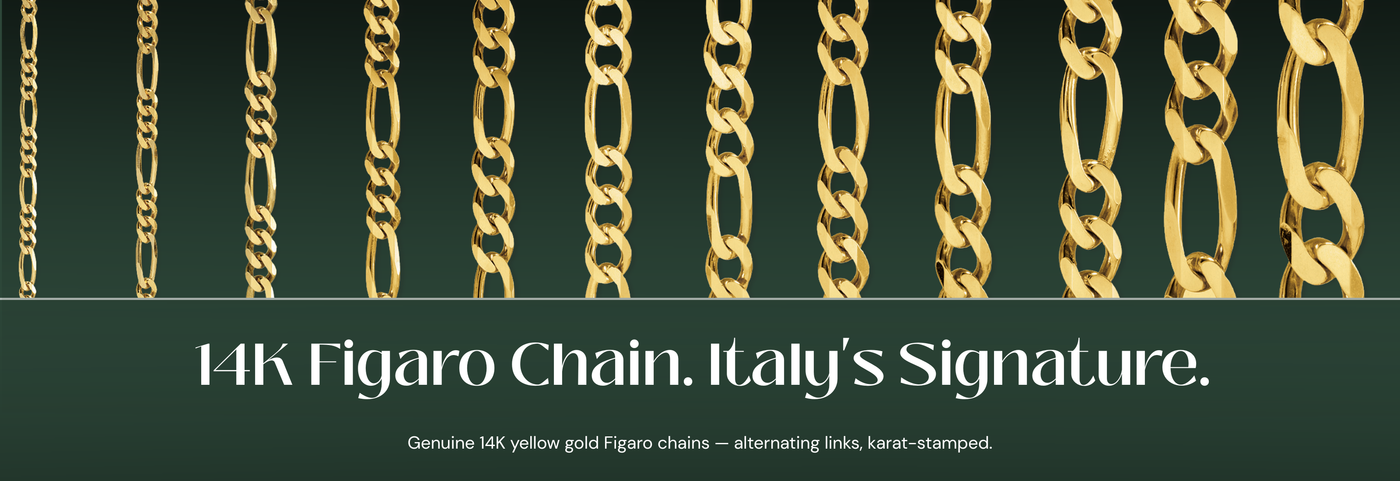
A figaro chain is a gold necklace or bracelet featuring an alternating link pattern — typically one elongated oval or rectangular link followed by two or three smaller round links, repeating continuously along the chain's length. This rhythmic long-short-short sequence gives the figaro its instantly recognizable visual character. The pattern creates a flat profile that lies cleanly against the skin and catches light differently along the elongated links versus the shorter ones, producing subtle visual dimension.

The figaro chain pattern is one of the oldest and most widely recognized link styles in fine gold jewelry. The elongated links are called 'long links' or 'bar links,' and the shorter connecting links are called 'short links' or 'round links.' The ratio of long to short links can vary — a classic figaro uses one long link to three short links (1:3 pattern), while other variations use 1:2 or 1:1 proportions, creating different visual rhythms. The chain is always flat in profile, which is a defining structural characteristic.

Figaro chains are available in necklace lengths (16–30 inches) and bracelet lengths (7–8 inches) for both men and women, in widths from 1.5mm (delicate) to 7mm+ (statement). In 14K yellow gold, a figaro chain is one of the most classic and enduring fine jewelry purchases — it works equally well as a standalone neck chain, as a pendant chain, and as a bracelet, making it among the most versatile gold chain styles commercially available.

What is the origin of the figaro chain pattern?

The figaro chain originated in Italy, with its name believed to derive from the opera 'The Marriage of Figaro' by Mozart, which was extremely popular in Italy during the 19th century. The chain pattern became strongly associated with Italian goldsmithing traditions, particularly in the Arezzo and Vicenza regions, which have been the centers of Italian gold chain production for generations. The figaro is one of the signature exports of Italian fine jewelry craft to global markets.

The figaro pattern's specific origin in Italian goldsmithing reflects the broader tradition of named chain patterns that emerged from Italian workshops during the 18th and 19th centuries. Italian chain-making guilds developed distinctive link sequences as trademark patterns, and the figaro — with its immediately recognizable long-short rhythm — became one of the most commercially successful. It arrived in the U.S. fine jewelry market in the late 19th and early 20th centuries through Italian immigrant jewelers and rapidly became one of the standard commercial chain patterns.

Today, figaro chains remain one of the top-selling gold chain styles globally, and the highest quality figaro chains are still manufactured in Italy — identifiable by the three-mark Italian hallmarking system on the clasp. Italian figaro chains set the benchmark for link uniformity, solder quality, and surface finish against which other origins are measured. When purchasing a 14K yellow gold figaro chain, 'Made in Italy' designation with verified hallmarks confirms both origin and craft tradition.

What makes a figaro chain different from other gold chains?

The figaro chain's defining feature is its alternating link pattern — one long link followed by two or three short links, repeating throughout the chain. This sets it apart from uniform-link chains like cable chains (all links the same size), rope chains (twisted wire construction), Cuban link chains (interlocking flat oval links with beveled edges), and box chains (square-profile links). The figaro's alternating rhythm creates visual interest that uniform chains lack at similar widths.

Structurally, the figaro chain is a flat-profile chain, meaning it lies flush against the skin rather than sitting with dimension above it (as rope chains do) or curving with dimensional links (as Cuban link chains do). This flat profile makes the figaro an excellent pendant chain — it lies cleanly under a pendant without bunching, and its flat surface keeps the pendant oriented correctly. The elongated links also create natural stop points for pendants that prevents the pendant from traveling along the chain.

Aesthetically, the figaro occupies a distinctive visual space: more interesting than a plain cable chain, less bold than a Cuban link, with more traditional Italian character than a box or herringbone chain. It reads as classic, timeless, and recognizably Italian fine jewelry — the chain style most associated with traditional gold jewelry gifting traditions in the U.S. and European markets. For men's and women's gold chains, the figaro is the definition of a 'classic' choice.

What does '14K yellow gold figaro chain' mean?

A '14K yellow gold figaro chain' is a figaro-pattern gold chain made from 14-karat yellow gold alloy. '14K' means the gold content is 14 parts pure gold out of 24 parts total alloy — 58.5% pure gold. The remaining 41.5% consists of other metals (primarily silver and copper) added to increase hardness and durability. 'Yellow gold' specifies the alloy composition produces the classic warm yellow gold color. 'Figaro' specifies the alternating long-short link pattern.

The three components together define exactly what the piece is: the karat grade determines gold content and price per gram; the gold color designation indicates the alloy composition (yellow gold uses silver and copper as primary alloying metals, while white gold uses palladium or nickel, and rose gold uses a higher copper ratio); and the chain style describes the link pattern. A 14K yellow gold figaro chain contains more gold and has a richer gold color than a 10K version, and costs more per gram than a 10K equivalent but less than an 18K version.

When comparing figaro chains across retailers, ensure you are comparing the same specifications: karat grade (10K, 14K, or 18K), metal color (yellow, white, or rose), width in millimeters, and length in inches. Two chains described as '14K yellow gold figaro' may differ substantially in width (2mm vs. 5mm), length (18 inches vs. 24 inches), and gram weight — all of which affect price and visual character. Always request gram weight in writing; it is the primary determinant of a chain's gold content value.

Is a figaro chain suitable for both men and women?

Yes — the figaro chain is one of the most gender-neutral gold chain styles commercially available. It is sold and worn by both men and women globally, with the primary difference being width and length. Men's figaro chains typically run 3–7mm wide at 20–24 inches, producing a more substantial, visible presence appropriate for men's jewelry scale. Women's figaro chains typically run 1.5–4mm wide at 16–20 inches, producing a refined, elegant look appropriate for women's fine jewelry scale.

The figaro pattern itself is inherently gender-neutral — neither delicate enough to read as exclusively feminine nor bold enough to read as exclusively masculine. This versatility has made it one of the standard choices for unisex fine gold jewelry gifting, class rings chains, religious medal and cross pendant chains, and ID bracelet chains for generations. In the U.S. fine jewelry market, figaro chains are consistently among the top-selling styles across both men's and women's categories.

For men seeking a figaro chain: 3–5mm width at 20–24 inches is the standard men's range. A 3mm figaro in 14K at 22 inches is refined and professional; a 5mm figaro at 20 inches is a visible statement piece. For women: 1.5–3mm at 16–18 inches covers the full range from delicate to statement. Couples who want matching jewelry often choose figaro chains in matching link patterns at different widths — the same link sequence reads consistently across scale differences.

What are the different figaro chain link patterns?

Figaro chains vary primarily in the ratio of long links to short links. The most common patterns are: 1:2 figaro (one long link to two short links), 1:3 figaro (one long link to three short links), and 1:1 figaro (alternating single long and single short links, sometimes called 'figaro romano'). Each ratio creates a different visual rhythm — the 1:2 pattern has the most frequent long links and appears boldest; the 1:3 pattern has the most balanced rhythm; the 1:1 is the most uniform and consistent.

Beyond the link ratio, figaro chains also vary in the shape and proportion of the long link. Standard figaro chains have an elongated oval or rectangular long link approximately 3–5 times the width of the short links. Some variations have wider, flatter long links (sometimes called 'flat figaro' or 'figaro broad link') that produce a more pronounced contrast with the shorter round links. The link surfaces may be plain (smooth polished gold), diamond-cut (faceted surfaces for additional sparkle), or textured (brushed or hammered).

When selecting a figaro chain pattern, consider visual effect: 1:3 is the most classically balanced and the most widely recognized as 'figaro.' Diamond-cut figaro chains add sparkle to the elongated link surfaces — each facet cut by diamond-tipped tools catches light at a different angle, producing significantly more brilliance than a plain figaro of the same width. Diamond-cut figaro chains in 14K yellow gold are among the most visually impactful gold chains available at women's and men's widths.

What is a diamond-cut figaro chain?

A diamond-cut figaro chain is a figaro-pattern chain where the surfaces of the links — particularly the elongated links — have been cut with additional flat facets using diamond-tipped cutting tools. These facets are not actual diamonds; 'diamond-cut' refers to the cutting process and the resulting faceted surface. Each facet is a precisely angled flat surface that reflects light in a different direction, creating a sparkle effect that plain polished links cannot produce. Diamond-cut figaro chains have significantly more visual impact per gram than plain figaro chains.

The diamond-cutting process is applied after the chain links are formed. A rotating diamond-tipped cutting wheel is passed over the link surfaces at calculated angles, removing thin layers of gold and creating flat faceted surfaces. On figaro chains, the diamond cutting is most commonly applied to the elongated links — the faces and edges of the long links are faceted, creating high-contrast bright-and-shadow patterns. The short links may be plain or also faceted, depending on the manufacturer.

Choosing between plain and diamond-cut figaro: plain figaro chains have a classic, warm glow — the polished curved surfaces diffuse light evenly in all directions. Diamond-cut figaro chains produce directional sparkle — bright flashes at specific angles, particularly in motion. For everyday wear, diamond-cut figaro chains appear 'brighter' and more eye-catching at a given width and gram weight. At fine gauges (2–3mm), diamond cutting dramatically increases visual impact — a 2mm diamond-cut figaro in 14K yellow gold appears more substantial than a plain 3mm chain at similar gram weight.

What widths do figaro chains come in?

Figaro chains are commercially available in widths from approximately 1.5mm (very fine, delicate women's gauge) to 10mm+ (very heavy men's statement gauge). The most popular retail widths are: 2mm (fine women's), 3mm (standard women's or slim men's), 4mm (medium men's or bold women's), 5mm (standard men's), 6mm (substantial men's statement), and 7mm (bold men's). Width describes the measurement across the chain at its widest point — on a figaro, this is typically measured across the elongated links.

Width selection significantly affects both appearance and gram weight (and therefore price). A figaro chain's gram weight scales roughly with the square of the width — doubling the width roughly quadruples the gram weight for a given length and link style. A 2mm figaro at 18 inches might weigh 2–4 grams; a 4mm figaro at 18 inches might weigh 8–14 grams; a 6mm figaro at 18 inches might weigh 15–25 grams. These gram weight differences represent proportional differences in pure gold content and therefore price.

Practical width guide: 1.5–2mm figaro is ideal for women's delicate everyday jewelry and as a pendant chain for small to medium pendants. 3–4mm is versatile for both women's statement and men's refined jewelry; this range is the most popular across genders. 5–6mm is solidly men's territory — clearly visible and substantial without being extreme. 7mm+ is a bold men's statement piece appropriate for men who want their gold chain to be the most visible element of their look. At any width, 14K yellow gold construction delivers excellent visual richness.

What lengths are available for figaro chains?

Figaro chain necklaces are available in standard lengths from 16 inches to 30 inches, with 18, 20, 22, and 24 inches being the most commonly stocked retail sizes. For women, 16 and 18 inches are the most popular — they sit at and just below the collarbone, the most flattering position for most necklines. For men, 20–24 inches are standard — they fall to the upper and mid-chest area, appropriate for men's proportions and typical men's jewelry styling contexts.

Length selection should consider both body proportions and intended use. A pendant chain should be long enough that the pendant rests at the desired position on the chest. A cross or religious medal on a 20-inch chain falls to the upper chest — clearly visible in open collar contexts. On a 24-inch chain, it falls to the mid-chest — more relaxed and casual in effect. For pendant-free chains worn as decorative necklaces, the chain length determines whether the look is choker-adjacent (16 inches), collarbone (18 inches), or chest-dropping (20–24 inches).

Figaro chain bracelets are available in standard lengths of 7 and 7.5 inches for women and 8 and 8.5 inches for men. Some retailers offer 6.5-inch sizes for smaller wrists. For bracelets, measure your wrist at the wrist bone and add 0.5 inch for a close fit or 0.75–1 inch for a comfortable looser fit. Figaro bracelets in 14K yellow gold at 3–5mm width and 7–8 inches combine classic elegance with the excellent gold content of 14K construction.

What is the difference between a flat figaro chain and a round figaro chain?

The distinction between flat and round figaro chains refers to the cross-sectional profile of the links. A flat figaro chain uses links where both the long and short links are flat — the link wire has been pressed into a flat, ribbon-like profile. This creates a chain that lies very flat against the skin with a smooth, broad surface on the front face. A round figaro chain uses links made from round-section wire — the links have a round or oval cross-section and therefore sit with slightly more dimension off the skin.

Flat figaro chains have a wider visual surface relative to their wire diameter — a 4mm flat figaro appears broader than a 4mm round figaro because the flat profile presents the maximum width to the front. Flat figaro chains are also better pendant chains — their flat front surface holds pendants in correct orientation and prevents the pendant from rotating or flipping behind the chain. Diamond cutting is more effectively applied to flat figaro links, where the flat surfaces provide more area for faceting.

For pendant use: flat figaro chains are the preferred choice. For standalone necklaces: both flat and round figaro styles are appropriate, with round-link figaro chains having a slightly more dimensional, substantial feel on the chest. The majority of commercial figaro chains sold in the U.S. are flat profile — this is the 'standard' figaro construction. If a retailer doesn't specify, the chain is most likely flat. Round-profile figaro chains are less common and often described specifically as 'round figaro' or 'figaro round link' in product descriptions.

About 14K Yellow Gold Figaro Chains

14K Yellow Gold Figaro Chain: Italy's Alternating Pattern in Fine Gold

The Figaro pattern — alternating short round links and longer oval links — originated in Italian chain making and remains one of the most recognized link styles in fine gold jewelry. The alternating pattern adds visual rhythm to the chain surface, making the Figaro more interesting to the eye than uniform-link chains while remaining less aggressive than bold styles like Cuban or rope.

Standard Figaro uses a 3:1 ratio of short to long links. Elongated Figaro variations increase the length of the oval link, producing more pronounced contrast between the pattern elements. In 14K yellow gold, the warm color and alternating surface geometry create a piece that works well in formal and casual contexts alike.

Figaro chains in the 3mm to 5mm range are versatile enough to function as both pendant chains and standalone necklaces. The pattern provides enough visual interest at 3mm to wear solo, while the individual link surfaces are large enough to support a pendant bail without looking overloaded. This dual functionality makes Figaro one of the most practical 14K yellow gold chain choices.

Comparar /3

Cargando...