Envío gratis en todos los pedidos superiores a $75 en los Estados Unidos

Cuando se trata de oro, garantizamos el uso de oro 100% real en todos nuestros productos de oro.

FLASH SALE— Save 25%

HAPPY25NOW
Italian 14K yellow gold rope chains with a diamond-cut twist

Cadena de cuerda de oro amarillo de 14 quilates

Cadena de cuerda de oro amarillo de 14 quilates
Ver como

What is a rope chain?

A rope chain is a gold necklace or bracelet constructed from a series of small oval or round links connected and twisted together in a helical pattern that closely resembles the visual appearance of twisted rope or cable. Each segment of a rope chain consists of multiple individual links interlocked at opposing angles, creating a continuous spiral that gives the chain its characteristic texture — small faceted surfaces that catch light from multiple angles simultaneously, producing constant sparkle as the chain moves.

The rope chain construction is fundamentally different from flat-link chains (cable, figaro, curb). While flat-link chains use individual links that open and close, rope chains use interlocking link segments twisted into a spiral — a more complex manufacturing process that produces a chain with a rounded, dimensional cross-section rather than a flat profile. The result is a chain that sits with visible texture off the skin and produces more light reflection per millimeter of width than any comparably sized flat chain.

Rope chains in 14K yellow gold are among the highest-selling fine gold chains globally — prized for their combination of visual sparkle, classic style, and substantial feel on the neck or wrist. They are equally appropriate for standalone wear and pendant chains, though at widths of 3mm or more they have enough presence to be worn without a pendant as a statement piece.

How is a rope chain made?

A rope chain is constructed through a specialized link-twisting process that creates the characteristic rope-like spiral. The manufacturing process begins with individual small links — typically oval or round wire loops — that are connected in pairs at alternating angles. Each pair of links is then connected to the next pair at the opposite angle, and so on down the chain's length. The resulting structure is a continuous helical linkage where adjacent link pairs oppose each other angularly, producing the twisted rope visual effect.

Italian-made rope chains are produced on specialized chain-making machines that automate the link-twisting and connection process with extraordinary precision. The consistency of link size, twist angle, and connection quality produced by modern Italian chain-making equipment far exceeds what manual production can achieve. The machines create the rope structure, then the chain passes through several quality-control stations — link uniformity inspection, solder join quality verification, and surface finishing — before final inspection and clasp attachment.

The quality of a rope chain's construction is visible in its surface appearance. A well-made rope chain has consistent, uniform links throughout its length — the spiral pattern runs evenly from clasp to clasp with no irregular links, kinks, or variations in the twist. Poorly constructed rope chains show link size variations, uneven twist, and irregular solder joins at the connection points. Italian manufacturing sets the benchmark for rope chain construction quality globally.

What does '14K yellow gold rope chain' mean?

A '14K yellow gold rope chain' is a rope-pattern chain constructed from 14-karat yellow gold alloy. '14K' specifies the gold purity — 14 parts pure gold out of 24 parts total alloy, equaling 58.5% pure gold content. The remaining 41.5% consists of alloying metals, primarily silver and copper, which provide the hardness and structural integrity that pure gold lacks. 'Yellow gold' indicates the alloy composition produces the classic warm gold color. 'Rope chain' specifies the helical link construction.

The three elements together define exactly what the piece is. The karat grade (14K) determines the gold content and baseline value per gram — a 14K rope chain contains 58.5% pure gold, which is recoverable at gold market prices through any gold buyer. The color designation (yellow gold) distinguishes it from white gold (which uses palladium or nickel alloying) and rose gold (which uses a higher copper ratio). The chain style (rope) describes the specific twisted-link construction that gives the chain its dimensional, sparkling character.

When shopping for a 14K yellow gold rope chain, the critical specification is gram weight — request the exact weight in writing before purchasing. Rope chains with the same described width and length can vary substantially in gram weight depending on construction. A heavier chain at a given width indicates thicker link wire and more gold content per unit length. Always compare gram weight, not just visual width or length, when evaluating competing offerings.

Why is the rope chain one of the most popular gold chains?

The rope chain's enduring popularity stems from three properties that work together exceptionally well: sparkle, versatility, and durability. The twisted-link construction produces more light reflection per millimeter of width than any flat-link chain style — the multiple small faceted link surfaces catch and reflect light from every angle simultaneously, creating continuous sparkle as the chain moves. This makes rope chains appear more brilliant and eye-catching than comparably sized cable, figaro, or curb chains.

Versatility adds to the appeal: a rope chain works equally well as a standalone necklace statement piece (at widths of 3mm or more), as a pendant chain (at widths of 1.5–3mm), and as a bracelet (at 3–5mm widths). The twisted construction also makes rope chains one of the most structurally sound chain styles — the interlocked helical links distribute stress across the full chain structure rather than concentrating it at individual link connection points, making rope chains among the most break-resistant of all fine gold chain styles.

Culturally, the rope chain has remained a consistent fine jewelry staple across decades of jewelry trend cycles. It was prominent in the 1980s gold chain era, maintained popularity through minimalist jewelry trends at finer gauges, and continues as a consistent top-seller in both men's and women's fine jewelry. The rope chain's combination of Italian craftsmanship heritage, visual impact, and durability makes it one of the safest gold chain purchases for buyers seeking lasting value.

What makes a rope chain different from other gold chains?

The rope chain differs from all other major gold chain styles in its construction method and resulting visual character. Unlike flat-link chains (cable, figaro, curb, box) that use individual links connected at single points, the rope chain uses pairs of links twisted in alternating directions and interlocked in a continuous helical structure. This creates a chain with a rounded, dimensional cross-section that sits with visible height above the skin — the chain has physical dimension, not just visual width.

The construction difference produces a fundamental visual difference: a rope chain produces dramatically more light reflection per unit width than any flat-link chain. Every link segment presents multiple small faceted surfaces at slightly different angles, meaning at any moment of viewing, different segments are catching and reflecting light toward the viewer. This creates the rope chain's signature sparkle effect — a continuous shimmer that intensifies as the chain moves. A 2mm rope chain reflects more light than a 3mm cable or figaro chain.

Rope chains also feel different to wear — the dimensional construction gives them a satisfying weight and texture against the skin that flat chains don't produce. The helical structure is also more inherently break-resistant than flat-link chains of similar weight: while a figaro or cable chain concentrates stress at individual solder joins, the rope chain distributes tension across its entire helical structure. This makes rope chains ideal for both standalone wear and pendant use, particularly for heavier pendants where chain strength is a consideration.

What are the different types of rope chain?

Rope chains vary primarily in the size and configuration of the twist — the number of links per spiral segment and the tightness of the helical twist determine the chain's visual texture density. Standard rope chains (also called 'diamond-cut rope chains') have the links cut with facets after twisting, producing maximum light reflection. Smooth rope chains (less common) have polished, unfaceted links that produce a softer overall glow rather than directional sparkle. Solid rope chains use fully solid 14K wire throughout; hollow rope chains (less desirable) use tubing.

Beyond standard and diamond-cut, rope chains also vary in link diameter (which affects how dense or open the twist appears) and twist direction (left-hand or right-hand twist — both are aesthetically equivalent but cannot be joined end-to-end without a twist-direction match). Some rope chains are produced with a looser, more open spiral that makes the individual links more visible; others use a tight, compact spiral where the individual links merge visually into a continuous textured surface. The latter is more common at finer gauges.

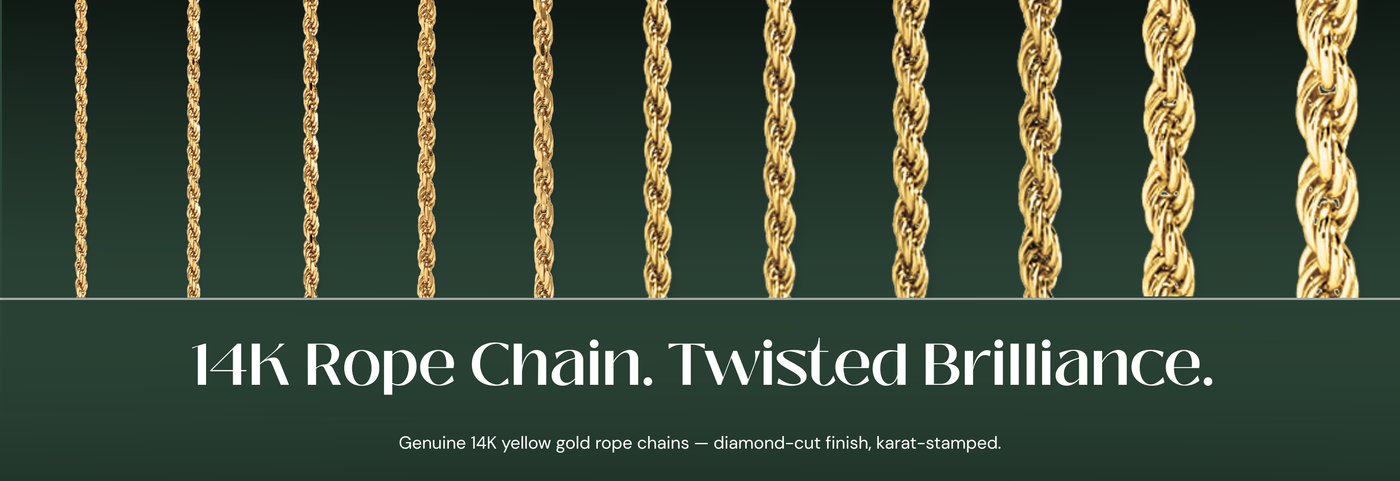
Width is the most commercially significant variation: 1.5mm for very delicate women's gauge, 2mm for standard women's pendant chains, 3mm for women's statement or slim men's, 4–5mm for men's standard, 6–8mm for men's bold statement. A 14K yellow gold rope chain at 3mm or wider worn without a pendant reads as a classic, high-presence fine jewelry statement; at 1.5–2mm it reads as a refined pendant chain. Diamond-cut construction is standard for most commercial rope chains and significantly increases visual impact at all widths.

What is a diamond-cut rope chain?

A diamond-cut rope chain is a rope chain where additional facets have been cut into the surfaces of the links using diamond-tipped cutting tools after the chain's rope structure is formed. These facets are not actual diamonds — 'diamond-cut' refers to the cutting process, where rotating diamond-tipped wheels are applied to the link surfaces at precise angles to remove thin layers of gold and create flat, polished facets. Each additional facet is a new flat surface that reflects light in a different direction, dramatically increasing the chain's total light output.

On a rope chain, diamond cutting is particularly effective because the twisted construction already presents multiple link surfaces at different angles. Diamond cutting adds additional facets to those surfaces, multiplying the number of light-reflecting planes per unit length. The result is a chain that produces significantly more sparkle than a plain (non-diamond-cut) rope chain of identical width and construction. At fine widths (1.5–2mm), a diamond-cut rope chain appears substantially more brilliant than its size would suggest.

Diamond-cut rope chains are the commercial standard — the vast majority of 14K yellow gold rope chains sold in the U.S. fine jewelry market are diamond-cut. If a chain is described simply as a '14K yellow gold rope chain' without further specification, it is almost certainly diamond-cut. Non-diamond-cut rope chains are sometimes described as 'smooth rope chains' or 'polished rope chains' — they are less common and produce a softer, more diffused glow rather than the directional sparkle that makes rope chains distinctive.

What widths do rope chains come in?

Rope chains are commercially available in widths from approximately 1mm (extremely fine, rarely stocked) to 12mm+ (very heavy men's statement gauge). The most widely stocked retail widths are: 1.5mm (women's fine/delicate), 2mm (women's standard pendant chain), 3mm (women's statement or slim men's), 4mm (men's or bold women's), 5mm (men's standard), 6mm (men's substantial), 7mm (men's bold statement), and 8mm+ (men's very bold). Width is measured at the chain's widest point across the twist.

Because rope chains have a rounded, dimensional cross-section, the 'width' measurement represents the chain's diameter — the chain is approximately as tall as it is wide when sitting on a flat surface. This means a 4mm rope chain appears more substantial than a 4mm flat figaro chain, because the rope chain presents its full 4mm dimension from multiple viewing angles, not just straight-on. When comparing widths across chain styles, rope chains read visually wider than the same stated width in a flat-link style.

Practical width guidance: 1.5–2mm rope chains are the classic fine women's pendant chain — delicate, refined, appropriate for small-to-medium pendants. 3mm is the crossover point where a rope chain can stand alone without a pendant as a clearly visible fine jewelry piece. 4–5mm is the versatile men's range — present and intentional without being excessive. 6mm+ is bold men's territory appropriate for men who want their gold chain as the centerpiece of their look.

What lengths are available for rope chains?

Rope chain necklaces are available in standard lengths from 16 to 30 inches, with 18, 20, 22, and 24 inches being the most commonly stocked retail sizes. For women, 16 and 18 inches are the most popular — the chain sits at or just below the collarbone, the most flattering position for most necklines. An 18-inch rope chain is the standard women's pendant chain length, placing a pendant at the upper chest. For men, 20–24 inches covers the standard range, with 22 inches being the single most popular men's length.

When selecting rope chain length for pendant wear, the length determines where the pendant rests on the chest. A cross, religious medal, or initial pendant on an 18-inch chain falls just below the collarbone — visible in an open-collar shirt but close to the face. On a 22-inch chain, the same pendant falls to the upper chest — more relaxed in effect. On a 24-inch chain, the pendant reaches the mid-chest area. Personal preference and the size of the pendant both influence ideal length selection.

Rope chain bracelets are available in 7, 7.5, and 8-inch lengths (with some retailers offering 6.5-inch sizes for small wrists and 8.5-inch for large). For bracelets, measure the wrist at the wrist bone and add 0.5 inches for a close fit or 0.75–1 inch for a looser, comfortable fit. A 14K yellow gold rope chain bracelet at 3–5mm width and 7–8 inches is among the most versatile and enduring fine gold bracelet styles, suitable for everyday wear.

Can a rope chain be worn as a bracelet?

Yes — rope chains are one of the most popular styles for gold bracelets as well as necklaces. The same construction that makes rope chain necklaces sparkle makes rope chain bracelets visually impactful on the wrist. On a bracelet, the rope chain's dimensional twisted construction catches light differently with every wrist movement, creating the continuous shimmer that characterizes rope chains. Rope chain bracelets are commercially available in women's (7–7.5 inch) and men's (8–8.5 inch) standard lengths, at widths from 3mm to 7mm+.

The structural properties of the rope chain also make it particularly well-suited for bracelet use. Bracelets experience more mechanical stress than necklaces — they flex more frequently, contact hard surfaces, and bear more lateral forces from everyday hand use. The rope chain's helical link structure distributes this stress across the chain's full construction rather than concentrating it at individual solder joins (as flat-link bracelets do), making rope chain bracelets among the most durable fine gold bracelet styles for daily wear.

For bracelet width selection: 3mm is the minimum rope chain width that reads clearly as a substantial bracelet on average wrists — it's the equivalent of a classic tennis bracelet in visual weight. 4–5mm is the most popular range for both men's and women's rope bracelets — visible, substantial, and versatile. 6–7mm is a bold men's statement bracelet. Women who prefer a more delicate look can choose 2–2.5mm; at this width the rope chain reads as a delicate accent bracelet rather than a statement piece.

About 14K Yellow Gold Rope Chains

14K Yellow Gold Rope Chain: Twisted-Strand Construction and Superior Light Interaction

A rope chain is built by interlocking multiple spiral rows of small oval links in opposing twist directions, creating a helical texture that reflects light from every angle. As the wearer moves, the twisted faces catch and release light continuously, producing more visual sparkle than flat-link styles of equivalent width.

The spiral construction also makes rope chains more self-supporting than flat-link chains at narrower widths. A 2.5mm rope chain has considerably more visual presence than a 2.5mm cable or box chain of equivalent width, because the twisted surface creates the impression of greater mass.

Rope chains in the 1.5mm to 2mm range work well as pendant carriers, with their delicate texture complementing most pendants. The 3mm to 5mm range is the most-requested for everyday standalone wear. At 6mm and above, rope chains are statement pieces that communicate luxury through both width and the constant sparkle of their twisted surface.

Comparar /3

Cargando...