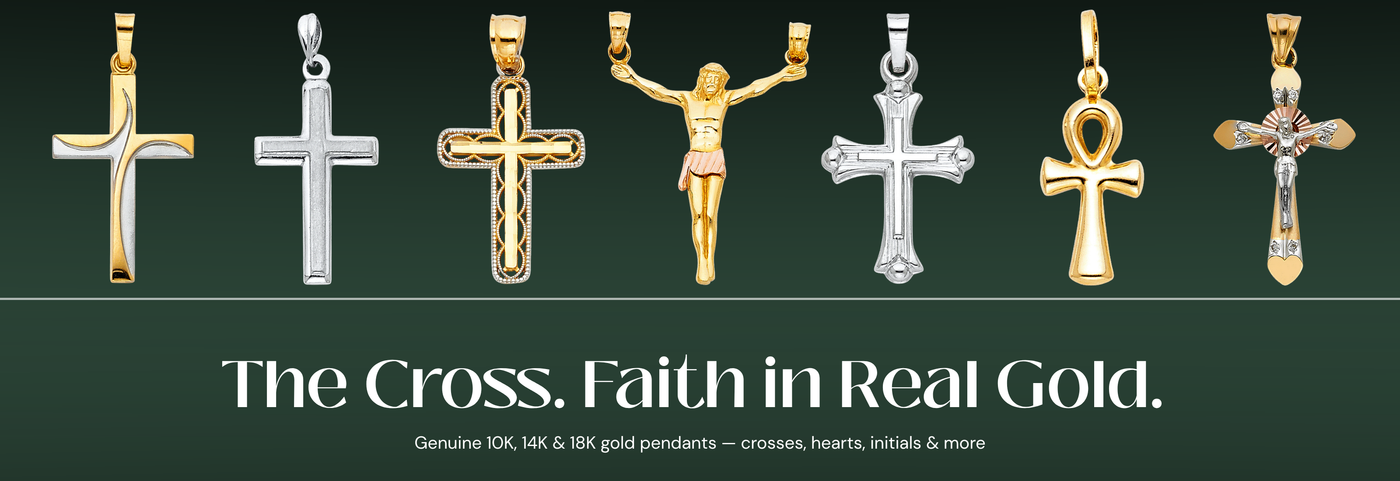
Gold crosses vary in quality along several specific dimensions that aren't always visible from photographs. The first is the metal gauge — the thickness of the gold tubing or wire used to form the cross arms. Thinner-gauge crosses look elegant but flex slightly under handling, while heavier-gauge crosses maintain their shape under all conditions. For a pendant worn every day, gauge consistency and rigidity are more important than for a piece worn occasionally.
The hollow vs. solid construction distinction directly affects both price and durability. Hollow gold crosses use less gold to achieve the same visual size as solid crosses, making them more affordable, but hollow construction is susceptible to denting under direct impact. Solid gold crosses in the same dimensions will be heavier and more expensive but will retain their shape through daily wear. Neither is universally better — the choice depends on how the cross will be worn and how much weight is comfortable.
Chain pairing matters more for cross pendants than for most pendant types because the proportions need to work together. A small cross (under 20mm) is proportioned for chains under 2mm wide — a wide chain visually overwhelms a small pendant. A large cross (40mm+) needs a chain with enough visual weight to balance it — a delicate 1mm chain under a large cross looks mismatched. As a general rule, match the pendant's visual weight class to the chain's: delicate crosses with delicate chains, statement crosses with statement chains.