Envío gratis en todos los pedidos superiores a $75 en los Estados Unidos

Cuando se trata de oro, garantizamos el uso de oro 100% real en todos nuestros productos de oro.

FLASH SALE— Save 25%

HAPPY25NOW
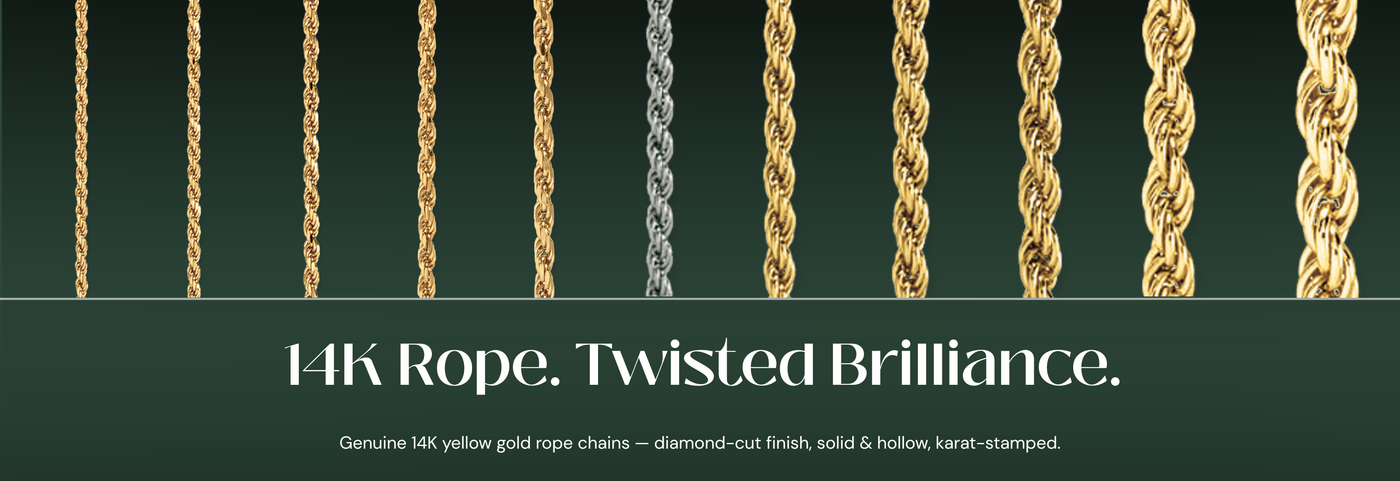
Italian 14K yellow gold rope chains with diamond-cut twisted links

Cuerda de oro amarillo de 14 quilates.

Cuerda de oro amarillo de 14 quilates.
Ver como

What is a 14K yellow gold rope chain?

A 14K yellow gold rope chain is a necklace or bracelet constructed from a series of small oval or round links arranged in a continuous spiral twist, creating a design that visually and texturally resembles a twisted fiber rope. Each link is set at a precise angle to its neighbor, and the cumulative twist of hundreds of links along the chain's length produces a three-dimensional, helical structure that rotates slightly under light, giving the rope chain its signature multidirectional sparkle. The 14K gold specification means the chain is 58.5% pure gold, alloyed with copper and silver for durability.

The rope chain is one of the oldest continuously produced gold chain styles. Its fundamental construction has remained essentially unchanged for centuries, refined by Italian craftsmen into the precision machine-made rope chains dominant in the contemporary market. The chain's spiraling link structure achieves a visual complexity that flat-lying chain styles (Cuban, figaro, mariner) cannot: the rope chain reflects light from every angle simultaneously, appearing to change brightness and character as the wearer moves. This dynamic light behavior makes rope chains visually active even in low light.

14K yellow gold is the optimal specification for rope chains in the U.S. market. The alloy's hardness protects the small, interlocking links that make up the rope chain's structure. Individual links in a rope chain are much smaller than Cuban or figaro links, making gauge and alloy quality especially important. 14K's rich, saturated yellow color also maximizes the visual impact of the chain's light-catching spiral structure, producing the warm, glowing rope chain appearance that has made this style a fine jewelry staple for generations.

How is a rope chain made?

A rope chain is constructed by interlocking dozens of small oval or round links in a precise angular sequence, then twisting the assembled structure to lock the links into the spiral orientation that creates the rope appearance. In machine-manufactured rope chains, the standard for contemporary fine jewelry production, this process is performed by precision link-assembly machinery that achieves the consistent link size, spacing, and twist angle that hand assembly cannot match at scale. The chain is then cut to length, fitted with a clasp, and polished to its final surface finish.

The quality of a rope chain's construction is determined primarily by three factors: link gauge, which is the thickness of the wire used to form each link; link consistency, the precision with which each link matches its neighbors in size and shape; and twist uniformity, the evenness of the spiral angle across the chain's full length. A high-quality 14K rope chain has links that are identical in size, a twist angle that is perfectly uniform from clasp to clasp, and a surface polish that is consistent across every link surface. These qualities are measurable with close inspection under magnification.

Italian-manufactured rope chains represent the premium tier of the global rope chain market and are produced on specialized machinery maintained by craftsmen with generational experience in gold chain production. The combination of precision equipment and experienced human quality control produces rope chains with link consistency and surface finish quality that mass-market manufacturing cannot replicate. When buying a 14K rope chain, Italian manufacture, indicated by Italian assay marks alongside the 585 purity stamp, is a meaningful quality indicator.

Why is the rope chain so popular?

The rope chain's enduring popularity rests on three simultaneous advantages: its dynamic, multidirectional sparkle that no flat-linked chain can replicate; its structural durability derived from the interlocking spiral link construction; and its design versatility that makes it appropriate as a standalone chain, a pendant vehicle, and a layering component across an exceptionally wide range of style contexts. The rope chain is one of the most visually alive gold chain designs. It does not read the same way under all lighting conditions, which gives the wearer an experience of visual variety from a single piece.

The rope chain's cultural positioning spans multiple style traditions simultaneously. In fine jewelry traditions, the rope chain at delicate widths (1-2mm) has been a classic fine jewelry chain for generations, appropriate for professional contexts, formal occasions, and pendant display. In fashion and streetwear contexts, heavier rope chains (5mm and above) carry the same cultural significance as Cuban links, worn by hip-hop artists and athletes as statements of authentic gold jewelry ownership. This dual positioning makes the rope chain uniquely versatile across style contexts and demographics.

The practical virtues of the rope chain reinforce its cultural appeal. Rope chains resist tangling because the spiral link construction creates a chain with directional stiffness. The links resist lateral crossing in the way that rounder-profile, open-link chains do not. The chain drapes elegantly, lies smoothly against the skin, and hangs pendants at the correct forward-facing angle without rotation. These wearing qualities, combined with the rope chain's proven durability under daily wear, make it one of the most recommended gold chain styles by professional jewelers for long-term, regular-wear use.

What makes a 14K yellow gold rope chain sparkle?

The rope chain's distinctive sparkle comes from the geometry of its spiral link construction. As the chain's small oval or round links are twisted into the rope's helical structure, each link surface is oriented at a slightly different angle than its neighbors. This means that at any given moment, different portions of the chain are reflecting light in different directions simultaneously. The chain presents multiple facets to any light source, creating a flickering, multidirectional brilliance that flat-linked chains like Cuban, figaro, and box styles cannot achieve. The chain appears to change brightness as the wearer moves.

The 14K yellow gold specification amplifies this sparkle effect. Yellow gold's warm, saturated color engages with white light differently than white metals. The gold's natural orange-yellow tone absorbs blue wavelengths and reflects red and yellow wavelengths richly, creating a warm glow that is distinct from the cooler, more neutral sparkle of silver or white gold. Under warm incandescent or candlelight, a 14K yellow gold rope chain produces an exceptionally rich, warm sparkle. Under cool daylight, the yellow contrast against the light source creates crisp, defined highlights.

Diamond-cut rope chains take the sparkle effect further. In the diamond-cutting process, machine-faceted cuts are applied to the outside surface of each link, creating flat, mirror-like facets that concentrate light into intense points of reflection rather than the rope's natural distributed glow. A diamond-cut 14K rope chain has a sharper, more brilliant sparkle than a plain-polished rope chain of equivalent width. It reads as more icy and brilliant, while the plain-polished rope reads as warmer and more glowing. Both are appropriate to 14K yellow gold; the choice is aesthetic preference.

How does a 14K rope chain feel to wear?

A 14K yellow gold rope chain has a smooth, silky wearing feel distinct from any other chain style. The spiral link construction creates a chain surface that moves in a unified fluid motion. The chain flows and drapes rather than falling in discrete segments or sections. When worn as a necklace, a rope chain settles against the chest in a single unified curve, conforming to the body's contours. At lighter weights (2-4mm), the chain feels almost weightless, moving with the wearer without registering as heavy or substantial. At heavier weights (5mm and above), the rope chain has a satisfying, definite presence.

The rope chain's spiral construction gives it distinctive flexibility characteristics. The chain flexes in all directions but resists the lateral rotation that causes some chain styles to twist and flip during wear. A well-made rope chain worn as a necklace maintains its orientation consistently. The rope pattern remains visible on the chest surface rather than rotating to show the chain's edge or back. This orientation stability is one of the rope chain's practical wearing advantages over flat-lying chains that can flip or twist during active movement.

As a bracelet, the rope chain has a particularly pleasant wrist feel. The smooth, continuous spiral surface moves against the skin without edges or points of contact. The bracelet feels like a fluid band of gold rather than a series of discrete links. Rope chain bracelets have traditionally been one of the most popular bracelet styles in fine jewelry specifically because of this comfortable, unobtrusive wearing experience. A solid 14K rope bracelet at 3-4mm and 7 inches typically weighs 6-10 grams, substantial enough to feel real and present, light enough to be worn comfortably through long days.

What is the difference between a solid and hollow rope chain?

Solid rope chains are made from continuous 14K gold alloy through the full cross-section of each link. The gold content is uniform from surface to core. Hollow rope chains use a tube-like link construction where the link's interior is air-filled, with a thin gold shell forming the link's exterior. At equivalent widths, solid and hollow rope chains can look nearly identical, but the structural and value difference is significant. The hollow rope chain's thin link walls are substantially more vulnerable to kinking and compression damage than solid links.

The rope chain's specific construction makes hollow variants particularly vulnerable. Because the rope chain's sparkle and character depend on the spiral link structure remaining intact and evenly twisted, any compression or kinking that deforms the link shape disrupts the chain's visual integrity. A solid rope chain subjected to a kink can often be straightened by a jeweler. A hollow rope chain with a kink typically has a permanent crease or dent in the link wall that cannot be fully repaired. For a daily-wear rope chain, solid construction is strongly recommended.

Value comparison: a hollow rope chain contains a fraction of the gold of a solid rope chain at equivalent visual dimensions. A hollow 4mm rope necklace might weigh 8-12 grams; a solid 4mm rope at the same length weighs 18-28 grams or more. The gram weight difference is real gold content difference and real recoverable value. Always request the gram weight in writing and compare against expected solid 14K weights at the stated dimensions. If a chain is significantly lighter than expected, hollow construction or misrepresented karat is the likely explanation.

What link gauge makes a quality 14K rope chain?

Link gauge in a rope chain refers to the diameter of the wire used to form each individual link. Higher gauge wire, meaning thicker wire, produces stronger, more substantial links that resist deformation under daily wear stress and produces a chain with more gold per unit length, reflected in higher gram weight. A quality 14K rope chain uses wire gauge appropriate to the chain's width and intended use. A 2mm rope chain for pendant or layering use requires lighter gauge than a 5mm rope chain intended as a standalone statement piece.

The practical test for adequate gauge is weight. A solid 14K rope chain should weigh proportionately to its dimensions. Approximate weight benchmarks for solid 14K rope chains at 20 inches: a 2mm rope should weigh approximately 6-10 grams; a 3mm rope approximately 10-16 grams; a 4mm rope approximately 16-25 grams; a 5mm rope approximately 25-38 grams. Chains significantly lighter than these ranges use under-gauge wire that compromises both structural durability and the chain's visual body. Under-gauge rope links look thin and insubstantial under close inspection.

Under-gauge rope chains have a specific visual tell: the links appear flat and ribbon-like rather than having the rounded, full cross-section of a properly gauged rope link. Under close inspection, a quality rope chain's links have visible depth and roundness. The wire cross-section is round, not flat. An under-gauge chain's links look like bent ribbon rather than formed round wire. This difference is visible to the naked eye on a properly lit chain and unmistakable under a 10x loupe.

What is a diamond-cut rope chain?

A diamond-cut rope chain is a rope chain that has undergone a secondary machining process in which cutting wheels create flat, mirror-like facets on the outer surface of the chain's links. The term diamond-cut refers to the cutting tool used, a diamond-edged cutting wheel, rather than the presence of diamond gemstones. The faceting process removes material from the link surface to create precise flat planes that reflect light as concentrated, intense points rather than the distributed glow of a plain-polished rope surface. The result is a noticeably more brilliant, icy sparkle.

The visual difference between diamond-cut and plain-polished rope chains is most apparent at wider widths (3mm and above) and under directional light such as natural daylight, spotlights, or bright overhead lighting. Under these conditions, a diamond-cut rope chain produces flashes of white light from individual facets that read as significantly more brilliant than the warm, distributed glow of a plain-polished rope chain. Under diffused or ambient lighting, the difference is less dramatic. Neither is superior. The choice is between the diamond-cut's cooler brilliance and the plain rope's warmer glow.

Quality consideration for diamond-cut rope chains: the cutting process removes material from the link surface, which means the base chain must be adequately gauged to support the cutting without producing thin-walled or structurally compromised links. An under-gauged diamond-cut rope chain has sharp, thin facet edges that catch on skin and clothing and are structurally weaker than a properly gauged chain. A well-executed diamond-cut rope chain has facets with visible depth and clean, sharp edges, and a base chain with adequate wire gauge that remains structurally sound after the material removal.

What clasp should a 14K rope chain have?

The standard clasp for 14K rope chain necklaces across most width ranges is the spring ring clasp or lobster claw clasp. Spring rings are appropriate for lighter rope chains, up to 3mm or approximately 12 grams, where the chain's weight and daily mechanical stress fall within the spring mechanism's capacity. Lobster claw clasps are preferred for heavier ropes (4mm and above) because the two-lever engagement provides more reliable closure under the higher pull forces that heavier chains generate during daily wear.

For very heavy rope chain necklaces (6mm and above, typically 40 or more grams) and all rope chain bracelets, a box clasp with a secondary safety mechanism is the appropriate choice. The box clasp's two-point engagement and safety tab provide the most reliable closure for high-weight applications. Rope chain bracelets specifically should always have a box clasp with safety tab. The wrist's range of motion and the potential for the bracelet to catch on clothing or objects creates higher snag risk than necklace wear, and the clasp is the highest-stress component under snag conditions.

Clasp quality is one of the most reliable indicators of overall chain quality. A quality clasp opens and closes with smooth, precise, positive-engagement action. The mechanism feels substantial and the closure is definite. The clasp body should be proportionate to the chain width and weight. A light, undersized clasp on a heavy rope chain indicates cost-cutting at the chain's most structurally critical component. Inspect the clasp for hallmark stamps: 14K, 14KT, or 585 should appear on or inside the clasp body and is a legal requirement for gold jewelry sold in the U.S.

What are the signs of a high-quality 14K rope chain?

Five visible quality indicators on a 14K rope chain: first, link uniformity, meaning all links should be identical in size, shape, and spacing across the chain's full length; any visible variation indicates manufacturing inconsistency. Second, twist consistency, where the spiral twist angle should be perfectly even from clasp to clasp with no sections where the twist opens, tightens, or loses its defined helical structure. Third, surface finish, where the polished surfaces of all links should be uniformly bright with no dull patches, machine marks, or surface porosity. Fourth, clasp quality, where the clasp should open and close with positive, precise action and feel proportionate to the chain's weight. Fifth, hallmark presence: 14K, 14KT, or 585 stamped on the clasp, readable under a 10x loupe.

Weight is the single most reliable quality proxy for a rope chain. Request the gram weight from the seller in writing. Compare against expected solid 14K weights for the stated width and length. A chain significantly lighter than the expected solid weight range is either hollow or under-gauged. Both are compromises that reduce the chain's durability and intrinsic value. A seller who cannot or will not disclose gram weight, or who becomes defensive when asked, is a reliable warning sign.

Italian manufacture is a quality signal worth understanding. Italy has produced fine gold chain jewelry for centuries, and the Italian chain-making industry, particularly in the Vicenza and Arezzo regions, operates at a quality level that most other global manufacturing centers cannot match. Italian 14K rope chains carry three marks: the 585 purity stamp, the manufacturer's registered production code, and an Italian government assay mark confirming independent gold verification. The presence of all three marks on a clasp provides meaningful authentication beyond the hallmark alone.

About 14K Yellow Gold Rope Jewelry

14K Yellow Gold Rope Collection: The Twisted-Strand Style Across Chains and Bracelets

The 14K yellow gold rope collection covers the twisted-strand style across chains and bracelets. The rope's interlocking spiral construction creates multi-directional light reflection — more visual sparkle per millimeter of width than flat-link styles.

The same construction principle produces both chain and bracelet forms with identical visual characteristics. The 14K yellow gold standard ensures consistent warm color across all pieces in the collection, regardless of width or length.

Rope chains under 2.5mm serve as pendant carriers. The 3mm to 5mm range is the most requested everyday statement range. At 6mm and above, the rope's continuous sparkle becomes the sole focal point. Rope bracelets are most effective at 4mm to 6mm, where the wrist context showcases the light interaction best.

Comparar /3

Cargando...