Free shipping on all orders over $75 in the United States

When it comes to gold, we guarantee the use of 100% real gold in all our gold products.

FLASH SALE— Save 25%

HAPPY25NOW
Italian 14K white gold Figaro chains

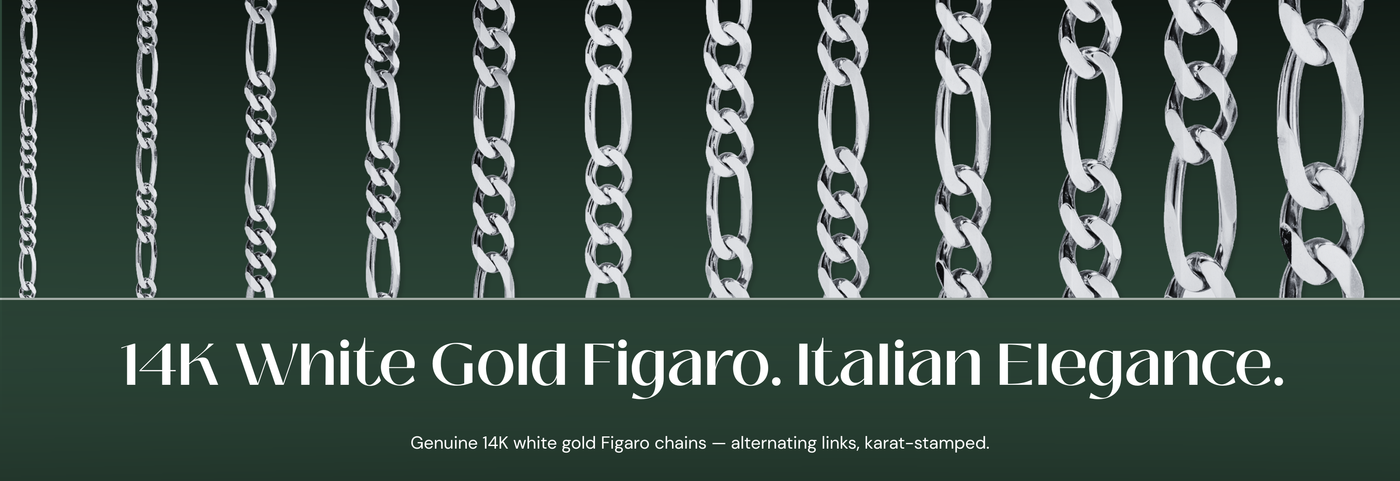
14K White Gold Figaro

14K White Gold — Italy's Alternating Pattern at the Fine Jewelry Level

14K White Gold Figaro: The Alternating Pattern in Cool Fine Gold

The 14K white gold Figaro chain brings Italy's most recognized alternating link pattern to the fine jewelry standard in a cool-toned metal. At 58.5% pure gold, the 14K white gold Figaro holds substantially more intrinsic gold value than a 10K version of the same chain — a meaningful distinction for buyers who want the Figaro as a gift, an heirloom-quality piece, or a chain with long-term resale value alongside its everyday wearability.

How 14K White Gold Changes the Figaro's Character

The Figaro pattern depends on the visual contrast between its short and long link elements. In 14K white gold, this contrast is amplified by a specific quality of the 14K base alloy: its slightly warmer underlying tone means that as the rhodium plating naturally wears at high-contact points over time, the base metal reads as warm and gold-like rather than the cooler grey of 10K's higher-alloy base. For buyers who expect to wear the chain for years before replating, 14K maintains a more traditionally gold appearance through the plating cycle. The 14K standard is also the appropriate choice when the Figaro is worn alongside other fine jewelry — diamond pendants, gold charms, fine earrings — where karat consistency and gold content quality matter.

Chains and Bracelets in the 14K White Gold Figaro Collection

14K white gold Figaro chains work from 3mm to 6mm at standard necklace lengths of 16 to 24 inches, where the pattern is clearly visible in white gold's cool, rhodium-plated tone. At 3mm to 4mm the Figaro functions as a refined fashion chain or pendant carrier. At 5mm to 6mm it makes a statement suited to fashion-forward and fine jewelry contexts equally. Figaro bracelets at 4mm to 7mm bring the alternating pattern to wrist wear at the 14K standard.

View as

What is a figaro chain?

A figaro chain is an Italian-origin chain style defined by its alternating link pattern: one elongated oval or rectangular link followed by two or three smaller round links, repeating throughout the chain's length. This specific alternating rhythm distinguishes the figaro from all other chain styles — no other commercial chain type uses this particular long-short-short or long-short-short-short pattern. The figaro's design is attributed to Italian goldsmith tradition and takes its name from a popular Italian opera character, reflecting its deep roots in Italian fine jewelry culture.

The figaro's flat link profile is its defining visual characteristic. Unlike rope chains (which are three-dimensional and twisted) or cable chains (which are round-wire oval links), the figaro uses flat stamped or die-struck links with broad, reflective surfaces. This flat profile creates a chain that lies smooth and flush against the skin, with the elongated links acting as natural light-catching mirrors that display the metal's color across a large surface area. In white gold, this flat reflective quality is particularly effective — the broad links become bright silver-white mirrors.

Figaro chains are produced in a wide range of widths (typically 2mm to 8mm for women, 3mm to 10mm+ for men) and in all standard fine metal colors — yellow gold, white gold, rose gold, and silver. The style is equally popular for men's and women's jewelry, making it one of the most commercially versatile chain styles available. A 14K white gold figaro chain is among the most classic and refined white gold chain choices — the Italian pattern in the cooler white gold color creates a sophisticated, timeless piece.

Where does the figaro chain style come from?

The figaro chain originates in Italian goldsmithing tradition, specifically from the fine jewelry manufacturing culture that developed in the gold districts of Tuscany — primarily Arezzo and the surrounding region. The name 'figaro' is borrowed from the barber character in Rossini's famous opera 'The Barber of Seville' — a character who became a popular cultural figure in 19th-century Italian life. The chain style bearing his name was developed by Italian craftsmen who created the alternating long-short link pattern that remains the defining feature of the figaro today.

The Arezzo gold district, where the figaro chain was refined and commercialized, became the global center of fine gold chain production in the 20th century. Italian manufacturers in Arezzo developed and patented the automated chain-making machinery that could produce figaro chains at commercial scale while maintaining the precise link geometry and proportions that define the style. This manufacturing innovation allowed the figaro to become an internationally available fine jewelry staple rather than a limited artisanal product.

The figaro chain's popularity spread globally through Italian jewelry exports beginning in the mid-20th century. Italian jewelry importers introduced the figaro to American consumers in the 1970s and 1980s, where it quickly became one of the most recognizable and purchased gold chain styles. Today, the figaro is as strongly associated with Italian-American fine jewelry culture as any chain style, and a 14K or 18K gold figaro chain — especially one with Italian hallmarks — carries the full cultural and craft heritage of the Arezzo gold tradition.

What makes a figaro chain different from other chain styles?

The figaro chain is distinguished from other chain styles by its asymmetric alternating pattern — one long link followed by two or three short links, repeating. This pattern creates a visual rhythm unique to the figaro: the elongated link draws the eye before the shorter links provide a visual rest, then the pattern repeats. No other commercial chain style — rope, cable, curb, box, Franco, wheat — uses this specific alternating geometry. The figaro is immediately recognizable precisely because of this distinctive pattern.

Compared to a cable chain (uniform oval links throughout), the figaro has more visual complexity and texture — the varying link sizes create visual interest at every scale. Compared to a rope chain (twisted helical construction), the figaro has a flatter profile and a calmer visual rhythm — the rope's multiple faceted surfaces create constant sparkle, while the figaro's flat links create a more structured, geometric display. Compared to a curb chain (interlocking flat links all of equal size), the figaro has a more dynamic, varied visual texture due to the size alternation.

The figaro's flat link construction also makes it one of the most pendant-friendly chain styles. Flat-link chains hold pendants in a stable, forward-facing orientation rather than allowing them to rotate, which is a practical advantage for pendants that have a defined front face — crosses, medals, portrait lockets, and engraved charms all display best on a figaro chain that keeps them facing forward. This combination of visual distinctiveness and pendant-display functionality has made the figaro one of the most consistently popular chain styles across decades of fine jewelry fashion.

What is a 14K white gold figaro chain?

A 14K white gold figaro chain is the classic Italian alternating-link chain style — the figaro pattern of one elongated link followed by two or three shorter links — manufactured from 14-karat white gold alloy. '14K' indicates that the gold alloy is 58.5% pure gold (14 parts out of 24), with the remaining 41.5% consisting of metals formulated to produce a white or near-white color: typically palladium and silver, sometimes nickel. The white gold alloy then receives a rhodium plating — a bright platinum-group metal coating — that produces the bright silver-white surface appearance consumers associate with white gold.

The combination of the figaro chain's flat, broad link surfaces and white gold's bright rhodium-plated finish creates a distinctive visual effect. The elongated figaro links, with their large flat reflective surfaces, act as bright mirrors of the rhodium-plated white gold — producing a piece that is simultaneously structured (the geometric link pattern) and brilliant (the highly reflective white metal surface). In white gold, the figaro's link contrast (long links vs. short links) reads as a play of light and shadow across the bright white surface rather than the warm color play seen in yellow gold.

14K white gold is the most commonly available karat for white gold figaro chains in U.S. jewelry retail. The 14K alloy provides the right balance of gold content (58.5%), structural hardness for fine chain construction, and cost accessibility for commercial fine jewelry pricing. The '14K' stamp or '585' (European numeric equivalent) on the clasp, along with the rhodium-plated bright white surface, are the defining marks of a 14K white gold figaro chain. Italian-made examples will also carry the manufacturer code and government assay mark.

What are the proportions of a figaro chain?

The proportions of a figaro chain — specifically the ratio of the elongated link's length to the shorter links' size, and the number of short links between each long link — are the key design variables that distinguish different figaro chain designs. The most common proportion is the 3-to-1 figaro: one long link (approximately 3 times the length of the shorter links) followed by three equal shorter links. Less common is the 2-to-1 figaro (one long link followed by two shorter links), which creates a more elongated, less busy pattern. The specific proportions are a manufacturer design choice.

Width is the second key dimension of figaro chain proportions. Standard figaro chain widths range from approximately 2mm (very fine, appropriate for delicate women's chains or as a fine pendant chain) through 3–4mm (standard women's medium figaro), 5–7mm (bold women's statement or men's fine to medium figaro), and 8–10mm+ (men's bold statement figaro). In white gold, the flat reflective surfaces of figaro links are particularly sensitive to width — a 4mm white gold figaro looks noticeably wider and more substantial than a 4mm rope chain of the same nominal width because the flat links cover more surface area.

The thickness (depth/gauge) of figaro chain links is the third proportion variable and is directly related to the chain's gram weight. Higher-end Italian figaro chains use thicker link wire (heavier gauge), producing a chain with more substance, better drape, and greater gram weight at the same stated width. Lower-quality chains at the same stated width use thinner link wire, producing a lighter chain with less substance. When comparing figaro chains, always request the gram weight — a heavier chain at the same stated width and length indicates better construction quality.

What is 14K white gold made of?

14K white gold is a gold alloy containing 58.5% pure gold (14 parts out of 24) with 41.5% consisting of other metals formulated to neutralize gold's natural yellow color and produce a white or near-white appearance. The alloying metals most commonly used for 14K white gold are palladium and silver — palladium is a platinum-group metal that strongly counteracts the yellow color, while silver contributes to the whitening effect and improves workability. Some 14K white gold formulations use nickel instead of or alongside palladium; nickel-based white gold is harder and less expensive but can cause allergic reactions in sensitive individuals.

The '14K white gold' designation refers to the gold purity of the alloy (58.5% gold) and the intended color direction (white), but the actual color of the unplated alloy is typically a light grayish-yellow or pale champagne — not the bright white that consumers expect from white gold jewelry. The bright silver-white color of 14K white gold chains in jewelry stores is produced by rhodium plating applied after the chain is manufactured. Rhodium, a platinum-group metal, is electroplated onto the chain's surface in a very thin layer (0.5–1 micron) that produces the bright, highly reflective white finish.

The full composition of a 14K white gold chain is therefore: a gold alloy core (58.5% gold + 41.5% palladium/silver or nickel/silver) with a rhodium surface coating. The rhodium plating is what the buyer sees, feels, and touches — it is the chain's visual identity. Over time, the rhodium plating wears through in high-contact areas, revealing the underlying lighter-colored but not-quite-white gold alloy. This wear is natural and reversible through rhodium re-plating, a standard jewelry service costing $40–$80 at any qualified jeweler.

What does '14K' mean on a white gold chain?

'14K' on a white gold chain is the karat designation indicating the alloy's gold purity: 14 parts pure gold out of 24 total parts, equal to 58.5% pure gold by weight. This is the same karat grade as 14K yellow or 14K rose gold — the karat number indicates gold content only, not color. The white color of a 14K white gold chain comes from the specific alloying metals used (palladium and/or nickel) and from the rhodium surface plating, not from a lower gold content. A 14K white gold chain and a 14K yellow gold chain of identical gram weight contain the same amount of pure gold.

On the clasp, '14K' is the U.S. standard karat stamp. European (including Italian) chains more commonly display '585' — the numeric equivalent, indicating 585 parts per thousand pure gold (58.5%). Both '14K' and '585' represent exactly the same gold content and are legally interchangeable. Italian fine jewelry hallmarking will show '585' alongside the manufacturer's government-registered identification code and the Italian government assay mark — the full three-mark system that certifies both gold purity and Italian origin. A '585' stamp alone (without the manufacturer code and assay mark) may indicate non-Italian European origin.

The practical significance of the '14K' designation for a white gold figaro chain: 58.5% of the chain's weight is pure gold, recoverable at market prices. At mid-2026 gold prices of approximately $106 per gram of pure gold, a 10-gram 14K white gold figaro chain contains $621 in pure gold content. This gold content floor value is identical for 14K yellow, 14K white, and 14K rose gold of the same gram weight — the gold content does not change based on color. The karat grade is the primary determinant of intrinsic value for any gold chain.

What is rhodium plating on a white gold chain?

Rhodium plating is a thin electroplated coating of rhodium — a rare, extremely hard platinum-group metal — applied to the surface of white gold jewelry to produce the bright, reflective white appearance associated with white gold. The underlying 14K white gold alloy, without rhodium plating, has a pale grayish or slightly yellowish white color that most consumers would not immediately identify as 'white gold.' The rhodium coating transforms this slightly off-white alloy surface into the brilliant, mirror-like white metal finish that defines white gold jewelry's visual character in the marketplace.

The rhodium plating process is electroplating: the chain is cleaned, polished, and submerged in a rhodium solution through which an electrical current is passed, depositing a thin rhodium layer onto the chain's surface. The plating thickness for fine jewelry is typically 0.5–1 micron (millionths of a meter). Despite this extreme thinness, rhodium plating is extraordinarily durable in the short term — rhodium is harder than gold, platinum, or any common jewelry metal — but it does wear through gradually in areas of sustained friction and contact. For a figaro chain's flat link surfaces, wear is typically most visible on the tops of the elongated links.

The rate of rhodium wear depends primarily on how much the chain is worn and how frequently it contacts hard surfaces. A 14K white gold figaro chain worn daily will typically show rhodium wear in the highest-contact areas after 1–3 years, at which point the chain should be re-plated. Re-plating is a standard procedure at any qualified jeweler: the chain is cleaned, polished, and re-plated in a process that takes 1–2 hours and costs approximately $40–$80. After re-plating, the chain looks identical to new. Re-plating can be done multiple times over the chain's life without affecting the gold content or structural integrity.

How durable is a 14K white gold figaro chain?

A 14K white gold figaro chain has excellent structural durability for fine chain jewelry — the 14K alloy (58.5% gold with 41.5% hardening metals) is among the most durable gold alloys used for chain production, and the flat-link figaro construction is inherently more robust than delicate fine-wire styles like Singapore or box chains. The primary durability concern specific to white gold is rhodium plating wear — the bright white surface coating gradually wears through in high-contact areas with normal daily use, requiring periodic re-plating. The gold alloy core itself is not affected by this wear.

The figaro chain's construction has one characteristic durability consideration: the elongated links. In a figaro chain, the longer links have more unsupported span than the shorter links and are therefore slightly more susceptible to bending if the chain is subjected to sharp lateral stress. For everyday wear — daily social, professional, and casual use — this is not a practical concern. For active use involving physical work, sports, or conditions where the chain might be caught or pulled, the figaro's longer links benefit from removal before those activities.

Compared to other chain styles in 14K white gold: figaro chains are more durable than cable chains of equal width (cable chains have thinner individual link wire at the same width), approximately equal in durability to curb chains of equal width, and less durable than solid rope chains of equal gram weight (rope chains' interlocked construction distributes stress across many small links simultaneously). For everyday fine jewelry wear, all these styles are appropriate. The figaro's flat profile and moderate weight distribution make it a practical choice for regular wear with appropriate care.

Does 14K white gold tarnish?

14K white gold itself — the gold alloy core — does not tarnish in the way that silver tarnishes. Pure gold is chemically inert and does not react with oxygen, moisture, or most environmental compounds. The 41.5% alloying metals in 14K white gold (primarily palladium and silver, or nickel and silver) can very slowly develop surface discoloration in response to concentrated chemical exposure over extended periods, but this is not the same as silver tarnish and is rarely a practical concern under normal jewelry use conditions.

What appears as 'tarnishing' on a 14K white gold figaro chain is almost always one of two things: rhodium plating wear, where the underlying gold alloy (with its slightly different, less white color) becomes visible through the worn plating; or surface deposit accumulation — the gradual buildup of body oil, skin product residue, sweat, and environmental particles on the chain's surface that dulls its brilliant white appearance. Both are reversible through cleaning (deposit removal) and re-plating (rhodium restoration).

To prevent surface dullness on a 14K white gold figaro chain: clean monthly with warm water and mild dish soap to remove accumulated deposits from link surfaces; remove before swimming (chlorinated pool water can accelerate deposit buildup and stress solder joins); apply all skin products — lotions, perfumes, hairsprays — before putting on the chain, not after. These practices are relevant for all white gold jewelry but are particularly worth maintaining for white gold because the contrast between a brilliant rhodium surface and a dulled one is visually very apparent on the bright white metal.

14K White Gold — Italy's Alternating Pattern at the Fine Jewelry Level

14K White Gold Figaro: The Alternating Pattern in Cool Fine Gold

The 14K white gold Figaro chain brings Italy’s most recognized alternating link pattern to the fine jewelry standard in a cool-toned metal. At 58.5% pure gold, the 14K white gold Figaro holds substantially more intrinsic gold value than a 10K version of the same chain — a meaningful distinction for buyers who want the Figaro as a gift, an heirloom-quality piece, or a chain with long-term resale value alongside its everyday wearability.

The Figaro pattern depends on the visual contrast between its short and long link elements. In 14K white gold, this contrast is amplified by a specific quality of the 14K base alloy: its slightly warmer underlying tone means that as the rhodium plating naturally wears at high-contact points over time, the base metal reads as warm and gold-like rather than the cooler grey of 10K’s higher-alloy base. For buyers who expect to wear the chain for years before replating, 14K maintains a more traditionally gold appearance through the plating cycle. The 14K standard is also the appropriate choice when the Figaro is worn alongside other fine jewelry — diamond pendants, gold charms, fine earrings — where karat consistency and gold content quality matter.

14K white gold Figaro chains work from 3mm to 6mm at standard necklace lengths of 16 to 24 inches, where the pattern is clearly visible in white gold’s cool, rhodium-plated tone. At 3mm to 4mm the Figaro functions as a refined fashion chain or pendant carrier. At 5mm to 6mm it makes a statement suited to fashion-forward and fine jewelry contexts equally. Figaro bracelets at 4mm to 7mm bring the alternating pattern to wrist wear at the 14K standard.

Compare /3

Loading...