FLASH SALE — Save 25% | Code: HAPPY25NOW

When it comes to gold, we guarantee the use of 100% real gold in all our gold products.

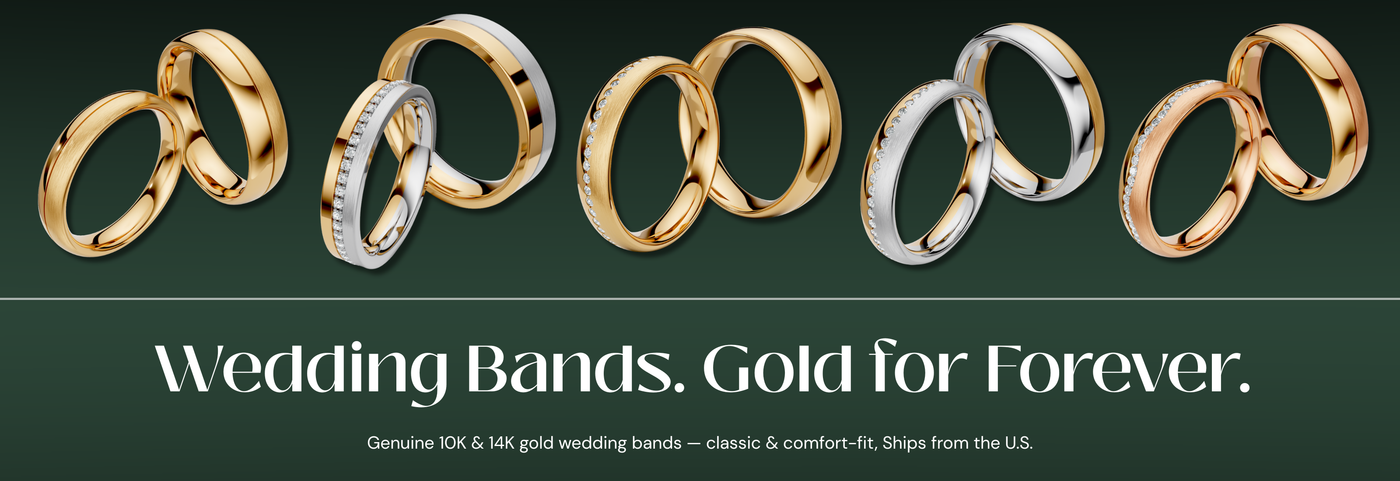
Italian gold wedding bands in classic and comfort-fit styles

Wedding Bands

Gold Wedding Bands: What Matters for a Ring Worn Every Day for Decades

A wedding band is the most continuously worn piece of jewelry most people will ever own — on the finger 24 hours a day, through work, sleep, sports, water, and decades of life. The metal and construction choice is more consequential here than for any other jewelry purchase. The band that looks good on the wedding day needs to still look good on the 25th anniversary.

Karat Selection: Gold Content vs. Durability

18K yellow gold has the deepest, warmest color and 75% gold content, but is the softest of the common karats — it scratches and deforms more easily under daily physical contact. 14K yellow gold (58.5% gold) is harder and more scratch-resistant while maintaining genuinely warm gold color — the standard recommendation for wedding bands worn through active, varied lifestyles. 10K yellow gold is the hardest and most durable standard karat, at a paler color and lower gold content — appropriate when durability is the primary concern. Under daily contact with hard surfaces, a 14K band will develop fewer visible scratches per year than an 18K equivalent.

Comfort Fit, Sizing, and Long-Term Wearability

A comfort-fit band has a domed interior — the center of the inside curves down toward the edges, so the ring glides on and off more easily and sits differently against the finger. For rings worn daily and never removed, comfort fit is consistently more comfortable over long periods because there is less edge contact. Wedding band sizing should account for daily finger size variation: sizing up 0.25 to 0.5 sizes from the precise measurement provides a comfortable fit across normal daily fluctuation. For matching sets, metal consistency is worth prioritizing — two bands in the same karat will age similarly and maintain the same color relationship over decades of wear.

View as

Choosing a Wedding Band

What does bevelled mean on a wedding band listing?

A bevelled band is a flat band whose two outer corners have been cut back at an angle, so that a narrow sloping face runs along each edge of the ring.

The bevel catches light as two continuous lines around the band, which gives a plain ring a pair of bright borders without adding any pattern to the face.

It also softens what the neighbouring fingers feel, since the square corner of a flat profile is removed while the flat top face is kept.

How does a knife-edge band feel when the hand closes around something?

A knife-edge carries a ridge along the centre of its outside, and when the hand grips a handle or a wheel that ridge is what meets the palm and the neighbouring fingers.

It is not sharp in any real sense, but it is noticeable in a way a domed or flat band is not, and the wearer tends to be aware of the ring for longer.

The ridge is also what the thumb finds when it reaches across to turn the ring, which many people come to like as a habit.

Does a half-round band feel different from a flat one of the same width?

Yes, and the difference is felt by the fingers on either side rather than by the finger wearing it. A flat band presents two corners to those neighbours; a half-round presents a curve.

On the inside the two are often the same, with a flat interior in both cases, unless the listing says the band is comfort fit.

The choice between them is therefore about the edges. People who hold their fingers close together, or who wear rings on adjacent fingers, tend to notice the corners of a flat band most.

Why does a band look narrower on the hand than in its photograph?

Because a listing photograph fills the frame with the ring, while on the hand the band is seen at arm's length against the whole back of the hand, and a stripe of a few millimetres is a small part of that view.

The knuckle makes the effect stronger, since a prominent one shortens the visible segment the band sits in, and the band reads as a line rather than as a surface.

Comparing the stated width with a band the wearer has already worn, rather than with the photograph, is the reliable way to picture it in place.

What is milgrain on a wedding band?

Milgrain is a row of tiny raised beads running along the edge of a band, cut into the metal with a small knurled wheel after the ring has been shaped.

It gives a plain band a fine decorated border and an antique character, since the technique was widely used on rings made a century ago.

Because the beads stand very slightly proud of the surface, they soften with years of wear, and a jeweller can re-cut them if the crispness is wanted back.

What does diamond-cut mean on a plain gold band?

It refers to a surface treatment rather than to any stone. Small flat facets are cut into the metal with a sharp tool, so the band flashes as it moves in the same way a faceted surface does.

On a band the facets are usually arranged as a pattern across the face or as a border along each edge, and the listing describes where they fall.

The effect depends on the facets staying crisp, which is why diamond-cut bands are more often chosen for hands that do not take heavy daily contact.

How is a wedding band chosen when there will be no engagement ring?

With more freedom than usual, since there is no existing ring to agree with. Width, profile, finish and colour are all open, and the band carries the whole role of marking the hand on its own.

A band worn as the only ring is often chosen slightly wider, and is more likely to carry a bevel, a milgrain edge or a pattern than one bought as half of a pair.

Profile can be decided for comfort alone, because nothing will be sitting beside the band to influence how its edges should be shaped or how much room it needs to leave.

Which finish families read as formal, and which as everyday?

A high polish is the most formal surface, because a mirror finish reads as new and deliberate. It suits a band that comes off for work and is worn on occasions.

Brushed, satin and matte surfaces read as everyday, partly because they look at home beside a watch or a bracelet and partly because they change less with contact.

Milgrain and diamond-cut sit between the two, dressier than a brushed band and less severe than a bare polish, and both are worn as daily bands by people who want a little ornament.

Which band designs are safest to buy as a surprise?

Plain bands in a familiar colour. A wearer who already owns yellow gold will accept a yellow band; someone whose pieces are all white will notice a change of colour at once.

A plain design can also be resized after the fact, which a pattern running the whole way round the ring cannot always accommodate cleanly, so plain is the forgiving choice.

Looking at whether the wearer's existing pieces are polished or brushed, and whether anything they wear is wide, answers most of the remaining questions before the purchase.

Can a band bought as a surprise be adjusted afterwards?

Usually, provided the design allows it. A plain band with an unbroken section of metal can be taken up or down by a jeweller, and a small correction is routine work.

Designs that run a pattern, a bevel or a row of beads round the entire ring are harder to alter without the join showing, so the listing is worth reading with that in mind.

The practical step is to note the size ordered and keep the paperwork, so that if the ring needs changing the starting point is known.

About Gold Wedding Bands

A Guide to Gold Wedding Bands

Wedding band sizing differs from other ring sizing in one important way: the band will be worn for decades, through conditions that cause the finger to change size — temperature, physical activity, age. A wedding band sized exactly to the finger at room temperature may feel uncomfortably tight after a gym workout or in summer heat. The conventional wisdom is to size up 0.25 to 0.5 sizes from the precise measurement, which provides a comfortable fit across normal daily variation. For wide bands (8mm and above), sizing up another 0.25 size is also standard because wider bands sit tighter on the finger due to greater surface contact.

The scratch resistance of a gold wedding band is a function of its karat. 14K gold (58.5% pure) is significantly harder than 18K gold (75% pure) because the higher alloy content in 14K includes harder metals — copper and silver — that reinforce the gold's crystalline structure. Under daily contact with hard surfaces (keyboards, steering wheels, gym equipment), a 14K band will develop fewer visible scratches per year than an 18K band. Both bands will develop a patina over decades — a collection of micro-scratches that produces a matte or satin-like surface. This patina is considered desirable by many wearers; a jeweler can polish it back to mirror finish if preferred.

For matching wedding band sets (bands purchased together for two people), metal consistency is worth prioritizing. Two bands in the same karat (both 14K yellow gold, for instance) will age similarly and maintain the same color relationship over years of wear. Mixing karats — one 10K, one 14K — creates a slight color discrepancy that becomes more visible as the pieces age differently. Matching the karat, the construction standard (solid construction for both), and the finish (both polished or both brushed) creates a set that reads as intentionally paired regardless of style differences.

Compare /3

Loading...