FLASH SALE — Save 25% | Code: HAPPY25NOW

When it comes to gold, we guarantee the use of 100% real gold in all our gold products.

Italian Figaro gold chain

Figaro Gold Chain

Figaro Gold Chains — Italy's Most Recognized Chain Pattern.

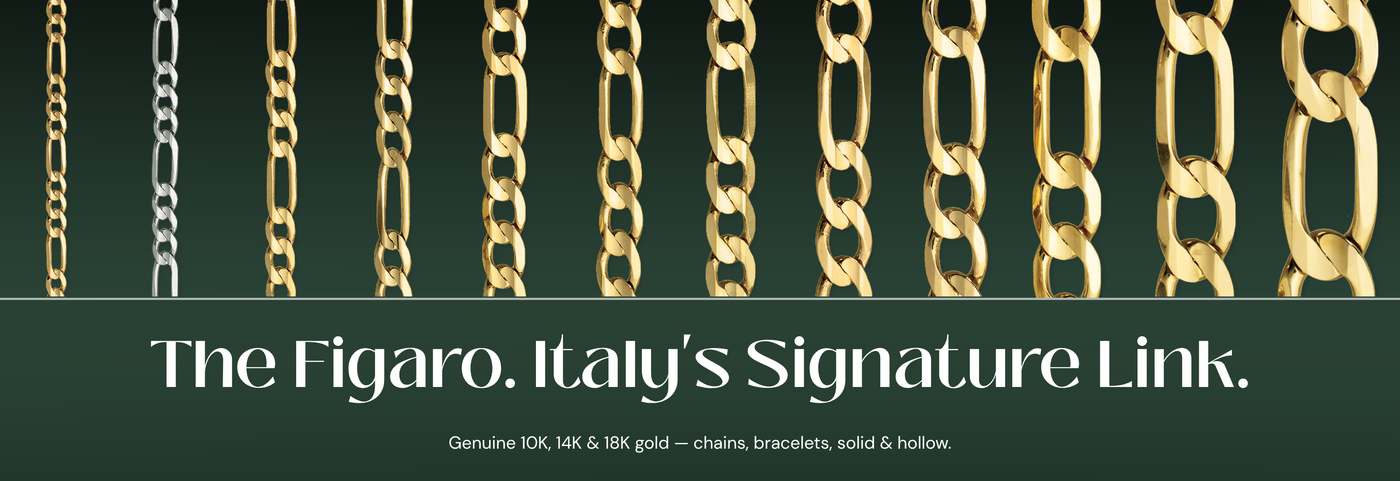
The Figaro's alternating short-short-long oval link sequence has been produced in the jewelry districts of Arezzo and Vicenza for generations. It's technically demanding to produce correctly — each long link must be precisely calibrated to the short links on either side, or the chain loses its characteristic rhythm. This precision is visible in quality Figaro chains; the pattern has a crisp, even cadence that distinguishes hand-finished work from machine shortcuts.

How the Pattern Affects Drape

The alternating links create a specific drape quality different from uniform-link chains. The long link acts as a hinge point that creates slight articulation — the chain falls more organically than a Cuban or box chain. This makes Figaro particularly effective as a pendant chain.

Choosing the Right Width

Because the link pattern creates its own visual interest, a narrower Figaro (2–4mm) reads clearly and elegantly. A wider Figaro (6mm+) becomes a statement piece. Unlike Cuban chains where wider widths tend to improve proportions, Figaro chains often look most balanced in medium widths.

View as

Understanding the Figaro at Neck Length

At what distance does the figaro pattern stop being visible on a chain?

Sooner than most people expect, and the width sets the distance. On a fine figaro of two millimetres or so, the long and short links can be told apart at reading distance, but by the far side of a table they have merged into a line with a slight flicker in it.

On a chain of four or five millimetres the long links stay distinct across a room, as a row of small bright dashes around the neck, and the short runs read as a darker ground between them. The count is no longer legible, only the beat.

This is why a figaro chosen for its pattern is usually chosen in a width that lets the pattern be seen at the distance it will actually be looked at. The listing gives the width; the pattern is the same at every width.

Which links of a figaro chain do the bending?

The short ones. A short link is compact enough to rotate a little in every direction against its neighbours, and a run of two or three of them behaves like a short length of plain chain. That run is where the figaro flexes.

The long link is a flattened bar several times as long as it is wide, and it does not bend along its length. When the chain curves around the neck, each long link stays straight and the curve is made up entirely of the small bends in the short runs between them.

The effect is a drape built from short straight segments rather than a smooth arc. On a fine chain the segments are too small to see; on a heavy one they give the curve a slightly angular quality.

Why does the long link of a figaro catch more light than the short ones?

Because it is a flat plate and the short links are not. A long link is rolled flat after it is formed, which gives it a broad polished face, and a broad polished face returns the light as one sharp flash when it is turned towards a source.

The short links are smaller and rounder in section. They reflect from a curved surface, which spreads the light into a soft glitter of points rather than a single flash, and at a distance that glitter reads as a fine texture.

As the wearer moves, the two kinds of reflection alternate along the chain in the same rhythm as the links, flash and glitter, flash and glitter. That alternation is what makes a figaro look more animated than a chain of uniform links.

Why does my figaro chain turn edge-on at the sides of my neck?

Every flat chain has to turn from face-out to edge-on somewhere between the front of the neck and the clasp at the back, because it lies on the chest at the front and hangs against the side of the neck at the back. The turn is normal.

On a figaro the place where it turns is set by the long links. They are broad and want to stay flat against the chest, so the chain remains face-out for as long as it has a surface to lie on, and the turn happens in a short run where the chain lifts off the body at the shoulder.

A fine figaro turns so gradually that nothing is seen. A heavier one can show the turn as a visible twist at one point on each side, and that is simply the pattern doing what its geometry requires.

Will a pendant settle on the long link of a figaro chain?

It will if the lowest point of the chain falls on a long link, and that is not guaranteed. A pendant slides to the bottom of the curve, and the bottom of the curve is fixed by the chain's length and where the clasp sits at the back of the neck.

When the lowest point lands on a long link, the bail rests on a single flat face and the pendant hangs still and square. When it lands on a short run, the bail straddles two or three small links and can rock from one to the next as the wearer moves.

If a pendant refuses to sit still on a figaro, the remedy is usually to move the clasp a little to one side. That shifts the lowest point along the chain by a few links and brings the bail onto the nearest long link.

What size of bail fits a figaro chain?

One that clears the long link, not the short ones. The long link is the broadest and thickest part of the chain, and a bail has to pass over it to travel along the chain at all. A bail that fits the short links comfortably will stop at the first long link.

In practice that means the bail opening should be a little wider than the long link's breadth and deep enough to take the thickness of its flattened face. The listing states the chain's width, which is measured across the long link.

A bail with room to spare slides freely and lets the pendant find its own level. A bail that only just clears the long link will pass, but it drags on each one and wears a bright line across the face of the link it rests on.

How is a figaro necklace shortened so the long link stays at the front?

By removing a whole number of repeats and paying attention to which end they come from. A repeat is one long link and its run of short ones, and only whole repeats can be taken out if the pattern is to continue unbroken across the join.

Removing one repeat from one end shifts the middle of the chain by half a repeat, so a long link that sat at the centre front moves slightly to one side. On a fine chain this does not show. On a heavy chain it can, because the long links are large enough to be seen individually.

The jeweller's answer is to take the same number of repeats from each end, or two from the same end, so that the centre of the pattern returns to the centre of the chest. The chain is then rejoined at the clasp, where the pattern is already interrupted.

Where do the facets fall on a diamond-cut figaro?

On the long links, mostly. A diamond-cut figaro is passed under a cutter after assembly, and the cutter can only reach surfaces that stand proud of the chain. The broad flat face of the long link is the largest of those surfaces, and it takes the clearest facets.

The short links are cut too, but they are smaller and rounder, so the facets on them are narrow slivers along their outer edges. The result is a chain where the long links flash hard and the short runs sparkle more finely, which exaggerates the rhythm already in the pattern.

Because the facets sit on the outermost surfaces, they are also the surfaces that meet clothing and skin, and over years they soften. A diamond-cut figaro that has been worn daily keeps its pattern but loses some of the sharpness of its flash.

Does a figaro chain have a front and a back?

Usually not in the construction. Both faces of a flattened link are rolled at the same time and polished together, so a plain figaro looks the same whichever way it is turned, and it can be put on without any regard to which side faces out.

Diamond-cut figaros are the exception. The cutter is often run over one face only, so one side of the chain carries facets and the other is plain. Such a chain does have a front, and it is worth checking at the clasp that the cut face is outward.

Because the chain turns edge-on at the sides of the neck and face-out at the front, a single-sided cut shows fully across the chest and hardly at all at the back, which is where the wearer will not see it in any case.

What widths are figaro chains made in?

Across a wide span, because the pattern survives at any scale. At the fine end, chains of around two millimetres carry a small pendant or are worn as a faint line of flicker close to the neck. Between three and five millimetres the long links become legible and the chain is worn on its own.

From six millimetres upward the long links are individual objects to the eye, the drape becomes visibly segmented, and the chain has real presence and real weight. Heavy figaros are common because the flattened long links spread the metal over a broad area and the chain looks larger than it weighs.

The width on a listing is measured across the chain at its broadest point, which on a figaro is the long link. The short links are always a little narrower than the stated figure.

About Figaro Gold Chains

How a Figaro Drapes, Turns and Carries a Pendant

The Figaro chain pattern is one of the oldest continuous Italian goldsmithing traditions — the alternating short-short-long oval link sequence has been produced in the jewelry districts of Arezzo and Vicenza since at least the early 19th century. It became internationally recognized partly because the pattern is technically demanding: each long link must be precisely calibrated to the short links on either side, or the chain loses its characteristic rhythm and visual balance.

The alternating link construction also gives the Figaro a specific drape quality different from uniform-link chains. The long links provide a hinge point that creates slight articulation in the chain's movement — it falls differently than a Cuban or box chain, with a more organic, flowing quality. This makes it particularly effective as a pendant chain, where the natural movement enhances the hang.

Figaro width selection works differently than Cuban width selection. Because the link pattern creates its own visual interest, a narrower Figaro (2–4mm) reads clearly and elegantly. A wider Figaro (6mm+) becomes a statement piece. Unlike Cuban chains where wider widths tend to improve proportions, Figaro chains often look most balanced in medium widths — the pattern is the point, not the scale.

Compare /3

Loading...