Genuine karat gold — never plated, gold-filled, or overlaid.

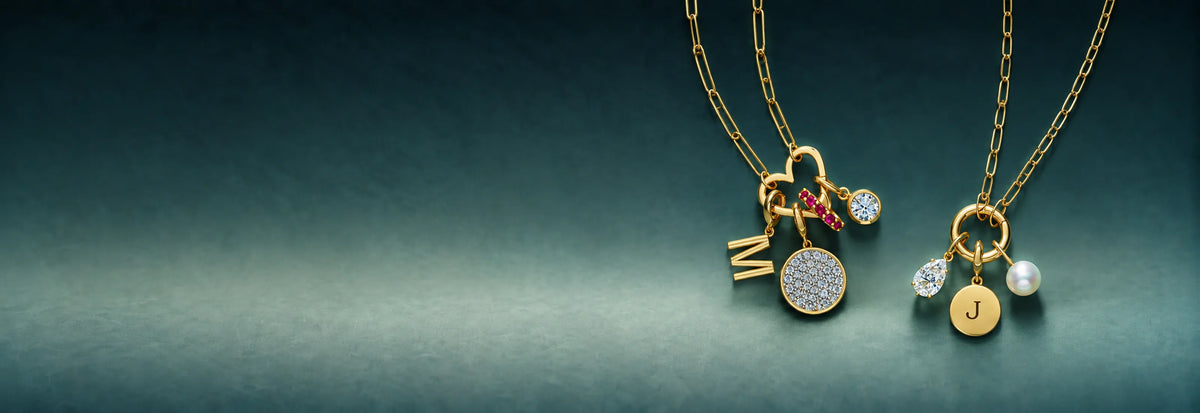
Gold charm necklaces with initial, heart and stone charms on a dark teal background

Necklaces built around a charm

Gold Charm Necklaces

Necklaces whose design centres on a charm rather than the chain. Guidance below covers how a charm is carried, and what to check when pairing one with a chain.

Gold Charm Necklaces

A charm necklace is unusual among pieces of jewelry in that it is rarely finished. It may be bought complete, with its elements already fitted and spaced by the maker, or it may begin as a chain carrying one charm and gain others across a decade. Either way the object is a composition rather than a single form, and the questions it raises are compositional: how the elements are spaced, whether they are fixed or free to move, where the weight collects, and what the chain beneath is asked to hold. Some designs combine yellow, white and rose gold in one piece, and the listings state the colours.

View as

A Necklace Assembled Over Time

Whether it arrives complete or is assembled across years, a charm necklace is a piece whose appearance is decided by arrangement rather than by a single design. The elements can be fixed or free, evenly spread or gathered, bought in one go or one at a time, and each of those choices alters both how the necklace looks and how it behaves once it is on.

Charm Necklace Questions

What is a charm necklace?

A charm necklace is a chain carrying one or more small decorative elements, either fixed into the chain at intervals or hung from it in a way that lets them move along it.

It differs from a plain pendant necklace in being a composition of several parts rather than one, and in being open-ended, since elements can usually be added to it later.

Some are sold complete with the elements already fitted, and others are bought as a starting point. The listing states which of the two is on offer.

Does a charm necklace have to be complete when it is bought?

No. Many are bought as a beginning rather than as a finished object: one chain, one element, and the expectation that others will follow over the years.

That changes what to look for. The chain has to suit the piece as it will eventually be and not only as it is on the first day, and the opening charm has to hold the composition on its own.

Necklaces sold already assembled are a different proposition altogether and are chosen the way any finished necklace is chosen, on how the whole thing looks rather than on what it might become later.

What is the difference between fixed charms and hanging charms?

A fixed charm is built into the chain at a set position and stays there. A hanging charm is carried on the chain in a way that lets it slide along it.

Fixed spacing preserves the arrangement exactly as it was designed, which suits pieces meant to look composed and even. Sliding elements gather at the lowest point of the chain, which is the centre front.

The two produce quite different necklaces from much the same components: one an even run of elements spread along the arc, the other a cluster gathered at the throat that reassembles itself each time.

Why do the charms end up at the front?

Because a chain hangs in a curve and the lowest point of that curve is the centre front. Anything free to slide finds its way there and then stays.

This is not a fault, and it cannot be prevented on a free-hanging arrangement. It is simply what a movable element does on a suspended chain.

Fixed stations are the answer wherever an even spread is wanted, because they are held within the chain itself rather than merely resting on it, and their intervals therefore survive being worn and put away.

Should charms be spaced evenly along the necklace?

On a station necklace they generally are, and the interval is part of the design. Even spacing gives the piece a calm, deliberate look and keeps the weight distributed along the chain.

On a necklace whose elements hang free, even spacing is not available at all; they will collect at the centre whatever their starting positions were.

What matters more than evenness is that neighbours are not closer than roughly their own width, since below that they overlap and turn each other out of view.

Does adding charms change the way the necklace hangs?

Considerably, and the change is felt as much as it is seen. Each addition puts mass at a particular point, and a chain redistributes itself until its heaviest point has become its lowest one.

A gathered group draws the chain forward and down at the centre, deepening the curve and lifting the sides. The same chain worn plain sits quite differently on the chest.

Fixed stations spread the same weight along the arc, so the curve stays much closer to its original shape as elements are added to it.

Why does the fastening sometimes travel round to the front?

A suspended chain rotates until its heaviest point hangs lowest. On a plain chain the fastening is often the single heaviest component, so it works its way round over the course of a day.

Adding elements usually settles the matter. Once the mass gathered at the centre front exceeds the mass of the fastening, the necklace has a reason to stay as it was put on.

An unevenly loaded necklace, with most of its elements gathered to one side of centre, will rotate to bring that side down, which is a different problem arising from the same cause.

What kind of chain suits a necklace that will carry several charms?

One with enough profile to take a load at a single link without that link deforming, and a link form that closes fully rather than being simply bent to shape.

Plainer chains work better as carriers, because the added elements are meant to be the subject. Heavily figured chains compete with whatever hangs from them.

Very fine chains suit one small element and become the limiting part of the piece once there are several, so it is worth choosing for the eventual load.

Should the charms on a necklace match one another?

They need not. A necklace assembled over time is usually a mixture, and the mixture is the point; a set of identical elements produces a station necklace rather than a collection.

Where a piece is bought complete, the maker has generally worked to a single theme, in one metal or in a deliberate combination of yellow, white and rose gold.

The one thing worth keeping consistent is scale. Elements of wildly different sizes on one chain read as an accident rather than as an accumulation.

Are charm necklaces sold with the charms already attached?

Some are. A complete necklace arrives with its elements already fitted and spaced by the maker, and it is worn exactly as it comes out of the box, with nothing further to decide.

Others are sold as chains intended to be built upon over time, or as single elements meant to be added to a chain or a necklace that is already owned.

The listing describes what is included in each case, and it repays reading before ordering, since the two can look very similar in a photograph.

Compare /3

Loading...