Free shipping on all orders over $75 in the United States

When it comes to gold, we guarantee the use of 100% real gold in all our gold products.

FLASH SALE— Save 25%

HAPPY25NOW
Italian Franco gold chain

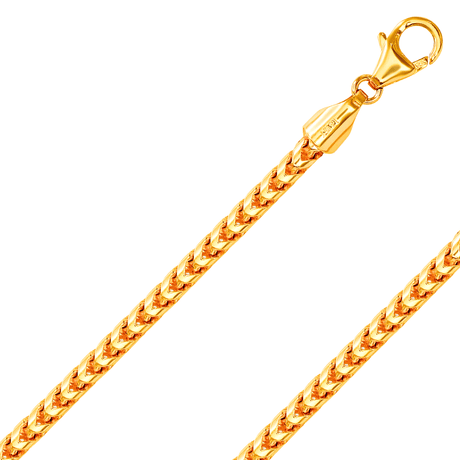
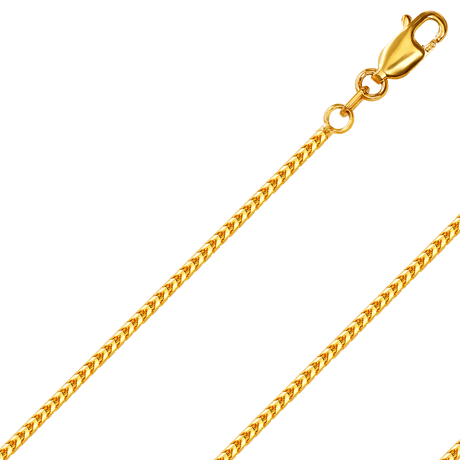
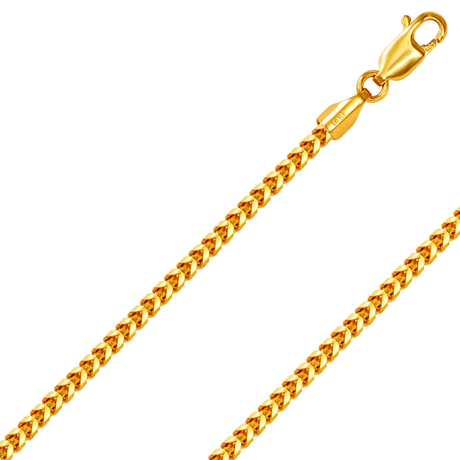
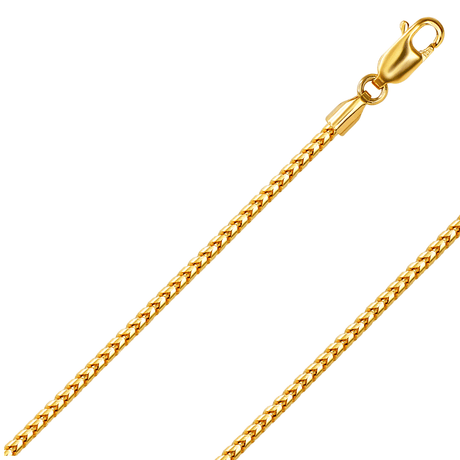
Franco Gold Chain

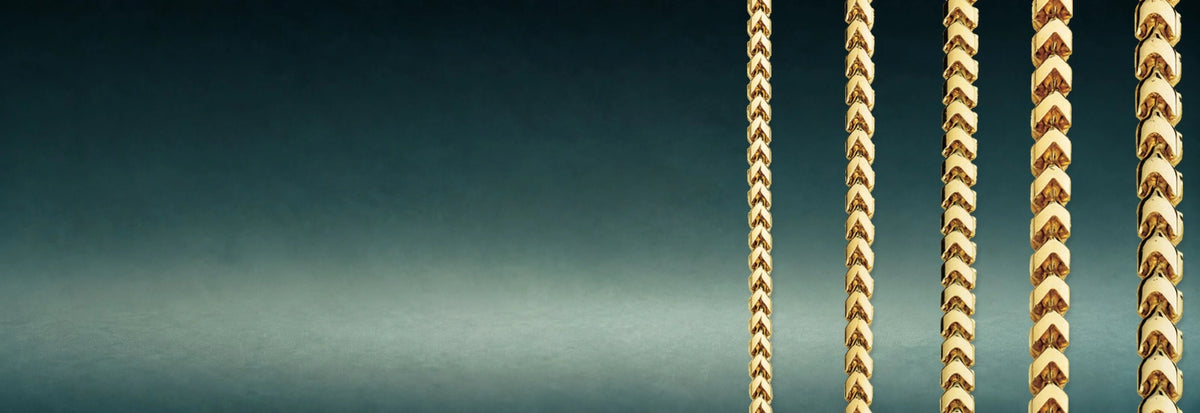
Franco Gold Chains — The Strongest Chain Construction Available.

The Franco chain's V-shaped links are woven together in a four-sided pattern that distributes tension across all four sides of each link simultaneously. Standard oval-link chains have a single hinge point per link where stress concentrates — the Franco eliminates that weakness. At heavier widths where other chains have breaking points, the Franco holds.

Why the V-Link Structure Matters

A Cuban or Figaro chain carries the load through one contact point per link. The Franco's four-sided construction spreads that same load across four surfaces — making it structurally the most break-resistant chain style for daily wear at any width above 4mm.

How Franco Chains Wear Over Time

The squared profile means minor surface scratches diffuse into the chain's texture rather than marking a flat surface clearly. A well-worn Franco retains its appearance longer than flat chain styles under the same daily wear conditions.

View as

What is a Franco gold chain?

A Franco gold chain is a fine jewelry necklace constructed from square, interlocking gold links woven together in a tight V-shaped or X-shaped pattern. The dense, interlocked construction creates a chain that is exceptionally rigid, strong, and resistant to kinking — one of the most durable and structurally sound chain styles available.

The Franco chain's defining characteristic is the way its square links interlock: each link is twisted and woven through adjacent links in a precise repeating pattern, creating a chain surface with a subtle herringbone-like texture of interlocked squares. Unlike rope chains — which achieve their helical structure from round links twisted together — the Franco chain's square links create a flatter, more structured appearance with sharper geometric edges. The result is a chain that looks sleek and refined from a distance, but reveals an intricate, tightly-woven architecture on close inspection. The Franco chain's rigidity is its most distinctive physical property: it maintains its shape even when laid flat, without the natural draping softness of rope, box, or Cuban chains.

Franco gold chains are available in 10K, 14K, and 18K yellow, white, and rose gold, in widths ranging from 1mm to 6mm and above. Their combination of exceptional durability, refined appearance, and structural strength has made them a favorite for both pendant chains and standalone statement necklaces.

How is a Franco gold chain constructed?

A Franco chain is constructed from square gold links that are individually twisted and interlocked in a continuous V or X pattern. Each link passes through two adjacent links simultaneously, creating a chain where every link is held by four connections rather than the two connections of simpler chain styles.

The Franco chain construction begins with square wire links formed at precise dimensions. Each link is then twisted 45 degrees and fed through the two links immediately adjacent to it — one from each side — before being closed. This four-point interlocking creates the Franco chain's signature density: every link in the chain is locked in place by four neighbors simultaneously, giving the chain exceptional structural integrity. When tension is applied to a Franco chain, the stress is distributed across all four connections of each affected link rather than concentrated at one or two points, as in simpler chain constructions. This load distribution is why Franco chains are among the most pull-resistant chain styles in fine jewelry.

The Franco chain's construction quality is visible in the consistency and tightness of its weave. Well-made Franco chains have links of perfectly uniform size with no visible gaps, misalignments, or variations in link spacing. The chain's surface should have a consistent, structured texture without any loose or protruding links anywhere along its length. Inconsistent link spacing is the most common quality indicator to examine when evaluating a Franco chain.

Why is it called a Franco chain?

The Franco chain takes its name from its Italian jewelry manufacturing heritage — 'Franco' is an Italian given name, and the chain style is believed to have been developed or popularized by Italian goldsmithing craftspeople who created the distinctive four-point interlocking link construction.

Italy's jewelry manufacturing centers — particularly Arezzo, Vicenza, and Valenza — have historically developed many of the world's most important chain styles, including the Franco chain. The Franco chain's name reflects this Italian origin, though like many chain style names, it has become a generic designation used globally rather than a trademark tied to a specific manufacturer or region. The chain is sometimes also called the V-chain (for the V-shape of its link pattern when viewed closely) or the Franco box chain (acknowledging its relationship to the box chain construction). Regardless of name, the four-point interlocking square link construction is the defining characteristic that all Franco chains share.

Understanding the chain's Italian heritage also explains why Italian-manufactured Franco chains are particularly valued: the goldsmiths who developed the Franco construction continue to produce it at the highest levels of precision and quality, with authentic Italian assay hallmarks certifying gold purity. When you encounter a Franco chain with Italian hallmarks, you're buying the chain style from the tradition that created it.

What makes a Franco chain unique compared to other chain styles?

A Franco chain is unique for its four-point interlocking square link construction, which makes it the most structurally rigid and kink-resistant of all common fine gold chain styles. Its tight weave creates a chain that maintains its shape under stress, resists permanent deformation, and has exceptional pull resistance.

Every other classic gold chain style has a two-point connection between adjacent links: each link connects to the one before it and the one after it. The Franco chain's design doubles this to four connections: each square link interlocks with two links on each side simultaneously. This architectural difference has profound consequences for the chain's behavior under stress. A standard chain concentrates pulling force at single link connections; a Franco chain distributes that force across four connections per link. The result is a chain that resists deformation, kinking, and breakage at a level that simpler chains cannot match. This property makes Franco chains particularly valued for pendant use — the pendant's weight and movement stress the chain constantly, and the Franco construction handles this better than most alternatives.

The Franco chain's rigidity also gives it a distinctive drape quality: unlike soft, fluid chains like rope or Singapore that move with the wearer's body, the Franco chain holds its form more firmly, lying against the skin with a structured, architectural quality. This rigidity is a character feature as much as a structural advantage — it gives the chain a bold, confident presence on the body that softer chain styles don't have.

How does a Franco chain compare to a rope chain?

A Franco chain has a flat, structured surface of interlocked square links with exceptional rigidity and pull resistance. A rope chain has a round, helical structure of twisted round links with multi-directional sparkle and softer drape. Franco chains are stronger and more rigid; rope chains are more brilliant and fluid.

Both Franco and rope chains are known for their durability relative to flat-link chains like herringbone or box chains, but they achieve their strength through very different constructions. The rope chain's helical twist creates inherent strength through structural geometry — the links support each other through the spiral pattern. The Franco chain's four-point interlocking creates strength through sheer connection density — every link is locked in place by four neighbors. In terms of pure kink resistance, the Franco chain is superior: the rigid, locked construction resists bending more effectively than the rope chain's helical structure. In terms of sparkle, the rope chain wins decisively — its multi-faceted twisted surface scatters light brilliantly in all directions, while the Franco chain's more controlled surface catches light in a more structured, less dazzling way.

For pendant use, both styles work extremely well, but the Franco chain's rigidity makes it especially reliable for heavier pendants that might stress weaker chains. For standalone wear, the choice comes down to aesthetic preference: the rope chain's brilliant sparkle vs. the Franco chain's structured, architectural character. Both are durable enough for daily wear.

How does a Franco chain compare to a Cuban link chain?

A Franco chain has tightly interlocked square links with a V-pattern surface and exceptional rigidity. A Cuban link chain has flat, oval links set at a slight angle in a dense, ribbon-like pattern. Both are known for durability, but Franco chains are more rigid and kink-resistant; Cuban chains are bolder and heavier for comparable widths.

The Franco and Cuban chains are the two most durable link-based chain styles in mainstream fine jewelry, and they're often compared. The Cuban link's flattened oval links create a chain that's heavy, bold, and extremely strong, with a wide, flat surface that lies against the skin with visual mass. The Franco chain's square interlocked links create a chain that's lighter per comparable width (because the four-point connection uses less metal volume than the Cuban's solid flat links), but with superior kink resistance — the locked construction makes the Franco chain functionally rigid in a way the Cuban's pliable oval links are not. For maximum gold content per inch, the Cuban chain is more efficient; for maximum structural resistance to bending and kinking, the Franco chain is superior.

The visual characters are also quite different: the Cuban link has a bold, solid-surface presence that projects weight and power; the Franco chain has a more refined, structured look that suggests precision and quality without the Cuban's visual mass. Both are excellent chains for men's jewelry but suit different aesthetics and use cases.

How does a Franco chain compare to a box chain?

A Franco chain is a structural evolution of the box chain — both use square links, but the Franco interlocks each link with four neighbors instead of two. This makes the Franco chain dramatically more rigid, kink-resistant, and pull-resistant than the standard box chain, at the cost of greater weight and less flexibility.

The box chain connects square links end-to-end in a simple sequential pattern: each link has one connection at each end. The Franco chain evolves this by interlocking each link with two neighbors on each side — the same square link format but with four times the connection points. The structural result is dramatic: a box chain of a given width flexes fairly easily and can be kinked by moderate bending force; a Franco chain of the same width is far more rigid and resists kinking under forces that would permanently damage a box chain. The Franco chain is also heavier per inch than a box chain of equivalent width because the four-point interlocking uses more material.

For pendant chains, the Franco chain's greater structural rigidity makes it a superior choice for heavier pendants or active wear. For a delicate, lightweight chain where flexibility and minimalism are the priority, the box chain is appropriate. For maximum durability in a chain that needs to handle regular stress, the Franco chain is the significantly stronger option.

How does a Franco chain compare to a Figaro chain?

A Franco chain has uniform square interlocked links throughout its length with exceptional rigidity. A Figaro chain has an alternating pattern of one long oval link and two or three shorter round links, creating a flat, elegantly patterned chain. Franco chains are stronger and more structured; Figaro chains are more visually distinctive and traditional.

The Figaro chain's alternating long-short link pattern creates a chain with immediate visual personality — the rhythmic variation between the long oval and short round links makes the chain's pattern recognizable at a glance. The Franco chain's uniform interlocked weave is more subtle at a distance but reveals its precision on close inspection. Both chains are flat and lie against the skin comfortably, but the Franco chain is significantly more rigid due to its four-point interlocking. The Figaro's two-point connections flex normally, giving it a softer drape than the structured Franco chain.

For pendant chains, both work well, but the Franco's superior rigidity makes it more appropriate for heavier pendants or active daily wear. For standalone styling where the chain's pattern is the visual focus, the Figaro's rhythmic long-short pattern provides more instant personality than the Franco's uniform weave. Both have Italian heritage and fine jewelry credentials.

How does a Franco chain compare to a Singapore chain?

A Franco chain has interlocked square links with exceptional structural rigidity and pull resistance. A Singapore chain has woven oval links with a flat drape and multi-angle shimmer. Franco chains are substantially stronger and heavier; Singapore chains are finer, more delicate, and produce more sparkle per gram.

These two chain styles serve very different purposes. The Singapore chain is a fine, delicate pendant chain optimized for shimmering beauty at minimal weight and width. The Franco chain is a structurally optimized chain designed for strength, rigidity, and durability — it can handle weights and stresses that would damage a Singapore chain. In terms of visual character, the Singapore chain sparkles more dynamically from its many small woven facets, while the Franco chain has a more controlled, structured gleam from its square interlocked surface. The Singapore chain is typically 0.5mm to 3mm wide; Franco chains are commonly available from 1mm to 6mm or wider.

Choose a Singapore chain for a delicate, sparkling pendant chain where the chain should be barely-there. Choose a Franco chain for a strong, reliable pendant chain for heavier pieces, or for a standalone chain with presence and structural confidence. The two chains are rarely direct alternatives — their construction philosophies are entirely different.

What metals are used in Franco gold chains?

Franco gold chains are crafted from 10K, 14K, or 18K gold, alloyed with copper, silver, and sometimes zinc or palladium. The alloy blend determines the chain's color, hardness, and karat purity — all important considerations for the Franco chain's characteristic weight and rigidity.

Pure 24K gold is too soft to maintain the precise square link dimensions that the Franco chain's four-point interlocking requires, so jewelers alloy it with harder metals for dimensional stability. Yellow gold Franco chains use copper and silver alloys that preserve the warm gold color while providing the necessary link hardness. White gold Franco chains use nickel, palladium, or zinc alloys and are typically rhodium-plated — the Franco chain's structured square link surface reflects the bright rhodium finish in a crisp, faceted way that complements the chain's geometric character. Rose gold Franco chains use a copper-heavy alloy that gives the square interlocked links a warm, pinkish-gold tone that contrasts interestingly with the chain's bold geometric structure.

Yellow gold Franco chains are the most traditional and most popular choice, particularly in wider widths where the warm gold color and the chain's bold structure create a powerful visual combination. White gold Franco chains have a modern, contemporary quality that's especially popular in thinner widths for everyday pendant chains. Rose gold Franco chains offer a distinctive look that combines geometric strength with warm romantic color.

About Franco Gold Chains

Built for the Width That Other Chains Can't Handle

The Franco chain's V-shaped link construction was developed specifically to handle heavier widths without the structural weakness that affects other chain patterns. Standard oval-link chains — Cuban, Figaro, Rope — all have a single hinge point per link where stress concentrates. At heavier widths, this creates a predictable breaking point. The Franco's four-sided construction distributes tension across all four sides of each link simultaneously, making it structurally resistant to the lateral forces that break other chains.

This is why the Franco became the preferred construction for chains in the 6mm+ range. At those widths, a Cuban or Figaro chain has enough weight that the hinge points are under constant stress. A Franco at the same width carries the load through four contact surfaces rather than one — genuinely more durable, not just visually bolder.

The Franco's squared profile also wears differently over time. Because it doesn't have flat surfaces the way a Cuban or herringbone does, minor surface scratches diffuse into the chain's texture and become less visible. A well-worn Franco retains its appearance longer than flatter chain styles under the same conditions.

Compare /3

Loading...