Free shipping on all orders over $75 in the United States

When it comes to gold, we guarantee the use of 100% real gold in all our gold products.

FLASH SALE— Save 25%

HAPPY25NOW
Italian gold earrings

Gold Earrings

Gold Earrings — The Jewelry Worn Closest to the Face.

Earrings are the only jewelry that makes direct, prolonged contact with sensitive skin — the earlobe and the area around a piercing. Metal choice matters more here than for any other piece. The construction and hardware quality are what determine whether earrings stay comfortable over hours of wear.

Hoops, Studs & Drop Styles

Hinged hoop earrings are more secure and easier to put on than tube hoops. For larger, heavier hoops, the hinge design is significantly more reliable for daily wear. Small hoops in the 10–15mm range work well in either construction; larger hoops above 25mm are better served by a hinged design.

What Post Quality Actually Means

A thicker post distributes the earring's weight across more of the piercing — more comfortable for extended wear. Very thin posts on heavier drops can cause the earring to pull the piercing over time. For earrings worn for long periods, post thickness matters as much as the design.

View as

What are gold earrings?

Gold earrings are earrings made from genuine gold alloy — 10K, 14K, or 18K — as distinct from gold-plated, gold-filled, or gold-tone earrings that use base metal with a surface gold coating. Solid gold earrings contain real gold throughout the metal, carry a karat hallmark, and retain intrinsic precious metal value permanently. They are among the most universally worn and gifted pieces of fine jewelry.

The distinction between solid gold earrings and gold-tone or plated alternatives matters enormously in the earring category because earrings are in constant, close contact with the body — specifically with the skin of the earlobe. Base metal beneath gold plating can cause irritation, discoloration, and allergic reactions as the plating wears through. Solid gold earrings, by contrast, are biologically inert and hypoallergenic, making them the appropriate choice for sensitive ears and long-term daily wear.

When buying gold earrings: the karat stamp ('14K', '585', '18K', '750', '10K', or '417') should appear on the post, earwire, or earring body itself. For studs, the stamp is typically on the back of the stud or the butterfly backing post. For hoops and drop earrings, it appears on the earwire or a link near the earring's top connection. The absence of a karat stamp on a 'gold' earring is not an oversight — it's disclosure that the piece is not solid gold.

What is the difference between 14K and 18K gold earrings?

14K gold earrings: 58.3% pure gold, harder alloy, more durable for daily wear, warm yellow color, lower cost per gram — the most popular karat for everyday earrings in the US. 18K gold earrings: 75% pure gold, softer alloy, richer deeper yellow color, higher cost per gram — preferred for fine jewelry pieces worn occasionally. Both are genuine solid gold; the practical difference for earrings is primarily durability and color richness.

For earrings specifically, the 14K vs. 18K decision has a clear practical dimension: earring posts, wires, and clasps experience constant mechanical flexion — insertion, removal, and daily movement stress the metal. 14K's harder alloy withstands this mechanical use better than 18K over years of daily wear. Posts are less likely to bend; wires are less likely to fatigue and crack. For earrings worn daily, 14K's durability advantage is meaningful.

18K earrings are the appropriate choice when: (1) the earrings are worn for occasions rather than daily; (2) the richer gold color is aesthetically important; (3) the buyer has known sensitivity to alloying metals and 18K's higher gold content reduces non-gold metal exposure. The color difference between 14K and 18K yellow gold is subtle but real — visible when compared directly side by side.

Are gold earrings hypoallergenic?

Solid gold earrings in 14K, 18K, or 24K are among the most hypoallergenic earring options available. Pure gold itself is biologically inert — it does not react with skin chemistry. Most earring reactions attributed to 'gold' earrings are actually reactions to nickel, a common alloying metal in some white gold and lower-quality yellow gold alloys. Italian 14K yellow gold alloys typically use copper, silver, and zinc without nickel, making them appropriate for most sensitive ears.

The hypoallergenic claim requires qualification based on karat and alloy composition. 24K (pure gold) is the most hypoallergenic because it contains no alloying metals. 18K contains 25% alloying metals — less than 14K. 14K contains 41.7% alloying metals. Yellow gold alloys without nickel are generally well-tolerated. White gold alloys containing nickel (a common sensitizer) can cause reactions that are mistakenly attributed to 'gold' itself.

For buyers with known metal sensitivities: request the alloy composition from the seller — specifically whether nickel is present in the alloying metals. Italian 14K yellow gold from quality manufacturers uses nickel-free alloys. White gold earrings from some manufacturers use nickel-containing alloys; others use palladium-based white gold alloys (nickel-free). If you've reacted to previous 'gold' earrings, the issue was almost certainly nickel in the alloy, not the gold itself.

What does 585 mean on gold earrings?

The '585' stamp on gold earrings is the European/Italian decimal hallmark for 14-karat gold, meaning 585 parts per 1,000 are pure gold — equivalent to 58.5% gold content. '585' and '14K' are legally equivalent designations for 14-karat gold. Italian gold earrings commonly use '585' as their primary purity stamp alongside a manufacturer registration code and an assay office mark — the three marks that constitute full Italian triple hallmarking.

Italian hallmarking uses the decimal fineness system rather than the US karat system. The number 585 is more precise than '14K' — it specifies the exact proportion of gold per thousand rather than a fraction of 24. Both marks confirm identical gold content. When shopping for earrings, '585' on the post or earwire confirms genuine 14-karat Italian gold just as definitively as '14K' on a domestic piece.

Full Italian triple hallmarking on earrings: look for three distinct marks on the post, earwire, or a small cartouche — (1) 585 or 750 (purity), (2) an alphanumeric manufacturer code, and (3) a geometric assay office symbol. All three together confirm that the gold content was independently tested and certified by an Italian government laboratory before the earrings entered commerce.

Why are Italian gold earrings considered the best quality?

Italian gold earrings from Arezzo manufacturers represent the global quality standard because of: alloy formulations optimized over generations for rich color and durability; precision casting and finishing that produces clean, consistent details; surface finishing that creates exceptional brightness; and mandatory Italian government triple hallmarking — independent assay verification that no other major gold-producing country requires.

The Arezzo advantage in earring manufacturing is particularly visible in the details: the smoothness of a hinge on Italian gold hoop earrings; the evenness of a pavé stone setting; the clean finish on a post. These details result from machinery, processes, and quality control systems developed over 70+ years of specialization in precision gold jewelry manufacturing. The quality difference is tactile before it's visual.

Italian triple hallmarking is the buyer's most powerful protection: before a piece reaches the market, an Italian government assay office tests it and confirms its gold content. This is third-party certification, not a manufacturer's self-declaration. The assay office mark on Italian earrings means a government laboratory confirmed the gold content — not just that the manufacturer claimed it.

What are the most popular gold earring styles?

The most popular gold earring styles: stud earrings (single stone or gold shape, pressed against the earlobe, most classic and versatile); hoop earrings (circular or oval rings through the ear, from small huggies to large statement hoops); drop/dangle earrings (hang below the earlobe, from simple drops to elaborate multi-link designs); huggie earrings (small, tight-fitting hoops that 'hug' the earlobe); and chandelier earrings (multi-tier drops, formal and statement).

Each earring style serves a different occasion and aesthetic purpose. Studs are the universal daily earring — appropriate from boardroom to beach, invisible at the right size or statement-making at larger scale. Hoop earrings span from delicate (2–3mm thin) to bold (60mm+ diameter), making them among the most versatile styles. Drop earrings create movement and elongate the face, making them particularly flattering for formal occasions. Huggies have become one of the most popular styles of the past decade — small enough for daily comfort, close enough to feel secure.

The current style moment in gold earrings: layered ear stacking (multiple earrings in multiple piercing positions, mixing studs, hoops, and huggies) has made it standard to own a range of earring types rather than one pair. Gold earrings of different sizes and styles mix well when they share the same metal tone — all 14K yellow gold at different scales creates a cohesive stack without visual conflict.

What are huggie earrings?

Huggie earrings are a style of small hoop earring with a thick, flat body that fits snugly against the earlobe, 'hugging' it closely. The hoop diameter is typically 8–15mm — small enough to sit flush against the ear with minimal movement. Huggie earrings close with a hinge-and-click mechanism rather than a traditional earwire, making them secure enough for active daily wear and comfortable enough for sleep.

Huggie earrings have become the most popular everyday gold earring style of the past decade because they solve the practical problems that make other styles less convenient: they're secure (the click closure doesn't open accidentally), they don't catch on hair or clothing (their small profile stays close to the ear), they're comfortable (their weight and size don't pull on the earlobe), and they're easy to insert and remove. They also stack exceptionally well with studs in higher ear positions.

Huggie quality differentiation: the hinge mechanism is the critical quality indicator for huggie earrings. A quality Italian gold huggie closes with a clean, definitive click and requires deliberate pressure to reopen — it doesn't pop open accidentally. A poorly made huggie has a loose, uncertain closure that may open during wear. Before purchasing, cycle the hinge through open-and-close several times to assess the mechanism's precision and security.

What are gold hoop earrings?

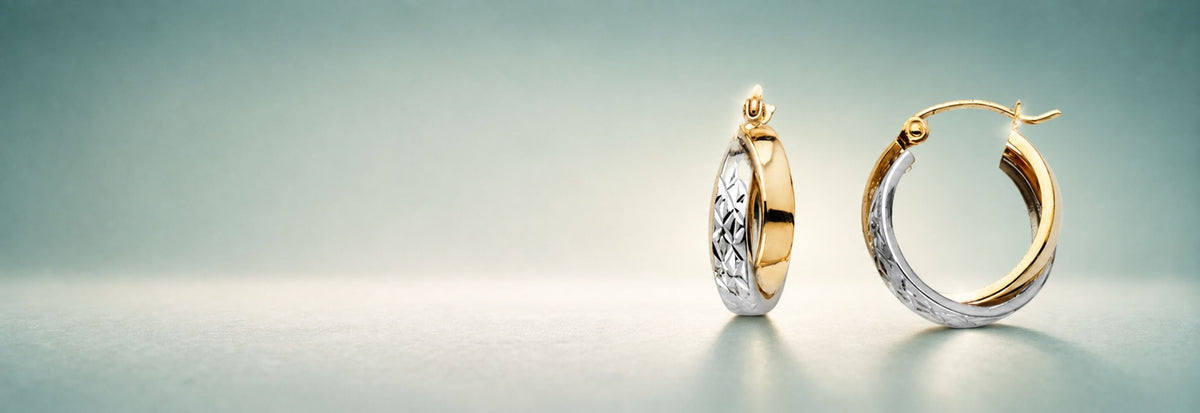
Gold hoop earrings are circular or near-circular rings worn through pierced ears, ranging in diameter from approximately 10mm (small, close to the lobe) to 70mm+ (large statement hoops). They are made in various tube thicknesses (from 1mm wire to 5mm+ tube), different gold finishes (polished, textured, hammered, matte), and with different closures (snap closure, click-close, continuous hoop). Hoop earrings are one of the most universally worn jewelry styles globally.

The hoop earring's dimensional vocabulary: diameter refers to the measurement across the circular opening (10mm = very small; 20–30mm = medium; 40mm+ = statement); tube thickness refers to the diameter of the gold tube forming the hoop (1–2mm = delicate wire; 3–5mm = substantial tube; 6mm+ = bold statement). Diameter and thickness together determine the earring's visual presence — a 40mm hoop in 1mm wire reads very differently from a 40mm hoop in 5mm tube.

Hoop earring closures matter for security: continuous hoops (single wire that passes through the ear and bends to secure itself) are the least secure and most likely to slip out; snap-close hoops (ball-end that snaps into a socket) are more secure; click-close tubes are the most secure and least likely to open accidentally. For daily wear, click-close tube hoops in appropriate diameter provide the best combination of aesthetics and security.

What are gold stud earrings?

Gold stud earrings are single-piece earrings consisting of a decorative front element mounted on a post that passes through the pierced earlobe, secured by a backing (butterfly/push-back, screw-back, or friction back). The front element can be a gemstone, a gold shape, or a combination — anything from a simple gold ball to a pavé diamond cluster. Stud earrings sit flush against the earlobe with no hang or movement.

The stud earring is the most versatile earring style because it works across every context from professional to casual to formal without visual incongruity. A 6mm gold ball stud is appropriate at a board meeting, on a beach, at a wedding, and at a gym. No other earring style has this range. The stud's versatility comes from its profile — it adds a point of brightness at the earlobe without creating movement or drama that might feel inappropriate in conservative contexts.

Stud backing types affect both security and comfort: butterfly/push-back backings are the most common and easiest to use but can loosen over time; screw-back backings provide the most security (thread-on design that won't pop off) and are recommended for children and valuable stones; LaLa/lever-back styles are secure and easy to operate with one hand. For everyday valuable studs (diamond or heavy gold), screw-back backings are the professional recommendation.

What are gold drop earrings?

Gold drop earrings hang below the earlobe, ranging from simple single-element drops (a small gold bar, a teardrop, a pearl) to elaborate multi-link designs with multiple elements in vertical sequence. Drop earrings are distinguished from dangle earrings by their relatively controlled movement — they may swing gently but don't move dramatically with body movement the way longer, looser dangle styles do.

Drop earrings are particularly effective at elongating the visual impression of the face and neck, making them a flattering choice for rounded face shapes. The downward movement draws the eye from jawline to neckline, creating a visual lengthening effect. Drop earrings are also effective at highlighting the neck — a pair of 1'–2' gold drops in a V-neckline frames the face and neckline simultaneously.

Drop earring length considerations: 1/2' drops (12–15mm from lobe to end) are office-appropriate and daily-wear comfortable; 1' drops (25mm) are a clear statement visible at conversation distance; 1.5'+ drops are formal or fashion statements that move significantly with head movement. For daily wear, shorter drops (under 1') provide more visibility and comfort than longer styles that move constantly and potentially catch on hair and collar.

About Gold Earrings

What Most People Get Wrong When Buying Earrings

Earrings are the only jewelry that makes direct, prolonged contact with sensitive skin — the earlobe and the area directly around a piercing. This is why metal choice matters more for earrings than for any other piece. Base metals used in plated earrings — typically brass or copper — oxidize when in contact with skin moisture and can cause reactions at the piercing site. The gold coating wears away fastest at the post, which is exactly where it contacts the piercing. Genuine 10K or 14K gold is biocompatible and doesn't oxidize under normal wear.

The mechanics of hoop earrings are worth understanding when choosing between styles. Hinged hoop earrings — where the hoop opens at a hinge point — are more secure and easier to put on than tube hoops, where the post inserts into a hollow tube. For larger, heavier hoops, the hinge design is significantly more reliable for daily wear. Small hoops in the 10–15mm range work well in either construction; larger hoops above 25mm are better served by a hinged design.

Drop earrings require attention to post gauge. A thicker post distributes the earring's weight across more of the piercing, which is more comfortable for extended wear. Very thin posts on heavier drops can cause the earring to pull the piercing downward over time. For earrings worn for long periods, post thickness matters as much as the design.

Compare /3

Loading...