FLASH SALE — Save 25% | Code: HAPPY25NOW

When it comes to gold, we guarantee the use of 100% real gold in all our gold products.

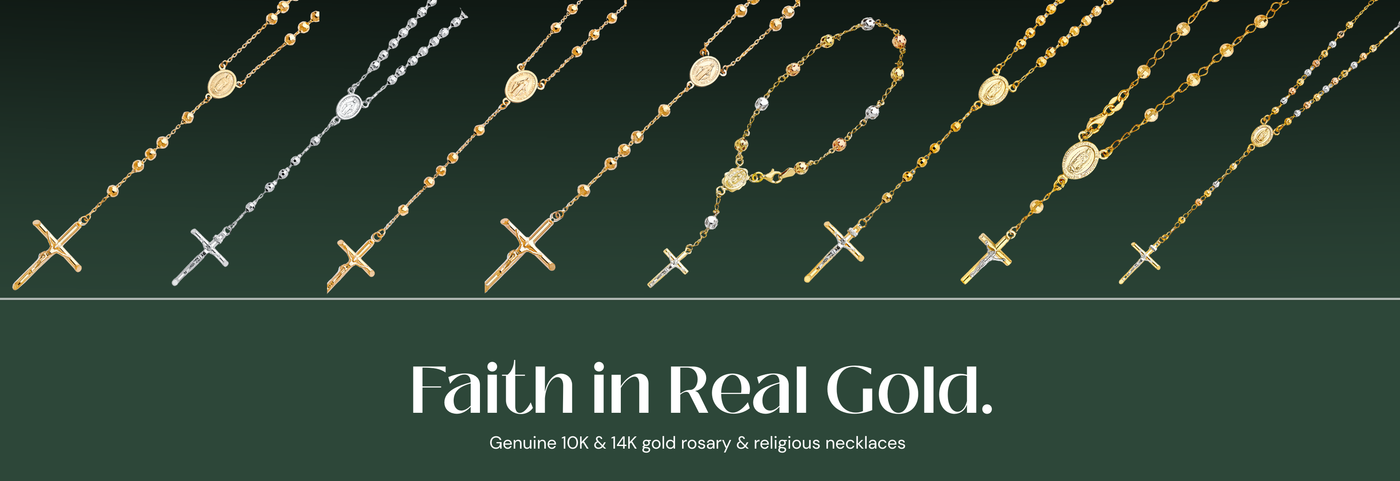
Italian gold rosary and religious necklaces in 10K and 14K

Gold Rosary Necklaces | Rosarios de Oro

Gold Rosary & Religious Necklaces — 10K, 14K, and 18K

Gold rosaries and religious chain necklaces in solid 10K, 14K, and 18K — constructed in Italy, karat-stamped, ships from the U.S. in 1–3 business days. Suitable for devotional use and as commemorative gifts for baptisms, first communions, and confirmations.

Rosaries and Religious Chain Necklaces

A gold rosary is a distinctly different construction from a standard chain necklace: an assembled sequence of specific elements (bead groups separated by single beads, connected to a center medal and crucifix) corresponding to Catholic devotional prayer. Religious chain necklaces are standard chain constructions (box, cable, or rope) with a religious pendant — cross, saint's medal, evil eye — attached. Both are available in this collection.

For Gifting and Occasions

Religious jewelry is frequently purchased as gifts for first communions, confirmations, baptisms, and other milestones. For occasion gifts, 14K or higher is the standard choice to reflect the occasion's significance. Many medals and pendants offer engraving space on the back for name, date, or a short dedication.

View as

Rosary Necklace Questions

How many beads does a five-decade rosary have?

Fifty-nine, in two sizes. Fifty-three of them are small and six are larger, and that difference in size is what allows the divisions to be felt by hand rather than counted by eye at every turn.

Fifty of the small beads form the five decades within the loop. The three that remain sit alongside the sixth large bead on the short strand hanging below the centre.

Rosaries with fewer decades are also made, and a single-decade arrangement is often built as a smaller piece, but the five-decade form is what the word normally describes.

What are the larger beads on a rosary for?

They mark the divisions. A larger bead stands before each group of ten, so a hand moving along the loop registers the change of section by feel alone, without the wearer having to look at what is being held.

In use the two sizes correspond to two different prayers, which is where the names Our Father bead and Hail Mary bead come from in ordinary speech.

On a rosary made as jewelry the same contrast is kept for both structural and visual reasons. An unbroken run of identical beads reads as a plain beaded chain rather than as a rosary.

What is the centrepiece on a rosary?

A small medal or decorative plaque that closes the loop and carries the strand hanging below it. It has three attachment points, two taking the ends of the loop and the third taking the drop.

The medal itself is frequently Marian, and on Mexican and Latin American pieces it often carries an image associated with a particular devotion. Each listing names the design where one is identified.

Because it is a three-way joint under load from every direction, the centre is the component worth inspecting whenever the piece is taken off and cleaned.

Can a rosary necklace be used for prayer?

That depends on how it is built rather than on what it is called. A piece with evenly spaced beads that move freely, and a clear difference between the two bead sizes, can be counted along in the ordinary way.

A piece built tightly as a necklace, with short stiff links and beads set close together, holds its shape well against the chest but will not run through the fingers easily.

Many people keep the two separate, using a cord or a plain rosary for prayer and a linked one as jewelry. The construction described in each listing is the thing to read.

How long is a full rosary when it is worn as a necklace?

Longer than a standard necklace. The loop alone has to accommodate fifty-five beads, and the strand and crucifix hang below that, so the crucifix commonly falls at or beyond the middle of the chest.

That is why most rosary necklaces have no clasp and are simply put on over the head: the circumference is already generous enough to pass without one.

The stated length is measured around the loop rather than from the neck down to the crucifix, so the drop has to be added when picturing where the piece will finish.

Why are some rosary beads made hollow?

Weight, almost entirely. Fifty-nine solid beads make for a heavy necklace, and hollow beads keep the diameter and the appearance while taking most of the mass out of the middle of each one.

The trade-off is a thin wall. A sharp knock dents a hollow bead where a solid one would shrug it off, and a dent in a sphere cannot simply be pushed back out again.

Each listing states how the beads are made. On a long piece worn over the head, hollow construction is often the reason the necklace is comfortable to wear at all.

Does a rosary necklace have a clasp?

Frequently not. A closed loop of that circumference passes over the head unaided, and leaving it continuous removes a component that might otherwise open under the weight of the strand below.

Where a clasp is fitted, it usually sits at the centrepiece, so that the loop opens at its most substantial point rather than between two beads on a fine wire link.

A clasp also allows the piece to be worn doubled or draped differently, which some wearers prefer. The listing says whether one is present on a given piece.

Where do rosary necklaces usually break?

At a link rather than at a bead. Each bead sits on a short wire turned into loops at both ends, and a loop pressed shut rather than wrapped can be sprung open by a snag on clothing or a door handle.

The centrepiece and the crucifix bail are the two other places worth watching, since both carry load arriving from more than one direction at once.

Because the failure is local, the repair usually is as well. A jeweller replaces or closes the affected link without having to disturb the rest of the run.

Can a broken bead link be repaired?

In most cases, yes. A jeweller cuts away the failed wire, threads the bead onto a fresh one, forms new loops at either end and joins it back into the run on both sides.

Wrapped loops take longer, since the wrap has to be cut off before anything can be opened, and hollow beads call for care with any heat applied nearby.

What cannot easily be put right is a crushed bead. A piece that has been trodden on is a different and much larger job than one that has simply come apart at a joint.

When is a rosario given as a gift?

Chiefly at religious milestones. A first communion and a confirmation are the usual occasions, and in some families a wedding, where a long rosary is used as the lazo placed around the couple during the ceremony.

It is also given in remembrance of a relative, and rosaries pass between generations rather more readily than most other jewelry as a result, which is why so many households already hold one.

Because the piece is treated as a personal one, it is usually chosen on its own rather than as part of a set, and any engraving goes on the reverse of the centre.

About Gold Rosary & Religious Necklaces

How a Rosary Is Built, and How It Wears

A gold rosary is a distinctly different construction from a standard chain necklace. Where a chain necklace is a continuous series of identical links, a rosary is an assembled sequence of specific elements: groups of ten beads (decades) separated by single beads, connected to a center medal or crucifix through chain links. Each element of a gold rosary has a specific function in Catholic devotional practice — the bead groups correspond to prayers, the center medal marks the location in the sequence. The construction is therefore liturgically precise as well as decorative.

Gold rosaries are made as both functional prayer objects intended for regular devotional use, and as commemorative or heirloom pieces intended for wearing on significant occasions. Functional rosaries prioritize durable construction: secure bead attachment, strong link connections, and clasps that hold reliably through repeated handling. Heirloom rosaries may prioritize visual quality: higher karat gold, polished bead surfaces, detailed crucifixes. Many buyers choose a mid-range option that serves both purposes.

Religious chain necklaces — crosses, medals, saints' medals, evil eye pendants — are typically standard chain constructions (box chain, rope chain, or cable chain) with a religious pendant attached. What distinguishes religious jewelry buying for many customers is the karat and craftsmanship significance: a first communion gift or a confirmation present is typically chosen at 14K or higher to reflect the occasion's importance, and the engraving option (name, date) on the back of medals and pendants is frequently used for commemorative purchases.

Compare /3

Loading...