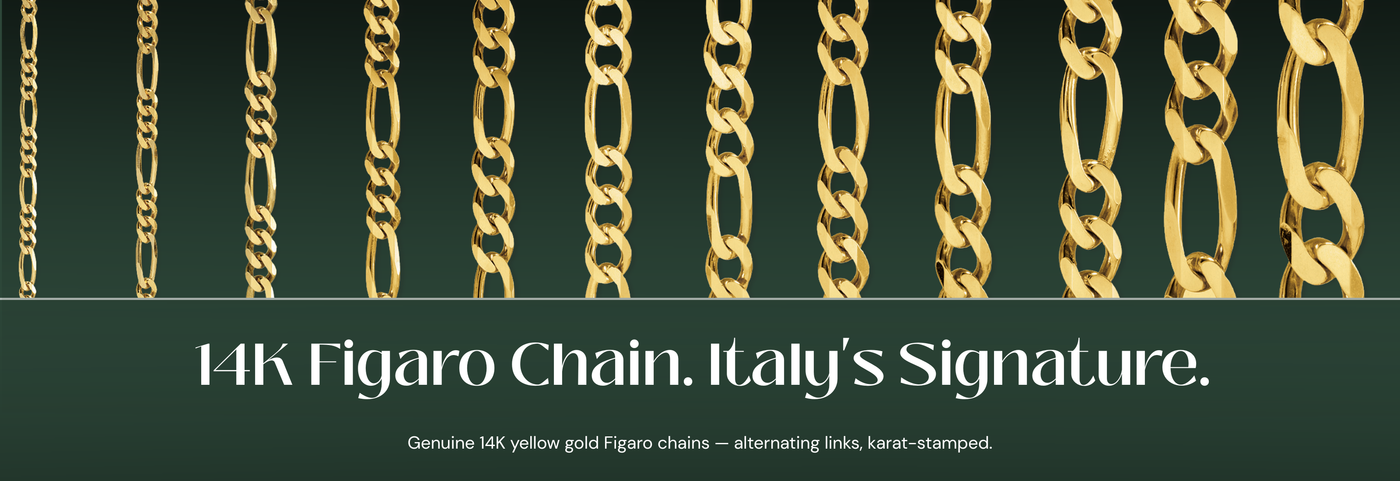
The figaro chain's defining feature is its alternating link pattern — one long link followed by two or three short links, repeating throughout the chain. This sets it apart from uniform-link chains like cable chains (all links the same size), rope chains (twisted wire construction), Cuban link chains (interlocking flat oval links with beveled edges), and box chains (square-profile links). The figaro's alternating rhythm creates visual interest that uniform chains lack at similar widths.
Structurally, the figaro chain is a flat-profile chain, meaning it lies flush against the skin rather than sitting with dimension above it (as rope chains do) or curving with dimensional links (as Cuban link chains do). This flat profile makes the figaro an excellent pendant chain — it lies cleanly under a pendant without bunching, and its flat surface keeps the pendant oriented correctly. The elongated links also create natural stop points for pendants that prevents the pendant from traveling along the chain.
Aesthetically, the figaro occupies a distinctive visual space: more interesting than a plain cable chain, less bold than a Cuban link, with more traditional Italian character than a box or herringbone chain. It reads as classic, timeless, and recognizably Italian fine jewelry — the chain style most associated with traditional gold jewelry gifting traditions in the U.S. and European markets. For men's and women's gold chains, the figaro is the definition of a 'classic' choice.