FLASH SALE — Save 25% | Code: HAPPY25NOW

When it comes to gold, we guarantee the use of 100% real gold in all our gold products.

Italian gold cable chain

Gold Cable Chain

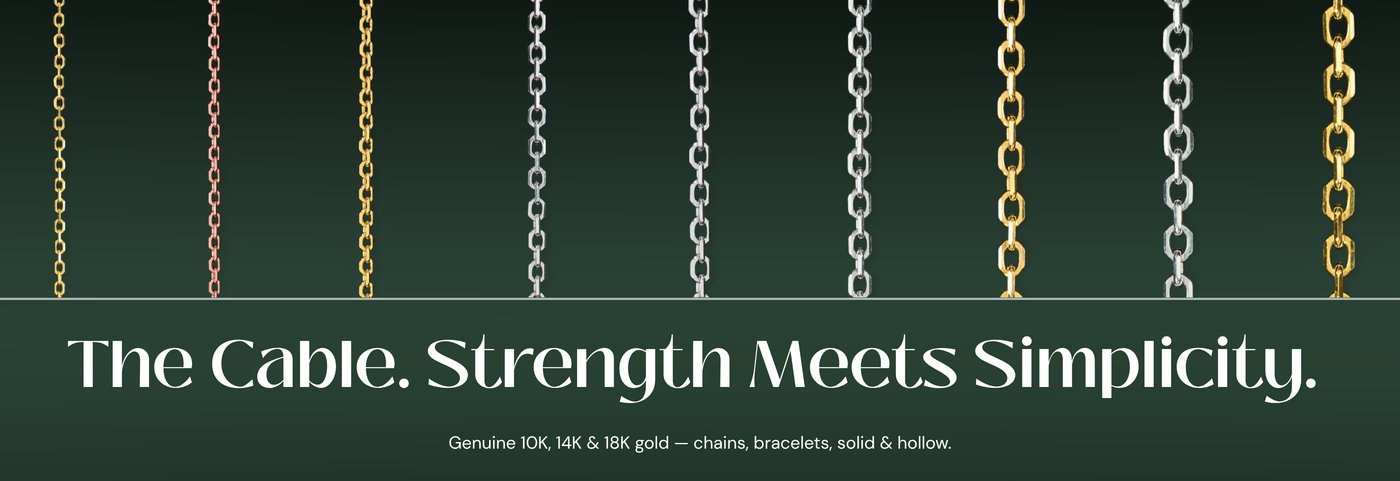
The cable chain is gold jewelry's baseline link design: uniform round or oval links of consistent size, connected at right angles to each other. The result is a chain with equal flexibility in all directions, consistent surface reflection, and predictable drape across the neckline. Cable chains are the most common pendant chain in fine jewelry for a structural reason — the link geometry provides unrestricted movement at the bail, so a pendant hangs centered and straight regardless of weight or movement direction.

Width determines the visual character. Fine cable chains at 1–2mm are used primarily as pendant chains — they carry the pendant and provide the gold connection to the neck while remaining visually understated. Medium cable chains at 2–3mm work both alone and as pendant chains. Substantial cable chains at 4mm and above are worn as statement chains where the chain itself is the visual element. The round link construction catches light differently than flat-link chains — the curved link surfaces create point reflections rather than panel reflections.

Cable chains are among the easiest to repair. Consistent link size and round geometry means a jeweler can replace a damaged link with an identical one and solder the repair invisibly. Over years of daily wear, a link will occasionally weaken or open, and a cable chain can be fixed reliably without visible evidence of repair. For pendant chains specifically, the cable is also resistant to tangling at the bail — the round links don't interlock in the way that flat links can when the chain hangs in contact with a pendant slide.

View as

Understanding the Cable Link

What is a cable chain?

The plain oval-link chain. Each link is an oval ring of round wire passed through the ring before it and turned a quarter turn, so that consecutive links sit at ninety degrees and the chain alternates between links seen face-on and links seen edge-on.

It is the chain most people picture when they hear the word, and the one from which the other styles are described as departures. Its character is set by the thickness of the wire and the size of the oval, and by nothing else.

It is made from very fine widths that carry a small pendant to bold widths with large clear links worn alone. The listing gives the width and the karat and colour of each chain.

Why is the cable link described as the basic chain?

Because nothing has been added to it. An oval ring, joined to the next oval ring, with a quarter turn between them: every element is necessary for the chain to hold together and flex, and no element is there for pattern or effect.

The other link styles can each be explained as a change to this one. Flatten the links, vary their lengths in a sequence, thread each through several others, fold the wire into a square, or twist the run into a spiral, and a named style results.

That is why the cable is used as the reference when chains are compared. It is also why it has no rhythm to preserve and no direction: any link can be opened and any section removed without spoiling anything.

Why do the links of a cable chain alternate direction?

To let the chain bend. Two rings lying in the same plane can only rock against one another. Two rings at right angles swing freely, each moving in the plane the other cannot, so the joint between them is a loose pivot.

Turning every new link a quarter turn from the last gives that pivot at every joint, and the chain bends easily in every direction as a result. The alternation is structural, not decorative.

It is also what produces the look of the chain. Alternate links show their full oval to the eye, and the links between them are seen edge-on as short bright bars, which gives a cable its slightly beaded line.

How does a cable chain hang around the neck?

Loosely and closely. Each joint has a little play, so the chain has no stiffness of its own and settles into whatever curve the neck and collarbone give it. It follows the body rather than standing away from it.

At the front it drops into a smooth curve and moves with the wearer, swinging slightly as they walk. A pendant hung from it swings with the chain and comes to rest at the lowest point.

Because the face-on links are open ovals, skin shows through the chain, and a fine cable reads as a line of tiny loops rather than a solid band. The effect is soft and understated at narrow widths and clearly linked at wider ones.

What decides whether a cable chain looks delicate or heavy?

Two things: the thickness of the wire and the size of the oval. Fine wire in a small oval gives a delicate chain that disappears under a pendant; heavy wire in a small oval gives a compact, dense chain with real weight.

Lengthening the oval opens the chain up. Fine wire in a long oval gives an airy chain with visible gaps; heavy wire in a long oval gives a bold chain of large clear links worn on its own.

The width on a listing is the outside width of the link, which rises with either variable. Two chains of the same width can therefore look quite different if one uses heavier wire and the other a longer link.

Can a cable chain be shortened at any point?

Yes. Every link is a single closed ring that touches only its two neighbours, so a jeweller can cut any ring, lift out the unwanted links, and solder the cut ring closed again around its new neighbour.

There is no pattern to preserve. Since every link is the same and the alternation of direction continues automatically, the chain can be cut at the clasp end, at the far end, or anywhere between, and the result looks as it did.

The same property makes it easy to move a clasp, to join two lengths of matching cable into one, or to attach a pendant with a closed loop by opening one link and closing it through the loop.

Why is a cable chain straightforward to repair?

Because a broken cable has lost one ring, and one ring is all that needs replacing. The failed link is cut out, a new oval of the same wire and size is threaded through its two neighbours, turned the quarter turn, and soldered closed.

No other link is disturbed. In a chain where each link passes through several others, a single failure loosens a whole section; in a cable, the damage stops at the link that broke.

The join is small and, once polished, difficult to find. The one place where care is needed is the seam of a hollow cable link, since a thin tube takes solder less easily than solid wire.

Will a pendant turn on a cable chain?

It may swing, but it does not lock in the wrong position. The bail sits on round wire and the links beneath it pivot freely, so a pendant that has turned in movement swings back to face forward as soon as it settles.

A cable has no flat face, so it does not hold a pendant square the way a chain with flat links does; nor does it twist a pendant sideways. The pendant simply finds the lowest point and hangs there.

A bail wide enough to clear the link comfortably slides along the chain and settles at the front. A bail that grips the wire tightly holds the pendant to one link and can be moved by opening that link.

What widths are cable chains made in?

From well under a millimetre, where the ovals are too small to read individually and the chain is a fine thread under a small pendant, up through one to two millimetres, where the links become visible and the chain is worn on its own.

At three, four and five millimetres the ovals are clearly seen as links, and the chain has enough presence to be worn as the piece rather than as a carrier. Wider still, the links are large enough to be the whole design.

The width reflects both the wire gauge and the oval size, so two chains of the same width can differ in weight and openness. Each listing states the width, the construction and the karat of that chain.

What is a flat cable chain?

A cable whose links have been pressed after assembly so that each oval is flattened in section rather than round. The construction is unchanged; the links still alternate at ninety degrees, but each now has a flat face on either side.

The flattened faces reflect light as small planes rather than as curved wire, so a flat cable is brighter and reads more crisply than a round one of the same width. It also lies a little closer to the skin.

It is treated as an attribute of the cable link rather than a separate style, and appears on listings as a filter or a note in the description. The chain is altered and repaired exactly as a round cable is.

About Gold Cable Chains

How a Cable Chain Is Built and How It Behaves

The cable chain's claim to being the universal pendant chain is structural. When a pendant is attached to a cable chain bail, the round link at the bail point can rotate freely in all directions — the pendant centers itself by gravity regardless of how the chain moves. Flat-link chains (Cuban, Figaro) have links that preferentially lie flat; a pendant on a flat-link chain tends to twist as the chain moves, requiring periodic manual recentering. For any pendant worn consistently — a cross, an initial, a medallion — a cable chain provides the most reliable forward-facing pendant presentation.

Cable chain widths span a wider practical range than most other chain styles because the round link geometry scales cleanly from very fine to very substantial. At 0.8–1mm, a cable chain is almost invisible — a thread of gold that adds warmth to the neck without registering as a chain in its own right. At 1.5–2.5mm, it reads as a fine chain with clear identity. At 3–4mm, the cable becomes a visible piece of jewelry independent of any pendant. At 5mm+, it's a statement chain with real weight and presence.

Cable chains age better than most chain styles because the round link geometry is easy to inspect and maintain. A damaged link in a cable chain is visible — the round shape becomes slightly oval or shows a stress crack — and easy to isolate for repair. A jeweler can cut out the damaged link, add a replacement, and solder both joins cleanly in a repair that is invisible from the outside. This repairability over a long life is one reason cable chains are recommended as the base chain for heirloom pendants: the pendant may be irreplaceable, but the chain can always be renewed.

Compare /3

Loading...