Frete grátis para todos os pedidos acima de US$ 75 nos Estados Unidos

Quando se trata de ouro, garantimos a utilização de ouro 100% verdadeiro em todos os nossos produtos de ouro.

FLASH SALE— Save 25%

HAPPY25NOW
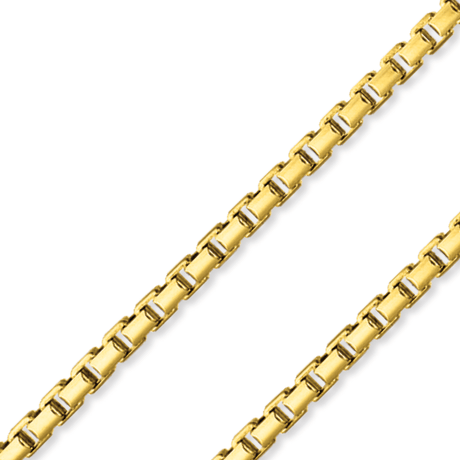
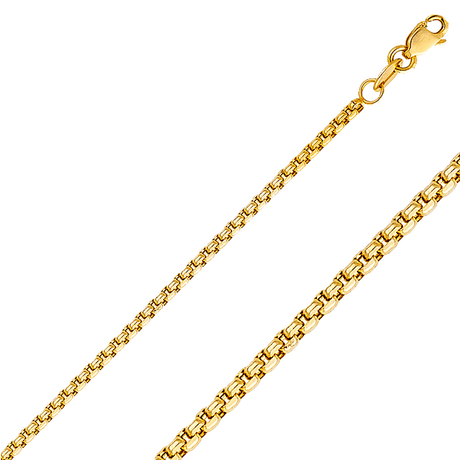
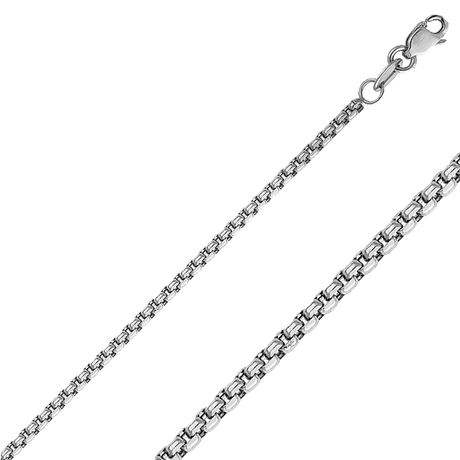
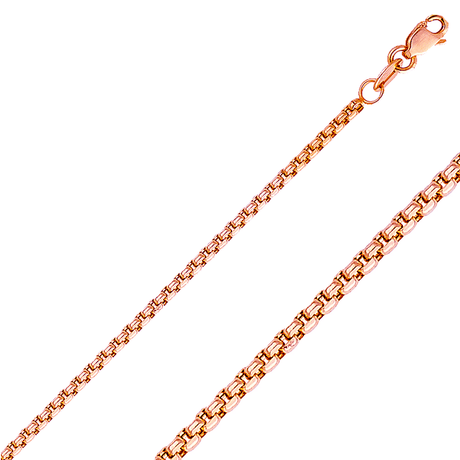
Italian 14K white gold chain

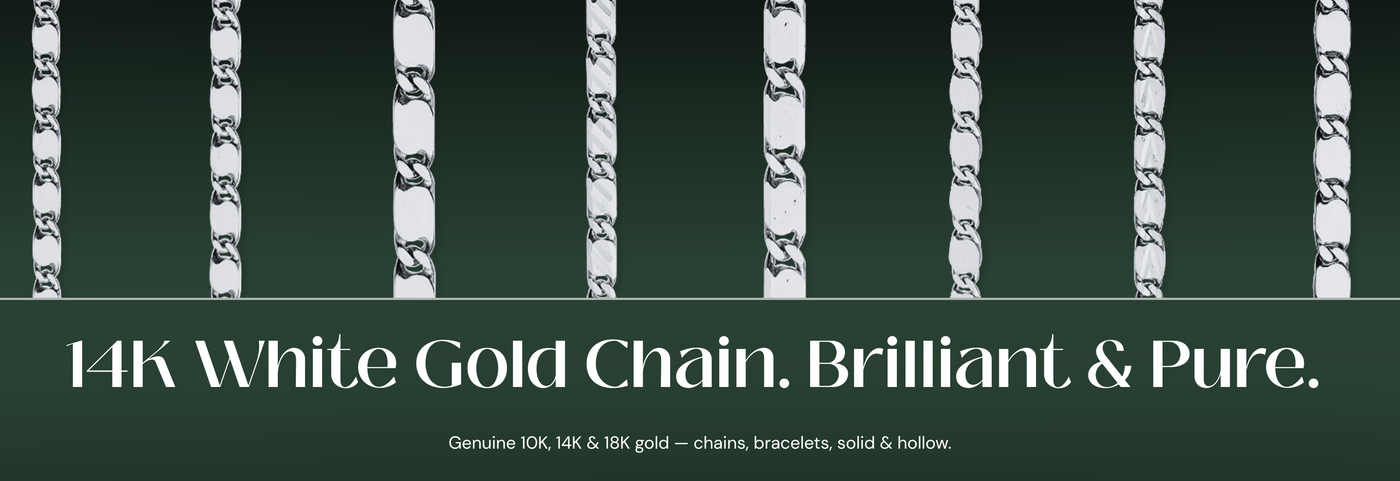
Corrente de ouro branco 14K

Corrente de ouro branco 14K
Ver como

What is 14K white gold?

14K white gold is a gold alloy that contains 58.5% pure gold combined with white-colored metals — typically nickel, palladium, or silver — that neutralize gold's natural yellow color to produce a silver-white metal. The 14K designation means 14 parts pure gold out of 24, placing this alloy at 58.5% gold content. White gold is not a naturally occurring metal; it is engineered through alloying to achieve its characteristic silver-white appearance while retaining the gold content, value, and workability that makes gold the premier precious metal for fine jewelry.

The composition of 14K white gold varies by manufacturer and application. The most common approach uses nickel as the primary whitening agent alongside copper and zinc. Nickel-white 14K gold is hard, durable, and achieves a near-white base color before rhodium plating. A second formulation uses palladium as the primary whitening agent, which is hypoallergenic, naturally white, and more expensive than nickel. Palladium-white 14K gold is preferred for buyers with nickel sensitivity and is used in higher-end jewelry production.

14K white gold chain necklaces are one of the most popular fine jewelry categories in the U.S. market. The combination of genuine 14K gold content, bright rhodium-plated white surface, and versatile neutral color makes white gold chains suitable for wearing with diamonds, colored gemstone pendants, or as standalone chain jewelry. 14K white gold chains are available in all standard chain styles including rope, Cuban link, figaro, box, wheat, and mariner, at a wide range of lengths, widths, and gram weights.

What gives white gold its white color?

White gold's silver-white color comes from two sources working together. First, the alloying process: pure gold is mixed with white-colored metals — primarily nickel, palladium, or silver — that chemically dilute gold's natural warm yellow color. At 14 karats, 41.5% of the alloy is non-gold metal, and if that non-gold portion is composed of sufficiently white metals, the resulting alloy has a pale, near-white appearance. However, the alloy alone rarely achieves a true bright white — it typically has a slightly warm, yellowish-white or grayish-white tone.

The second and more important source of white gold's color is rhodium plating. Rhodium is a platinum-group metal that is naturally bright silver-white, extremely hard, and highly reflective. All commercial white gold jewelry — including chains, rings, bracelets, and earrings — receives a thin electroplated layer of rhodium before sale. This rhodium layer, typically 0.5 to 1.0 microns thick, covers the alloy's base color completely and provides the bright, mirror-like silver-white surface that consumers recognize as white gold's appearance.

The rhodium plating's presence means that the color you see on a new or recently re-plated white gold piece is rhodium's color, not white gold's base alloy color. As the rhodium layer wears over time, the base alloy color begins to show through at high-wear points. On chain necklaces, this typically appears first at the clasp and at link contact points. Re-plating by a jeweler restores the original bright white appearance and is a standard maintenance procedure for white gold jewelry.

How much gold is in 14K white gold?

14K white gold contains 58.5% pure gold by weight. The remaining 41.5% is other metals — typically nickel or palladium (as the primary whitening agent), copper (for hardness and workability), silver (for color adjustment), and sometimes small amounts of zinc. The pure gold content in 14K white gold is chemically identical to the gold in 14K yellow gold, 18K gold, or 24K gold. Karat grade describes the proportion of pure gold in the alloy, not the color of the finished piece.

The gold content is permanent and unchanging throughout the piece's lifespan. A 14K white gold chain purchased today will contain exactly 58.5% pure gold fifty years from now. The gold does not evaporate, oxidize, or diminish over time. This permanent gold content gives 14K white gold its intrinsic, recoverable value: at any time, the piece can be sold to a gold buyer or refinery to recover the pure gold. The gold recovery value is calculated from the piece's gram weight multiplied by 0.585 multiplied by the current gold price per gram.

The rhodium plating on white gold's surface does not change or diminish the gold content. The plating layer is applied on top of the gold alloy and does not mix with or alter the alloy's composition. When a white gold piece is re-plated, the old rhodium layer is stripped and new rhodium is applied. This process does not remove any gold. The gold content before and after re-plating is identical. Re-plating affects only the surface color and finish, not the gold content or intrinsic value.

Is 14K white gold better than 10K white gold for chains?

14K white gold offers meaningful advantages over 10K white gold for chain necklaces in most buying contexts. The primary advantages are richer gold content (58.5% versus 41.7% pure gold), better long-term value as a gold asset, and the prestige associated with the internationally recognized 14K karat standard. 14K is the most widely sold gold karat in the United States and the benchmark for fine gold jewelry quality in the American market.

For chain necklaces specifically, the practical performance differences between 14K and 10K white gold chains are moderated by two factors. First, both karat grades receive identical rhodium plating, so the initial white color appearance is the same regardless of karat grade. Second, 10K gold is harder than 14K gold due to its higher base metal content, which can be a minor durability advantage at the link level in thin chains.

The decisive advantage for 14K white gold over 10K in most purchase decisions is gold content value. A 14K chain contains 40% more pure gold per gram than an equivalent 10K chain. At equivalent gram weights, a 14K chain has a gold melt value approximately 40% higher than the same weight in 10K. For buyers who want maximum gold content and long-term value in their chain investment, 14K is the appropriate choice.

Is 14K white gold real gold?

Yes. 14K white gold is real gold. It contains 58.5% pure gold alloyed with other metals to achieve its white color and mechanical properties. The gold in 14K white gold is chemically identical to the gold in any other karat grade — the same element, the same atomic structure, the same permanent precious metal. The white color is a result of the alloying composition and rhodium surface plating, not a change to the gold's fundamental nature.

14K white gold is legally recognized as genuine gold in the United States under FTC regulations. Pieces meeting the 14K standard are stamped with 14K, 14KT, or 585. These stamps are legal declarations that the piece contains at least 58.5% pure gold and may only appear on pieces that actually meet this standard. Misrepresenting gold content is a federal violation enforceable by the FTC. A 14K stamp on a white gold piece confirms you are purchasing genuine gold.

The white appearance sometimes causes confusion about whether white gold is real gold. White gold achieves its white color through alloying and plating; platinum is naturally white without plating. Both are genuine precious metals with real value. The distinction matters for long-term maintenance (white gold requires periodic re-plating; platinum does not) and for value per gram (platinum is significantly more expensive per gram than 14K gold).

What makes a high-quality 14K white gold chain?

Four factors determine 14K white gold chain quality: solid construction versus hollow, gram weight at stated dimensions, link uniformity and finish consistency, and clasp mechanism quality. Solid construction means the chain's links are formed from solid gold wire or sheet, with no hollow or tubular core. Solid chains are heavier, more durable, more resistant to kinking and link deformation, and contain more gold per centimeter of length. For a permanent piece worn regularly, solid construction is always preferable.

Gram weight at stated dimensions is the single most objective quality indicator for chain necklaces. At a given width, length, and karat, a heavier chain contains more gold per link, thicker wire gauge, and proportionally more structural material. Two chains with identical stated dimensions but different gram weights are not equivalent — the heavier chain is a better chain. Request the gram weight from the seller before purchase and compare it against expected solid 14K white gold weights. Significantly under-weight chains at stated dimensions indicate hollow construction or misrepresented dimensions.

Link uniformity and surface finish reflect manufacturing precision. In a quality chain, links are consistent in size and shape throughout the length, solder joins are invisible, and the surface finish is uniformly bright. The clasp mechanism should operate smoothly and hold reliably under normal tension. For chain necklaces above $500, a lobster claw or box clasp is preferable to a spring ring clasp. Italian manufacture, identifiable by the three-mark clasp stamp, is the international quality standard for gold chain production.

How durable is a 14K white gold chain?

A solid 14K white gold chain necklace is durable enough for daily wear over many years when properly cared for and periodically maintained. The 14K gold alloy is harder than 18K gold due to its higher base metal content, providing good scratch resistance. The rhodium plating adds additional surface hardness. At typical chain widths for daily wear (2-4mm), a quality solid 14K white gold chain can withstand the mechanical stress of normal wear without structural failure for years to decades.

The weakest points in any chain necklace are the clasp mechanism and the links at the clasp end. Periodic inspection of the clasp by a jeweler identifies fatigue before failure. The second vulnerability is the rhodium plating, which wears at high-contact points — the clasp area, link contact surfaces in wider chains, and areas where the chain rests against skin. This wear is cosmetic rather than structural and is corrected by re-plating.

14K white gold chains at finer gauges (under 1.5mm width) are more fragile than wider chains and require more careful wear. Very fine chains can kink or break if caught on clothing or hair and pulled sharply. For wearers who carry heavy pendants (above 5-8 grams), selecting a chain with adequate width (2mm or above) and solid construction reduces the risk of bail or link failure at the pendant connection point.

What is the difference between solid and hollow white gold chains?

Solid white gold chains are constructed from solid gold wire or stamped gold links with no internal cavity. Every part of the link material is the gold alloy. Hollow white gold chains are constructed from gold tube or sheet formed into link shapes, with an empty interior core. The hollow construction uses less gold per link to achieve the same visual width, making hollow chains lighter and less expensive than equivalent solid chains. The key difference is that hollow chains contain less gold per inch of length and are more fragile.

The practical differences are significant. A hollow chain at 5mm width might weigh 6-8 grams at 20 inches, while a solid chain at the same width and length might weigh 15-22 grams. The gram weight difference is the gold content difference. Hollow chains are also weaker structurally: the link walls are thinner, and the chain is more susceptible to collapse or distortion from bending and compression. A hollow chain that is sat on, sharply bent, or caught and pulled may collapse in a way that a solid chain would not.

Repair considerations also differ. A broken link in a solid chain can be resoldered by any goldsmith. A collapsed section in a hollow chain requires replacement of the damaged section, which may not be cost-effective. For chain necklaces intended for regular wear, solid construction is the recommended choice, even at the cost of higher price per visual size. The durability and gold content advantages of solid construction make it the better long-term value for most buyers.

What chain widths are available in 14K white gold?

14K white gold chains are manufactured in widths from approximately 0.8mm (very fine, barely visible) to 10mm or wider (bold statement chains). The practical everyday wear range for most buyers is 1.5mm to 4mm. Within this range: 1.5-2mm chains are delicate and appropriate for wearing a pendant or as a subtle standalone piece; 2.5-3mm chains are the versatile middle range, visible and substantial without being heavy; 3.5-4mm chains are clearly visible statement chains that read as intentional jewelry choices at a glance.

Chain style affects the visual weight at a given width measurement. A 3mm rope chain has more visual presence than a 3mm box chain at the same stated width, because the rope's spiral construction creates a more three-dimensional, light-catching profile. A 3mm Cuban link chain has a distinctly different visual character from a 3mm figaro chain at the same width. When selecting a width, consider both the millimeter measurement and the chain style, as two chains at the same stated width can look very different on the neck.

Width recommendations by intended use: for pendant chains, 1.5-2mm is usually appropriate — thin enough to not compete with the pendant visually, strong enough to support typical pendant weights. For standalone chain jewelry worn as a statement, 3mm or above reads clearly as jewelry. For layering with other chains of different styles, mixing widths (e.g., a 1.5mm with a 3mm and a 4mm) creates visual interest. For men's white gold chains, 3-5mm is the typical range for a confident everyday statement.

How is a 14K white gold chain made?

14K white gold chains are manufactured through one of two primary production methods: machine fabrication and hand fabrication. Machine-fabricated chains — which represent the vast majority of commercial chain production — are made on specialized chain-making machines that draw gold wire to precise gauges, form individual links, interlock them in the chain pattern, and solder the links closed in a continuous automated process. Machine-fabricated chains achieve extremely consistent link sizing and spacing, which is a hallmark of quality commercial chain production.

Italian chain manufacturing, centered in the Arezzo and Vicenza regions of Italy, is the international quality standard for gold chain production. Italian chain factories use advanced machinery calibrated to precise tolerances and employ quality control processes that verify link consistency, solder quality, and surface finish at multiple production stages. Italian-manufactured chains are identifiable by three marks on the clasp: the 585 or 14K purity stamp, the manufacturer's production code, and the Italian government's assay mark.

After fabrication, chains go through finishing processes: tumbling to smooth link surfaces; surface polishing to achieve the desired finish; and rhodium electroplating to apply the white gold's final silver-white surface color. The rhodium plating process involves cleaning the chain thoroughly, applying an electrochemical bath with rhodium dissolved in solution, and passing electrical current to deposit the rhodium layer onto the gold surface. Quality rhodium plating is applied in multiple thin layers to achieve uniform coverage across complex link surfaces.

About 14K White Gold Chains

14K White Gold Chains: The Cool-Toned Alloy Behind the Silver-White Finish

14K white gold's silver-white finish comes from rhodium plating applied over a gold-and-palladium or gold-and-nickel alloy. The base alloy produces a grayish-yellow metal; the rhodium transforms the surface to bright silver-white. On chains, the plating is applied evenly across all link surfaces.

Rhodium on chain links wears at the high-contact junction points over time, especially on chains worn daily. As the plating thins, the yellowish base alloy begins to show at those points. Replating — a standard jeweler service — restores the bright white finish. Daily-wear chains may need replating every 12 to 24 months; occasional-wear chains hold their plating significantly longer.

14K white gold chains pair most naturally with white, silver, and cool-toned pendants — diamonds, white sapphires, light-colored stones — where the cool base metal color creates visual harmony. For buyers who prefer silver-toned jewelry but want genuine fine gold, 14K white gold is the fine jewelry standard in the silver-white color family.

Comparar /3

A carregar...