Frete grátis para todos os pedidos acima de US$ 75 nos Estados Unidos

Quando se trata de ouro, garantimos a utilização de ouro 100% verdadeiro em todos os nossos produtos de ouro.

FLASH SALE— Save 25%

HAPPY25NOW
Italian 14K yellow gold jewelry collection

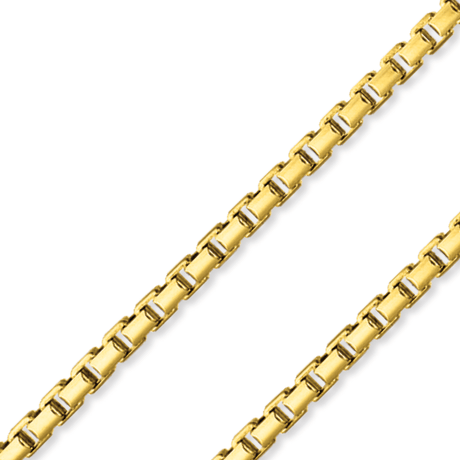
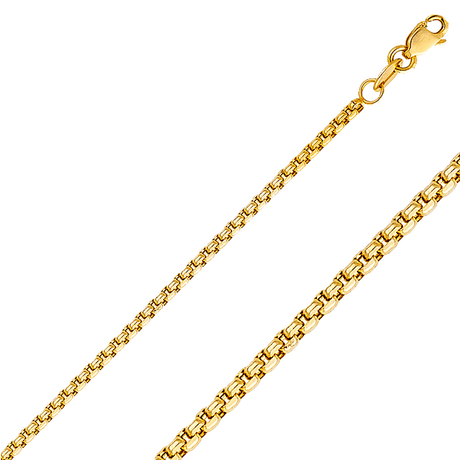
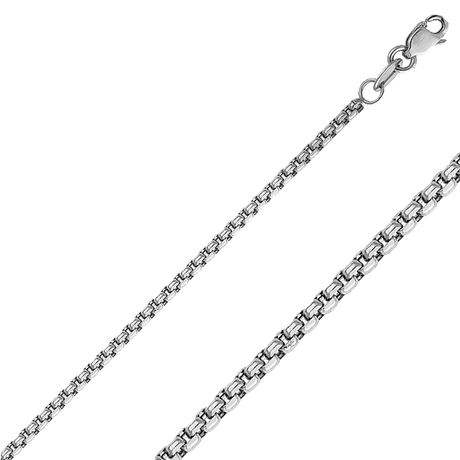
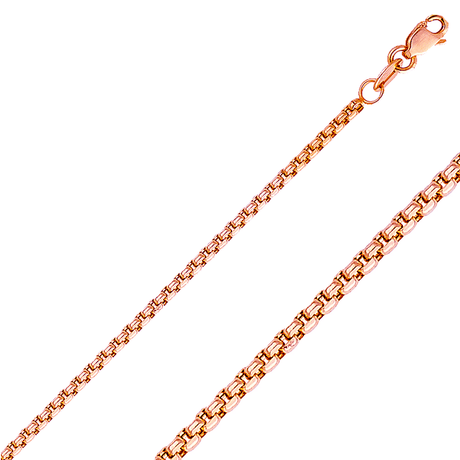
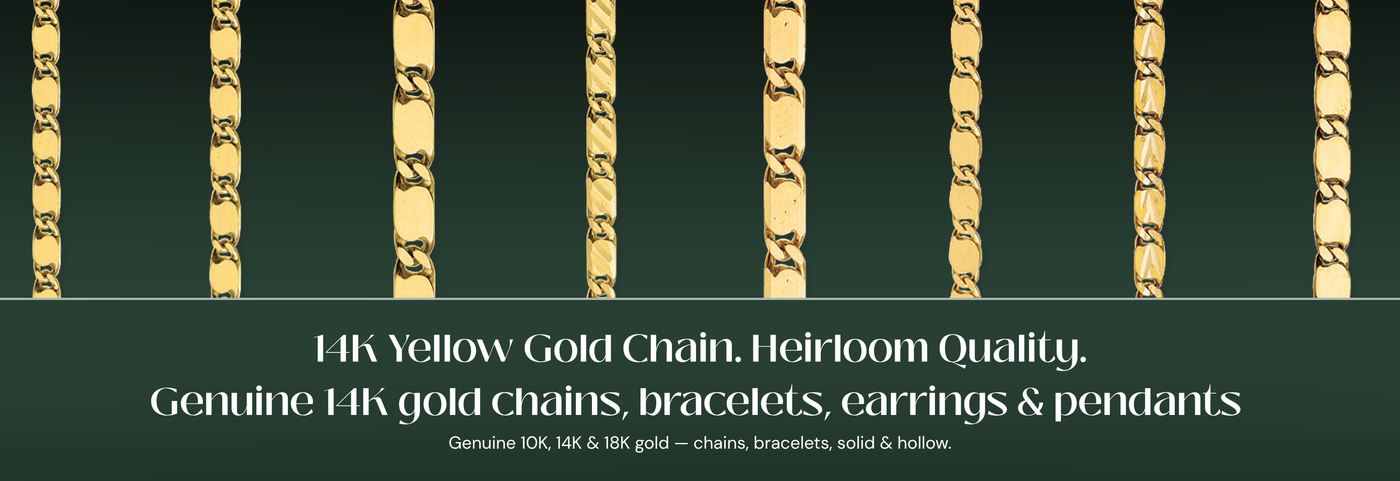
Corrente de ouro amarelo 14K

Corrente de ouro amarelo 14K
Ver como

Why is 14K gold the best karat for a gold chain?

14K gold is the optimal karat for gold chains because it balances three critical factors: durability, color, and value. Chain links undergo constant friction and mechanical movement — link-on-link contact as the chain moves with your body. 14K gold's higher alloy content (41.7% non-gold metals) gives it significantly more hardness than 18K or 22K gold, which means the link surfaces resist the wear and micro-scratching that constant chain movement creates over years of daily wear.

At 58.3% pure gold, 14K yellow chain reads unmistakably as gold — warm, bright, and clearly valuable. This is not the case for 10K chain, which has a perceptibly paler, more washed-out yellow due to its lower 41.7% gold content. 18K chain has a richer, more saturated yellow but at a 20–30% premium per gram and reduced durability. 14K hits the middle precisely: the quality buyer's chain karat.

A simple comparison confirms 14K's position: the vast majority of US fine gold chain jewelry sold by Italian manufacturers ships in 14K. The global chain manufacturing centers — particularly Arezzo, Italy — produce most of their volume in 14K because market research consistently confirms buyer preference. This is not a marketing convention but a genuine expression of which karat serves chain wearers best.

How does 14K gold chain compare to 18K for durability?

18K gold chain contains 75% pure gold — 16.7% more gold than 14K. That additional gold content makes 18K chains softer (pure gold is much softer than alloy metals), which means 18K link surfaces accumulate micro-scratches faster under daily wear. Under a loupe, a 14K chain worn daily for 5 years will show less surface texture change than an 18K chain worn the same way. The alloy content in 14K acts as a hardening agent that protects the surface.

The practical implications for chains: rope chains (where dozens of thin rings twist and make constant contact), curb chains (where every flat link face rubs its neighbors), and Cuban links (where tight interlocking links generate friction) all benefit from the harder surface of 14K gold. The clasp spring and lobster mechanism also benefit — 14K spring wire retains its tension longer than 18K.

The recommendation: for a chain worn every day as a lifestyle piece, 14K is clearly the right karat. For a chain worn for special occasions, kept in a jewelry box most of the time, or selected primarily for maximum color richness, 18K is worth the premium. The durability advantage of 14K only matters if the chain is worn regularly — which is exactly the condition under which most chain buyers wear their pieces.

Is 14K gold chain real gold?

Yes — 14K gold chain is real gold. It contains 58.3% pure elemental gold throughout every link, every inch of the chain. The remaining 41.7% is copper, silver, and zinc alloy, which adds hardness and color character. All jewelry karats from 10K through 24K are real gold; the karat number indicates how much gold is present. 14K gold chain is absolutely genuine fine gold — not plated, not filled, not simulated.

Confusion arises because '14K gold' sounds different from 'solid gold' or 'real gold,' but these terms are synonymous in fine jewelry. A 14K chain is as real as gold can be in a wearable alloy — pure gold (24K) is too soft for practical chain use. The '14K' hallmark on any chain clasp or tag confirms the piece is legally verified fine gold per US FTC standards.

How to confirm: look for the '14K', '14KT', or '585' stamp on the chain clasp — this is legally required on all gold jewelry sold in the US and confirms karat content. For further verification, any jeweler can test with an XRF spectrometer in under a minute, providing non-destructive elemental composition analysis. Chains from reputable importers come with this verification already performed by their suppliers.

What is the 585 stamp on a 14K gold chain?

The '585' stamp on a gold chain indicates 14K gold purity — specifically, 585 parts per thousand of pure gold content. This equals 58.5% (rounded from 58.3% = 14/24). The 585 notation is the European and Italian standard for marking gold purity, equivalent to '14K' in the US system. Italian-manufactured gold chains — among the world's finest — are almost universally marked 585 rather than 14K.

Italian chains carry three hallmarks together as part of Italy's government-mandated assay system: the purity mark (585), a maker's mark (a unique alphanumeric code registered with the Italian Chamber of Commerce, identifying the specific manufacturer), and a provincial assay office mark (confirming independent testing by an Italian government-authorized body). The combination of these three stamps is the most rigorous gold authenticity documentation system in the world.

When you purchase a chain stamped 585 with a maker's mark and assay stamp, you're receiving a piece whose gold content has been verified by the Italian government — not just by the seller. This is why Italian gold carries a premium trust signal in the global fine jewelry market. '585' is not a lesser designation than '14K'; it is the same gold, verified with greater institutional rigor.

Why does 14K gold chain feel different from 18K?

14K gold chain and 18K chain feel different primarily because of weight and surface character. 18K chain is slightly denser per cubic centimeter than 14K — pure gold is one of the densest common metals, so 18K's higher gold content makes it heavier for the same visual volume. For heavy chains where gram weight is already significant, 18K amplifies that weight. For lightweight chains, the difference is less perceptible.

Surface feel also differs subtly: 18K's softer surface develops a satiny patina from micro-scratches faster than 14K. After a year of daily wear, an 18K chain has a slightly less mirror-sharp surface than the same chain in 14K — the 18K looks 'lived-in' more quickly. Many wearers find this patina appealing; others prefer the maintained crispness of 14K. Neither is objectively better — the preference reflects personal aesthetic.

Temperature response is another physical difference: gold conducts heat rapidly, so both 14K and 18K chains warm to body temperature quickly after contact with skin. The higher gold content in 18K means it conducts heat marginally faster, but this difference is imperceptible in practice. Both metals feel smooth against skin; the higher alloy content in 14K does not create any roughness.

What chain styles are available in 14K yellow gold?

14K yellow gold chains are manufactured in virtually every link style in commercial production: Cuban link (tight, rounded, interlocking links — maximum presence), curb link (flat, interlocking C-shaped links — the most classic), rope (twisted round wire links creating a spiral texture), figaro (alternating long oval and short round links — distinctly Italian), box (square cross-section links — architectural and clean), wheat/Spiga (four-stranded woven pattern — delicate and intricate), Singapore (twisted box links — delicate with excellent light reflection), and snake (smooth serpentine tube — sleek and contemporary).

Each style has specific aesthetic and practical characteristics. Cuban link chains dominate in men's jewelry for their visual weight and luxury associations. Rope chains are the most popular women's daily-wear chain because they combine visual interest with flexibility and strength. Figaro chains have strong Italian heritage appeal. Box chains are the most resistant to kinking. Snake chains lie most smoothly against the neck but are the most difficult to repair if damaged.

For buyers choosing among styles: Cuban link for maximum statement; rope for elegant daily wear; curb for classic versatility; figaro for Italian authenticity; box for low-maintenance durability; wheat/Singapore for delicate layering. Within each style, 14K yellow gold is available in a wide range of widths and lengths, allowing every buyer to find the exact combination of style, weight, and presence they want.

What is a 14K yellow gold Cuban link chain?

A Cuban link chain (also called a curb link or Miami Cuban link) is constructed from tight, rounded, interlocking oval links that sit close together and lie flat when worn. The links interlock at a 45-degree angle, creating a chain with significant visual density and weight. Cuban link chains are among the heaviest chains per inch of length — a 5mm Cuban link chain weighs approximately 2–3× more per inch than a rope chain of similar visual width.

14K yellow gold Cuban link chains have become one of the most recognized luxury jewelry statements globally. Their association with hip-hop culture, Italian-American tradition, and high-end fashion has made them the aspirational chain style of multiple generations. In 14K yellow gold, the Cuban link's warmth, density, and gleam create a distinctly powerful wrist and neck statement that no other chain style replicates.

Width and length guide for 14K yellow gold Cuban links: women's (3–5mm, 16–20 inches), unisex (5–8mm, 18–22 inches), men's statement (8–12mm, 22–26 inches), men's luxury (12–20mm+, 24–30 inches). Gram weights rise dramatically with width: a 7mm × 22-inch Cuban link typically weighs 25–40 grams; a 12mm × 24-inch version may weigh 80–150 grams. Price scales accordingly with gram weight × gold content.

What is a 14K yellow gold rope chain?

A 14K yellow gold rope chain is constructed from twisted strands of round gold wire or small oval links arranged in a spiral pattern that resembles a braided rope. The rope construction creates a visually textured surface that catches light from multiple angles simultaneously, giving the chain excellent brilliance and depth. Rope chains are one of the most popular fine gold chain styles globally due to their combination of elegance, strength, and versatility.

The rope twist can be machine-made from drawn gold wire (most common, highly consistent) or from linked components (less common, more artisanal). Italian rope chains — particularly from Arezzo manufacturers — are noted for the precision of their wire drawing and twisting, which produces chains with consistent diameter, tight twist angles, and excellent luster. A quality 14K Italian rope chain maintains its appearance for decades with proper care.

Width and length options: women's (1–3mm, 16–20 inches) for delicate everyday wear; medium (3–5mm, 18–22 inches) for visible presence; men's (5–8mm, 22–26 inches) for bold statement wear. Rope chains can be worn plain or with pendants — their construction handles pendant weight well. Among chain styles, rope is the most universal: appropriate for men and women, formal and casual, plain and pendant-hung wear.

What is a 14K yellow gold figaro chain?

A figaro chain consists of alternating link sizes: one longer oval link followed by two or three shorter, rounder links, repeated in a specific pattern. This alternating rhythm creates visual interest without the texture of rope or the heaviness of Cuban — the figaro reads as classical and deliberate. The pattern has clear Italian origins; figaro chains are deeply associated with Italian gold manufacturing and the aesthetic sensibility of the Vicenza and Arezzo manufacturing traditions.

14K yellow gold figaro chains have been a staple of Italian-American jewelry culture since the mid-20th century. The style suits both neck and wrist wear — figaro bracelets are as common as figaro necklaces. The pattern is equally appropriate for pendants (the varying link sizes create interesting transitions around a pendant bail) and for plain wear (the pattern is engaging enough to stand on its own).

Width and length options: women's (2–3.5mm, 16–20 inches), medium (3.5–5mm, 18–24 inches), men's (5–8mm, 22–28 inches). Figaro chains are among the most popular chains for pendant gifting because their visual character is strong enough to complement most pendant styles without competing. The name 'figaro' comes from the opera character, though the link design's Italian manufacturing heritage is far more specific than its naming origin.

What is the difference between a 14K curb chain and a Cuban link chain?

Curb chains and Cuban link chains are related styles with an important distinction. A classic curb chain uses flat, interlocking C-shaped links twisted at a consistent angle so the chain lies flat when worn. The links are typically 5–10% thinner in cross-section than Cuban link chains and sit with less density between links. Curb chains have a cleaner, more understated look — each link is visible and distinct.

Cuban link chains (Miami Cuban links) use rounder, more substantial links with tighter interlocking that leaves less visible space between links. The links themselves are thicker in cross-section and more heavily beveled at the edges. The result is a chain that appears denser and more solid than a curb chain of equivalent width. Cuban links also tend to be heavier per inch because of their greater metal mass per link.

For buying guidance: choose curb chain when you want a classic, versatile chain that works with pendants, suits any occasion, and reads as traditional fine gold jewelry. Choose Cuban link when maximum presence, weight, and visual impact are the priority — the Cuban link is a statement piece even at moderate widths. Both are excellent constructions in 14K yellow gold; the choice is purely aesthetic.

About 14K Yellow Gold Chains

14K Yellow Gold Chains: Every Italian Style in the Fine Jewelry Standard

The 14K yellow gold chain is the central piece in the Italian fine jewelry tradition — the combination of gold content, link craftsmanship, and color that defines what a gold chain is. At 58.5% gold, 14K produces a warm, distinctly yellow tone that retains its color permanently without plating or treatment.

Link style selection depends on intended use: Cuban and rope chains read as bold statement pieces and work best worn solo; Figaro and box chains are more refined and serve equally well as pendant carriers or standalone necklaces. Width determines visual weight — narrower under 2.5mm recedes as a pendant chain, 3mm to 5mm is the primary everyday range, above 5mm is a bold statement.

Length positions the chain on the body: 16 to 18 inches sits near the collarbone, 20 to 22 inches falls to the upper chest, 24 inches and above creates a longer drape. Standard for men's everyday wear is 22 to 24 inches; women typically prefer 16 to 20 inches.

Comparar /3

A carregar...