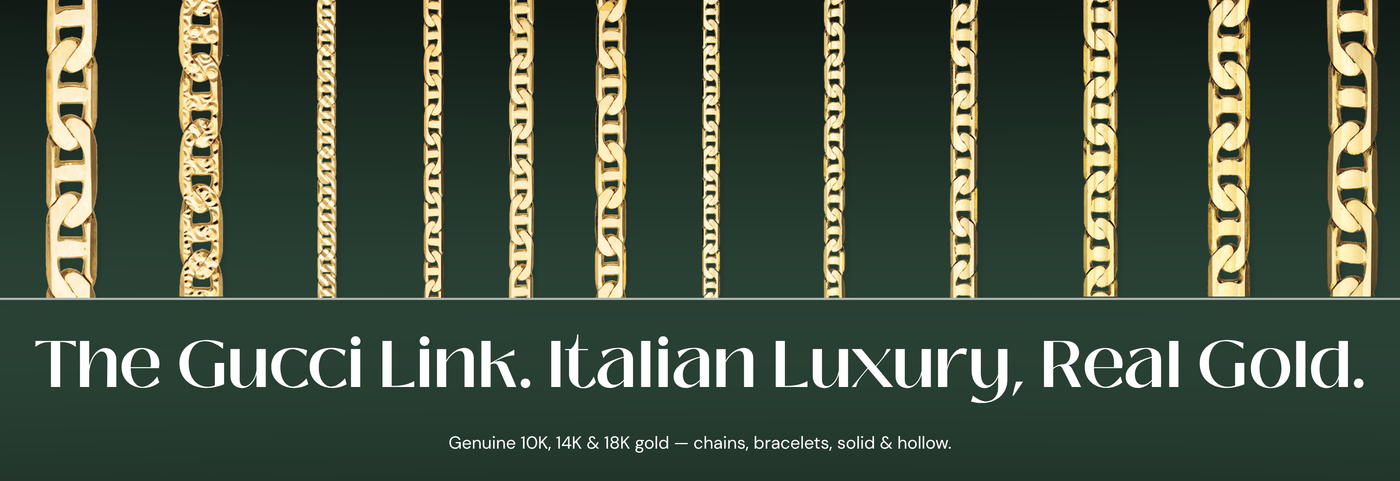
The Gucci link chain gets its name from its association with the interlocked G logo of the Gucci fashion house, but the actual chain pattern predates that association. The interlocking oval link was an established Italian jewelry construction long before it became associated with luxury branding. What defines the pattern is the 90-degree alternation of link orientation: each link is threaded through the previous one with its face perpendicular to the face of its neighbor. This creates a chain that lies flat when held still but moves with a characteristic three-dimensional flex when worn.
The visual quality of a Gucci link chain depends more than most chain styles on the specific link dimensions chosen by the manufacturer. Small, closely-spaced oval links create a dense, finely-textured chain that reads as delicate at narrow widths. Larger, more widely-spaced ovals create a chain where each individual link is visible as a design element. The wall thickness of each link affects the chain's feel: thin-walled links create a lighter, more flexible chain; thicker-walled links create a chain with more weight and presence in the hand. These variations are why two Gucci link chains can read quite differently despite using the same fundamental pattern.
For buyers choosing between Gucci link and other Italian chain styles, the Gucci link occupies a specific aesthetic position: more dimensional than flat-link chains (Cuban, Figaro, box), more structured than twisted chains (rope, Singapore), and recognizable as a specific named style rather than a generic chain pattern. It pairs well with pendants that have round bails because the oval links provide natural bail passage points. Worn alone, it works at any length and creates a look that is Italian in character — patterned, structured, and reflective in a way that reads as carefully made.