Free shipping on all orders over $75 in the United States

When it comes to gold, we guarantee the use of 100% real gold in all our gold products.

FLASH SALE— Save 25%

HAPPY25NOW
Italian 10K gold jewelry collection

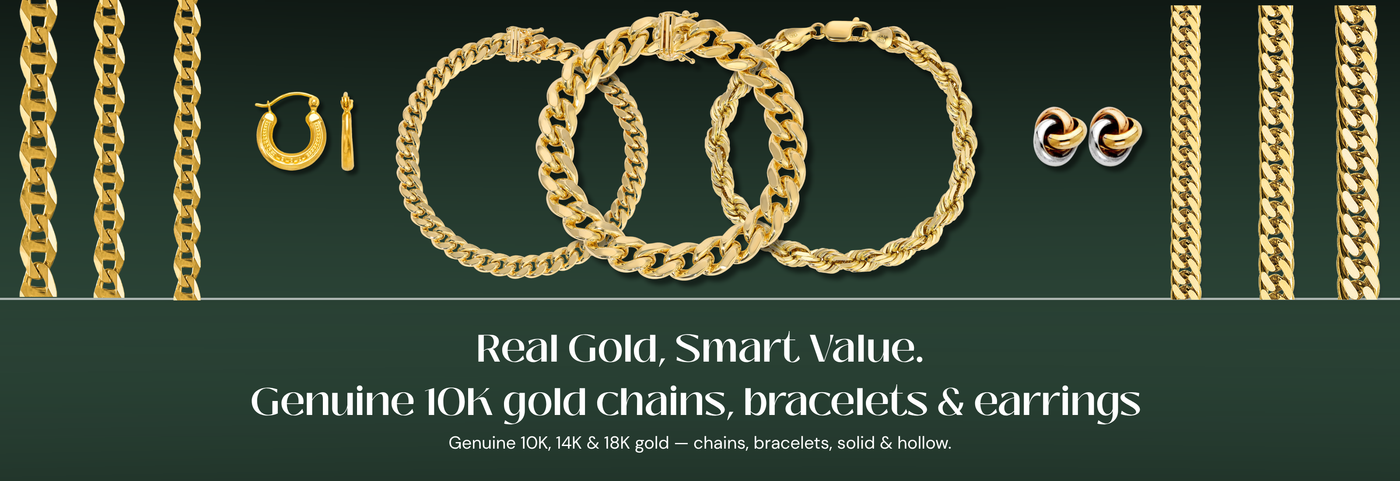
10K Gold Jewelry Collection

10K Gold: The Hardest, Most Impact-Resistant Standard Gold Karat

10K gold contains 41.7% pure gold and 58.3% alloy metals, making it the hardest and most durable of the three standard karats sold in the United States. The high alloy content — metals like silver, copper, and zinc — gives 10K gold resistance to scratching and bending that neither 14K nor 18K can match. For jewelry worn through daily activity and physical work, 10K gold holds its shape better over time.

The Price Difference Between 10K and 14K Gold

The lower gold content in 10K makes it less expensive per gram than 14K or 18K. For buyers who want a real gold stamp and genuine fine jewelry without the premium of higher-karat pieces, 10K provides an accessible entry point. The color difference between 10K and 14K yellow gold is subtle — 10K appears slightly less warm, though the difference is minor in most lighting conditions.

What 10K Gold Jewelry Works Best For

10K gold excels in chain necklaces, bracelets, and earrings worn through active lifestyles. Its hardness means it resists the minor scratches and dings that accumulate on 14K and 18K pieces over years of wear. Italian-crafted 10K gold jewelry uses the same link construction and clasp systems as higher-karat pieces — the quality of the chain weave, the clasp, and the overall finish remain consistent across the karat range.

View as

What is 10K gold?

10K gold is a gold alloy that contains 41.7% pure gold, with the remaining 58.3% composed of other metals such as copper, silver, zinc, and nickel. The designation 10K refers to 10 karats out of a possible 24, where 24 karats represents pure gold. In the United States, 10K gold is the minimum gold content legally allowed to be sold and marketed as gold jewelry.

The 10K gold alloy's high base metal content gives it properties that differ measurably from higher-karat gold alloys. The copper and silver content makes 10K gold harder than 14K or 18K gold, which translates to improved scratch resistance and longer polish retention under daily wear. The alloy is also more resistant to denting and deformation under physical stress, making 10K particularly suitable for chain necklaces, rings worn on working hands, and children's jewelry.

10K yellow gold has a lighter, more pale yellow color than 14K or 18K yellow gold, because the lower gold content dilutes the yellow color saturation. 10K white gold achieves its silver-white color through nickel or palladium alloying and typically receives rhodium plating to maximize its white appearance. 10K rose gold, achieved through higher copper content, has a warm pinkish-gold color that is distinctive and durable.

What does the 417 stamp mean on 10K gold jewelry?

The 417 stamp on gold jewelry indicates 41.7% pure gold content, which is the European and international standard marking for 10-karat gold. The number 417 represents the gold purity in parts per thousand: 417 parts of pure gold per 1,000 parts of total metal. In the United States, the equivalent markings are 10K or 10KT. All three markings are legally equivalent and identify the same 41.7% gold content.

When purchasing 10K gold jewelry from international sources, particularly Italian-manufactured jewelry, the 417 stamp is the standard marking rather than 10K. Italian jewelry also carries two additional marks: the manufacturer's registered production code and the Italian government's assay mark, confirming that an independent government assay office has verified the piece's gold content. This three-mark system provides the strongest field authentication available for Italian-manufactured gold jewelry.

The purity stamp appears on the most discreet practical location: inside a ring's band, on a necklace or bracelet clasp, or on the post of earrings. The stamp is small, typically 1-3mm, and requires a 10x jeweler's loupe to read clearly. If a piece claimed to be 10K gold does not have a legible purity stamp, this is a legal violation under FTC regulations and a strong reason to request independent testing before purchase.

What metals are in 10K gold?

10K yellow gold contains 41.7% pure gold alloyed with copper, silver, and often small amounts of zinc. The copper content in 10K yellow gold is typically higher than in 14K or 18K yellow gold, giving 10K yellow gold its characteristic pale, slightly warm yellow-orange tone. The silver content lightens and brightens the alloy slightly, balancing the copper's reddening effect.

10K white gold achieves its silver-white color through two primary alloying approaches. The first uses nickel as the primary whitening agent alongside copper and zinc. Nickel-white 10K gold is very hard and achieves the whitest color but can cause allergic reactions in approximately 15% of the population who have nickel sensitivity. The second approach uses palladium as the primary whitening agent, which is hypoallergenic and highly stable but more expensive. Palladium-white 10K gold is appropriate for buyers with known nickel sensitivity.

10K rose gold is alloyed with a higher proportion of copper than yellow or white gold at the same karat. The copper content in 10K rose gold typically ranges from 50-58% of the alloy's non-gold component, compared to approximately 35-40% in 10K yellow gold. This elevated copper content produces the warm pinkish-gold color that characterizes rose gold, and also makes 10K rose gold the hardest of the three 10K color variants.

Is 10K gold real gold?

Yes, 10K gold is real gold. It contains 41.7% pure gold by weight, permanently alloyed with other metals to create a durable, workable jewelry material. The gold in 10K gold jewelry is chemically identical to the pure gold in 24K jewelry — it is the same element, the same atomic structure, the same metal. The alloying process combines gold with other metals at the atomic level to create an alloy with enhanced mechanical properties.

The legal definition in the United States confirms 10K gold as genuine gold. The Federal Trade Commission's regulations specify that gold jewelry must contain at least 10 karats (41.7% pure gold) to be legally marketed as gold in the United States. A piece below 10K cannot legally be called gold in the U.S. market. The 10K stamp is a legal declaration by the seller that the piece meets this minimum gold content standard.

10K gold's gold content is permanent and unchanging. The gold in a 10K gold piece does not wear away, evaporate, or diminish over time. The piece retains its 41.7% gold content indefinitely, which is why 10K gold jewelry holds recoverable value that can be realized by selling to any gold buyer or refinery at any time. This permanent, recoverable gold content distinguishes 10K gold from gold-plated, gold-filled, and gold-tone materials.

How is 10K gold different from gold-plated jewelry?

10K gold is a solid gold alloy: 41.7% pure gold is permanently alloyed with other metals throughout the complete cross-section of the piece. The gold is in every part of the metal, from the surface to the core. Gold-plated jewelry is a base metal piece with an extremely thin layer of gold electroplated onto the surface, typically 0.5 to 2.5 microns thick. The two are fundamentally different in gold content, durability, and value.

The practical difference is lifespan. 10K gold's gold content is permanent — the piece never loses its gold content through normal wear. Gold plating wears through at high-contact points including edges, raised surfaces, clasps, and the insides of rings, typically within weeks to months of daily wear. As the plating wears through, the base metal beneath is exposed, causing discoloration, tarnishing, and skin staining. A 10K gold piece shows no such progression because there is no plating layer to wear through.

Value and recoverability are also completely different. A 10K gold piece contains gold that can be recovered at its melt value at any time. A gold-plated piece contains so little gold by weight that the gold content is essentially worthless as a recoverable asset. When buying jewelry intended for lasting value rather than fashion use, the difference between 10K solid gold and gold-plated is the difference between an asset and a consumable.

How durable is 10K gold jewelry?

10K gold is the most durable karat grade of gold jewelry available. Its high base metal content, particularly copper, produces an alloy that is measurably harder than 14K or 18K gold on the Vickers hardness scale. This hardness translates to real-world benefits: 10K gold jewelry holds its polish longer, resists surface scratching more effectively under daily wear, and maintains its shape under the mechanical stresses of regular use.

The hardness advantage is most meaningful in specific use contexts. A 10K gold ring worn on a working hand will show less surface wear over five years than an equivalent 18K ring in the same conditions. A 10K gold chain worn daily will show less individual link deformation over time than a higher-karat chain at equivalent gauge. These differences are measurable but gradual. For buyers prioritizing durability over maximum color richness, 10K gold's hardness advantage is a genuine practical benefit.

10K gold jewelry can be repaired, resized, soldered, and polished by standard goldsmithing techniques. The alloy's higher hardness requires appropriate tool settings but presents no unusual challenges for experienced goldsmiths. 10K gold's durability means it also requires less frequent professional maintenance than more easily scratched higher-karat pieces, which can offset some of the cost difference between 10K and higher-karat jewelry over the long term.

Does 10K gold tarnish?

10K gold does not tarnish in the same way that sterling silver, brass, or copper tarnish. The gold content in the alloy is chemically very stable and does not oxidize or tarnish. However, 10K gold's higher base metal content can develop a very subtle surface oxidation under certain conditions, including prolonged exposure to air and moisture, contact with acidic sweat, chlorine, or household chemicals, and contact with perfume or lotion. This surface change is mild and localized, and regular cleaning removes it completely.

The practical experience of wearing 10K gold jewelry is that properly cleaned and maintained pieces look bright and warm indefinitely. Most wearers do not notice any tarnish or color change with normal care. The occasional dulling of the surface finish that any gold jewelry develops between cleanings, caused by body oil, soap residue, and environmental deposits, is removed by standard home cleaning with warm water and mild dish soap. After cleaning, 10K gold returns to its original bright surface appearance.

Certain exposures accelerate surface changes and should be avoided: chlorinated swimming pools, which react with copper in the alloy; strong household cleaning chemicals; perfumes and colognes applied directly to the jewelry rather than the skin; and prolonged contact with highly acidic sweat. Removing 10K gold jewelry before swimming in chlorinated water, applying cosmetics before putting jewelry on, and storing jewelry in a dry environment between wears are all practices that maintain the jewelry's appearance between professional cleanings.

Does 10K gold cause skin reactions?

10K gold can cause skin reactions in some individuals, specifically those with nickel sensitivity. 10K white gold, in particular, commonly uses nickel as the primary whitening agent. Nickel allergies affect approximately 10-15% of the population and are among the most common contact allergies. In nickel-sensitive individuals, wearing nickel-containing 10K white gold can cause contact dermatitis: redness, itching, and occasionally rash at the contact area.

10K yellow gold and 10K rose gold have lower nickel content or no nickel, depending on the specific alloy formulation, and are much less commonly associated with skin reactions. Very high copper concentrations can occasionally cause a greenish skin stain from copper oxidation at sweat contact points. This green staining is a cosmetic effect, not a health concern, and disappears when the jewelry is removed. Regular cleaning prevents the staining from occurring.

For buyers with confirmed nickel sensitivity, options include: 10K yellow or rose gold (lower or no nickel content), 10K white gold specifically formulated with palladium rather than nickel as the whitening agent (ask the seller explicitly), or higher-karat white gold where less alloy metal is needed overall. If you have a history of jewelry reactions, ask specifically about the nickel content of any white gold piece before purchase.

How long does 10K gold jewelry last?

Well-maintained 10K gold jewelry lasts a lifetime and beyond. The gold alloy does not degrade, dissolve, or lose its composition over time. A 10K gold piece properly cared for and periodically serviced by a jeweler will be in wearable condition 50 years from now. What requires maintenance is the surface finish (periodic polishing), the clasp or setting mechanism (which may wear and need replacement), and prongs holding gemstones (which require re-tipping).

Practical lifespan by jewelry type: chains worn daily can last 20-40 or more years with proper care and annual inspection, as link wear is a slow process measured in decades. Rings worn on working hands wear faster, particularly at the inner shank, and may require shank replacement after 10-20 years of continuous daily wear. Earrings and pendants, with less mechanical stress, can last indefinitely. The weakest components are always mechanical ones: clasps, springs, and setting prongs that experience repeated flexing.

Regular maintenance extends effective lifespan significantly. Annual professional inspection catches developing issues before they become failures. Clasp springs that have loosened are replaced before the clasp fails. Prongs that have worn thin are re-tipped before a stone falls out. Chain links that have worn thin are identified and the section is replaced. A 10K gold piece receiving this annual care has a functionally indefinite lifespan.

Can 10K gold be resized or repaired?

Yes. 10K gold jewelry is fully resizable and repairable by any competent goldsmith. Ring resizing is the most common repair: the goldsmith cuts the ring shank, adds or removes gold to achieve the target size, and solders the join using 10K gold solder matched to the ring's alloy. When done correctly, the resize is invisible and the ring's structural integrity is fully restored.

Common repairs for 10K gold jewelry include: chain link repair (resoldering a broken link or replacing a damaged section); clasp replacement; prong repair (re-tipping or rebuilding worn prongs that hold gemstones); ring shank repair (patching or replacing a worn shank section); and surface refinishing (professional polishing that removes accumulated scratches). All of these are routine goldsmithing work that any full-service jeweler can perform on 10K gold.

10K gold's lower gold content means some repair operations require slightly higher temperatures or different solder formulations, but this is a technical detail the jeweler handles without any impact on the customer's experience or the repair outcome. Reputable jewelers work with all karat grades daily. A properly executed repair on a 10K gold piece is indistinguishable from a repair on a 14K piece. The repair's quality depends entirely on the goldsmith's skill, not the karat grade.

About 10K Gold Jewelry

10K Gold: The Hardest, Most Impact-Resistant Standard Gold Karat

10K gold contains 41.7% pure gold alloyed with copper, silver, and zinc, making it the hardest and most scratch-resistant standard gold karat available in the US. The alloy content gives 10K a resistance to surface wear that 14K and 18K cannot match under identical use conditions.

The practical advantage of 10K is most visible over years of daily wear. A 10K chain or bracelet shows fewer accumulated surface scratches and holds its original shape better than 14K under the same conditions. For jewelry worn through active daily life without removal, the durability advantage of 10K is real and measurable.

10K yellow gold is slightly less warm in color than 14K — the higher alloy content produces a marginally lighter, cooler yellow tone. The difference is subtle in most lighting, and the lower price per gram makes 10K the most accessible karat for buyers who want genuine fine gold jewelry.

Compare /3

Loading...