Free shipping on all orders over $75 in the United States

When it comes to gold, we guarantee the use of 100% real gold in all our gold products.

FLASH SALE— Save 25%

HAPPY25NOW
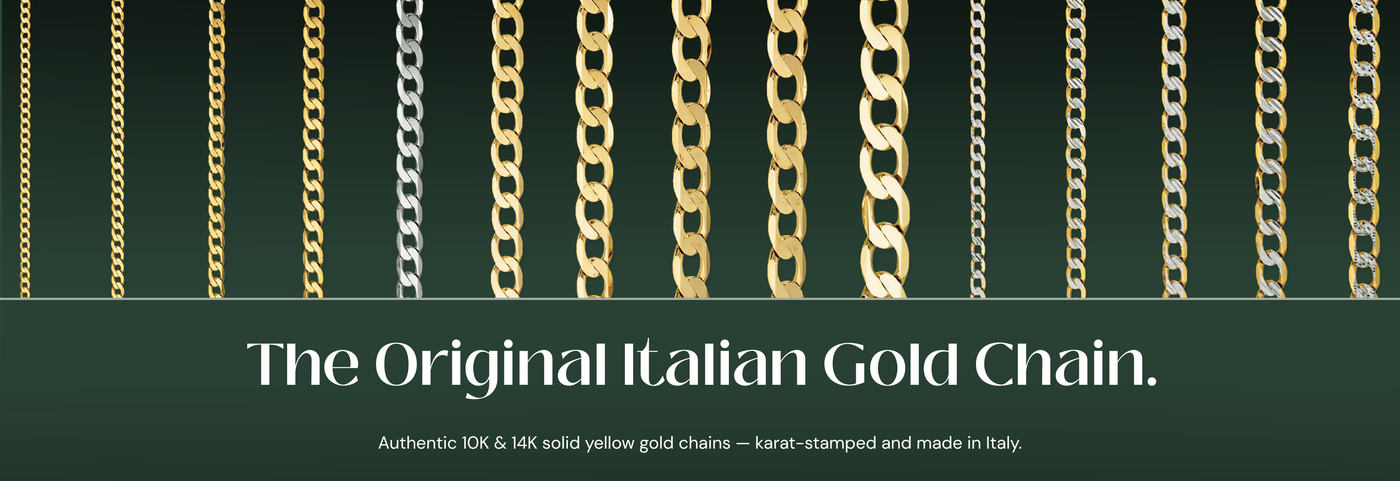
Italian real gold chains in 10K and 14K, karat-stamped

Real Gold Chain

Every chain in this collection carries a karat stamp — 10K, 14K, or 18K — because every piece is genuine karat gold, not plated, not gold-filled, and not bonded. The stamp is a legal guarantee of gold content: 10K contains 41.7% pure gold, 14K contains 58.5%, and 18K contains 75%. The remaining percentages are alloy metals added to harden and color the gold for jewelry use.

Gold plating looks like gold but behaves entirely differently. A plated piece has a thin layer of gold — often less than 1 micron — over a base metal core. That layer wears through in months to years depending on plating thickness and wear frequency. Karat gold has gold content through the full mass of the piece: the surface, the interior, the links, and the clasp. When you wear a real gold chain for five years, you are still wearing gold on day 1,825.

The practical difference shows up in resale and repair. A karat gold chain has intrinsic metal value — it can be sold, melted, or exchanged based on its gold weight at any time. A plated chain has no intrinsic metal value once the plating wears. For repair, a karat gold chain can be soldered, resized, and refinished by any jeweler. A plated chain cannot be repaired through standard gold-working techniques without damaging the plating.

All chains here are Italian-made. The link construction, clasp mechanisms, and finish quality reflect the standards of Italian fine jewelry manufacturing — an industry with centuries of development behind the specific skill of making gold chain. When buying a real gold chain, the construction quality of the links and clasp matters alongside the karat: a well-made 10K chain will outlast a poorly-made 14K chain in daily wear.

View as

What does 'real gold' mean in jewelry?

In jewelry, 'real gold' means the piece is made from solid gold alloy — an actual gold-containing metal throughout its entire structure, as opposed to gold-plated, gold-filled, or gold-colored base metal. Real gold jewelry carries a karat stamp (10K, 14K, 18K, or higher) indicating the percentage of pure gold in the alloy. In the US, a piece must contain at least 10K gold to be legally sold as 'real gold.'

The karat system measures gold purity in 24 parts: 10K is 41.7% pure gold, 14K is 58.3% pure gold, 18K is 75% pure gold, and 24K is 99.9% pure gold. All of these are real gold — the difference is in how much gold they contain and how that affects color, hardness, and price. Italian gold jewelry typically uses a parallel '585' hallmark system for 14K, representing 585 parts per thousand pure gold.

The fastest way to identify real gold jewelry is by its hallmark. On chains and necklaces, look for the karat stamp on the clasp hardware or a small soldered tag near the clasp. Real gold does not tarnish to black or green, does not attract a magnet, and feels noticeably dense and cool in the hand. Any reputable jeweler can verify gold content with an XRF tester in seconds.

What is the difference between real gold and fake gold?

Real gold jewelry contains genuine gold alloy throughout the piece — typically 10K, 14K, or 18K solid gold. Fake gold jewelry uses base metals (brass, copper, zinc alloys) with no actual gold content, or uses gold-colored platings so thin they are essentially cosmetic. The critical practical difference: real gold does not tarnish, corrode, or turn skin green; fake gold eventually will.

Gold-plated jewelry occupies a middle category — it has a real gold surface layer (usually 0.5–2.5 microns thick) over a base metal core. It is technically partially real but functionally temporary: the gold layer wears through within months to years of daily wear, exposing the base metal underneath. Gold-filled is thicker (5% gold by weight) and more durable than plating but still not solid gold.

To test for real gold at home: real gold does not react to a magnet (base metals like iron or nickel do); real gold will not turn skin green (copper alloys do); real gold maintains its color indefinitely (plating fades). The definitive test is a hallmark stamp and XRF spectroscopy. Buying from reputable jewelers with documented karat stamps eliminates uncertainty entirely.

What karat is considered real gold?

In the United States, any gold jewelry containing at least 41.7% pure gold — stamped 10K — is legally classified as real gold. Below 10K purity, the Federal Trade Commission does not permit the piece to be marketed as gold jewelry. So 10K, 14K, 18K, 22K, and 24K are all real gold; anything marketed as gold with no verifiable karat content is not.

Different countries set different minimum thresholds. In the UK, the minimum legal standard for gold is 9K (37.5% gold). In France and Italy, the minimum is 18K (75% gold) for pieces sold as fine gold jewelry, though lower karats exist. Italian fine jewelry hallmarked as gold is typically 18K or 14K — both well above any country's minimum real gold threshold.

For practical purposes, most buyers should treat 14K and above as the meaningful standard for fine gold jewelry. While 10K is legally real gold, its gold content is low enough that the color difference is visually apparent and the intrinsic value is noticeably lower per gram. 14K is the US standard for fine jewelry; 18K is the European preference for the richest gold color.

What is a real gold chain?

A real gold chain is a necklace made from interlocked metal links composed entirely of genuine gold alloy — 10K, 14K, 18K, or higher — with no base metal core or gold plating. Each link in the chain is solid gold alloy throughout its cross-section, giving the piece authentic gold color, weight, chemical stability, and intrinsic metal value.

Real gold chains are manufactured using machine-drawn gold wire that is cut, shaped, and soldered into link structures. The most common link styles — curb, rope, Cuban link, figaro, box, and mariner — are all available in real gold, ranging from delicate 1mm chains to heavy statement pieces weighing 50+ grams. The manufacturing process determines the chain's flexibility, light-catching properties, and durability.

A real gold chain can be distinguished from plated alternatives by its hallmark stamp (found on the clasp), its weight (real gold is noticeably dense), and its price relative to gram weight. At any current gold price, a 14K chain's raw metal value can be calculated precisely — and that value is one of the defining characteristics of real gold as a category.
What are the most popular real gold chain styles?

The most popular real gold chain styles are curb link, Cuban link, rope, figaro, box, and mariner. Curb chains — flat, symmetrical links that lie flush against the skin — are the single most widely sold chain type globally and have been for over a century. Rope chains are second in popularity, prized for their brilliant twisted texture and light-catching surface.

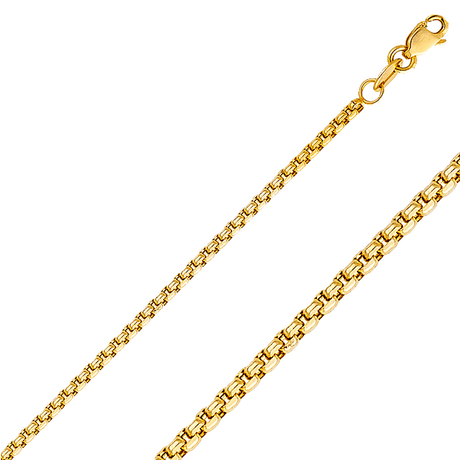
Cuban link chains have surged in popularity through the 2010s and 2020s, driven by hip-hop culture and mainstream fashion adoption. Their wide, flat, beveled links create maximum visual weight and a bold statement. Figaro chains — alternating long and short links in a classic Italian pattern — remain consistently popular in both men's and women's markets. Box chains use square links for a modern, architectural feel particularly suited to pendant use.

For buyers choosing their first real gold chain, a 14K curb or rope chain at 18–20 inches covers the widest range of uses: it works with pendants, layers with other chains, suits any outfit, and will never go out of style. For statement pieces, Cuban link at 6–10mm in 14K yellow gold is the strongest contemporary choice with the deepest visual impact per dollar spent.

How do I know if a chain is real gold?

The most reliable way to confirm a chain is real gold is its hallmark stamp. On necklaces and chains, the karat mark (10K, 14K, 18K, or '585', '750' in European notation) should appear on the clasp hardware or a small soldered tag attached near the clasp. View the stamp under a loupe or magnifying glass — it should be crisp, uniform, and deeply struck, not printed or worn.

Simple field tests add supporting evidence: real gold does not attract a magnet (unlike iron or nickel-based costume metals); real gold will not turn skin green or black under normal conditions (copper-heavy base metals do); real gold feels unusually heavy and cool for its size. However, these tests can be fooled by some alloys — only XRF spectroscopy (offered free by most reputable jewelers) provides definitive confirmation.

When purchasing online, verify the seller lists the piece as solid gold (not gold-plated, gold-filled, or gold-tone), provides the gram weight, and shows the hallmark clearly in product photos. Ask for the karat stamp location. A seller who cannot answer these questions clearly is a significant red flag. Italian gold chains sourced from established importers with documented hallmarks carry the strongest authenticity assurance.

What length real gold chain should I buy?

The correct chain length depends on where you want the chain to rest on your body and your personal aesthetic. General reference: 16 inches sits above the collarbone, 18 inches rests at the collarbone, 20 inches falls at mid-chest, 22–24 inches drapes across the upper chest, and 26–30 inches falls to the sternum or lower.

For women, 18 inches is the most popular everyday length — the chain rests at or just below the collarbone and is visible above most necklines without disappearing into them. For men, 20–22 inches is the most common range, placing the chain at mid-chest where it reads with confidence. Body frame affects how a given length reads: taller wearers and those with longer torsos typically need 2 additional inches.

For pendant use, choose the chain length based on where you want the pendant to hang rather than the chain itself. A pendant at mid-chest needs a 20–22 inch chain for most women; at the collarbone, an 18-inch chain works. Adjustable chains with multiple clasp positions are ideal if uncertain — they allow repositioning across 2–3 lengths in a single piece.

What karat real gold chain is best?

For most buyers, 14K is the best karat for a real gold chain. At 58.3% pure gold content, 14K delivers a warm, rich yellow color and meaningful intrinsic metal value — while the 41.7% alloy content provides the hardness that keeps the chain scratch-resistant and structurally sound through years of daily wear. 14K is the US standard for fine jewelry chains for exactly these reasons.

18K chains contain more gold (75%) and display a richer, deeper yellow color, but they are significantly softer than 14K and will show surface scratches and link deformation faster under daily wear conditions. 18K is the better choice for special-occasion chains worn occasionally. 10K chains are the most affordable and hardest, but their lower gold content produces a noticeably paler color that many buyers find less visually appealing.

The practical decision tree: for a chain worn every day, choose 14K. For a chain with the richest possible gold color worn for occasions rather than daily, choose 18K. If initial price is the primary concern, 10K delivers real gold at the lowest cost. Most Italian gold chains are offered in 14K for the US market and 18K for European markets.

What is the difference between 10K, 14K, and 18K real gold chains?

10K, 14K, and 18K real gold chains all contain genuine gold but in different proportions. 10K contains 41.7% pure gold — the minimum legal threshold in the US, the most affordable price point, and the hardest karat. 14K contains 58.3% pure gold — the most popular choice in the US, balancing color richness, hardness, and value. 18K contains 75% pure gold — the richest yellow color and highest gold content, but noticeably softer.

Color differences are clearly visible side by side. An 18K chain has a deep, saturated gold hue. A 14K chain is warm and distinctly gold but slightly less vivid. A 10K chain reads as notably lighter — some buyers find it appears closer to yellow-white than to traditional gold. Under natural light, the difference between 10K and 18K is obvious; between 14K and 18K it is subtler but still perceptible.

Durability reverses the color ranking: 10K is hardest (most alloy), 14K is intermediate, 18K is softest. For a chain worn every day with an active lifestyle, 14K provides the best balance. A 14K Cuban link worn daily will maintain its surface finish significantly longer than an equivalent 18K piece under the same conditions.

Is 18K real gold worth the price premium over 14K for chains?

Whether 18K is worth the premium depends on how you'll wear the chain. 18K contains 28.5% more pure gold per gram than 14K, which translates to a 20–35% price premium at retail. The visual difference is a richer, more saturated yellow tone — noticeable in direct comparison but subtle in everyday wear. For a chain worn daily, the premium rarely justifies the color difference given the durability tradeoff.

18K is genuinely worth the premium when: you plan to wear the chain for special occasions rather than daily use (durability matters less); you want the richest possible Italian gold color for sentimental or investment pieces; or the chain will be passed down as an heirloom where gold content matters as a long-term store of value. Italian 18K gold in particular is renowned for its deep, warm hue.

For buyers building a first real gold chain collection, 14K is the practical starting point. Once you have a versatile daily-wear 14K chain, an 18K piece in a special style — a fine rope chain for layering, a heavy curb for occasions — makes sense as a meaningful addition. The premium is real and warranted for the right use case, just not universally justified.

About Real Gold Chains

What "Real Gold" Actually Means on a Chain

The karat stamp on a gold chain is a legal guarantee of its gold content — enforced by the FTC in the United States and by equivalent standards bodies internationally. 10K means the metal is 41.7% pure gold; 14K means 58.5%; 18K means 75%. The remaining percentage in each case is alloy metal — copper, silver, zinc, or palladium — added to increase hardness, adjust color, and make the gold practical for jewelry manufacturing. A stamp of '14K' means every link in the chain meets this standard, not just the surface.

Gold plating deposits a thin gold layer — typically 0.5 to 2.5 microns — over a base metal core such as brass or copper. That layer wears at the points of highest friction: the back of the chain where it contacts the neck, the clasp, and any area that rubs against clothing or skin. A quality gold-plated piece may last one to five years before the base metal shows through; a heavily worn plated piece may show wear within months. Karat gold wears too — but what wears away is gold, not a coating over something else. The piece remains gold throughout its life.

For a real gold chain, construction quality works alongside karat to determine longevity. The link geometry, wall thickness, solder joints, and clasp mechanism determine how the chain holds up under daily stress. Italian chain manufacturing has been optimizing these variables for generations — the production techniques for gold chain in Italy's jewelry-producing regions (Arezzo, Valenza, Vicenza) represent accumulated expertise that translates into chains that hold their construction integrity over decades of wear.

Compare /3

Loading...