Free shipping on all orders over $75 in the United States

When it comes to gold, we guarantee the use of 100% real gold in all our gold products.

FLASH SALE— Save 25%

HAPPY25NOW
Italian handmade gold chain & bracelet

18K Gold Jewelry Collection

18K Yellow Gold — Maximum Gold, Unmistakable Color.

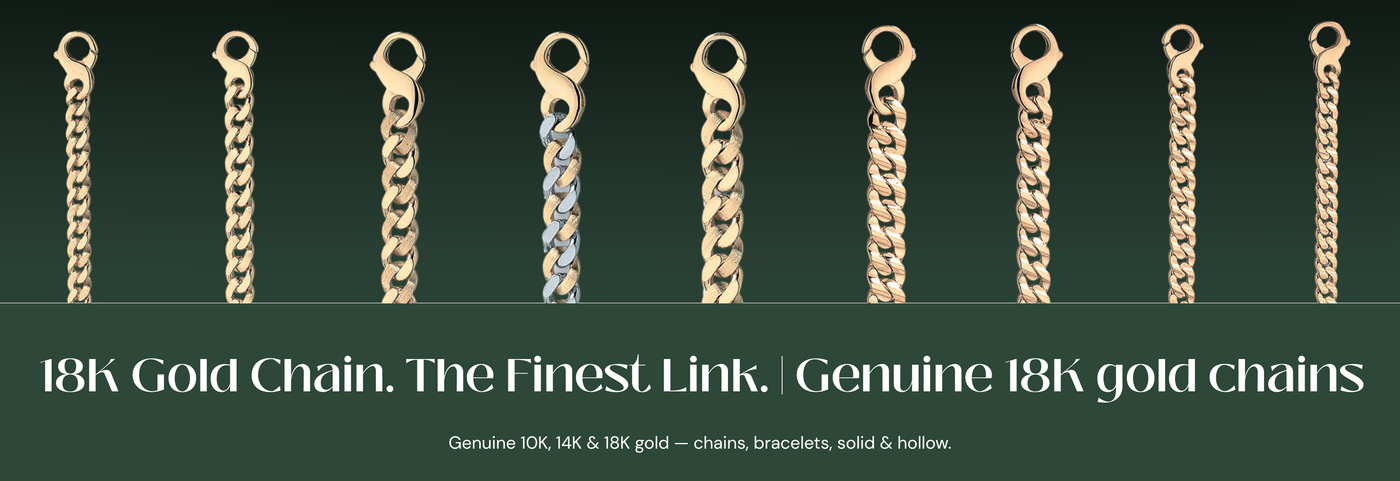
18K contains 75% pure gold — the highest purity widely used in wearable jewelry. The result is the deepest, most saturated yellow gold color available, and the intrinsic value that comes from holding the European fine jewelry standard.

What 18K Looks and Feels Like

The visual difference between 18K and 14K is immediately apparent when seen side by side. 18K has a distinctly deeper, more saturated yellow — it reads as richer and more intensely golden. This is why 18K is chosen for pieces where color presence matters most.

The Trade-Off Worth Knowing

18K is softer than 14K. Higher gold content means less alloy, which means less hardness. 18K shows fine surface scratches over time more readily than 14K or 10K — many people consider this acceptable, and a well-worn 18K chain develops a patina that solid gold buyers appreciate.

View as

No products found

What is 18K gold jewelry?

18K gold jewelry is fine jewelry crafted from an alloy that is 75% pure gold -- 18 parts out of 24 on the karat scale -- combined with 25% alloy metals that provide structure, hardness, and color variation.

At 75% gold content, 18K is the highest-purity alloy widely used in commercial fine jewelry manufacturing. The 25% alloy component -- typically silver, copper, palladium, or zinc depending on the desired color -- gives 18K the structural rigidity required for chain, bracelet, and ornament fabrication while preserving the deep, rich gold color that distinguishes high-purity pieces. 18K jewelry is the dominant standard in European and Asian fine jewelry markets and is internationally recognized as a premium quality designation.

For buyers seeking the finest gold color, the closest approach to pure gold warmth, and a proven international quality standard, 18K gold jewelry represents the optimal balance between maximum gold richness and practical wearability.

What does 18K mean in gold jewelry?

The 18K designation means the gold alloy is 75% pure gold -- 18 parts out of 24 on the universal karat measurement scale -- with the remaining 25% composed of alloy metals that determine the jewelry's color and structural properties.

The karat system divides gold purity into 24 equal parts: 24K is pure gold (99.9%), 18K is 75% gold, 14K is 58.5%, and 10K is 41.7%. Each step down in karat represents less pure gold and more hardening alloy. 18K is the European fine jewelry standard -- stamped 750 in millesimal fineness notation -- and is considered the benchmark for high-quality gold jewelry in global markets outside the United States, where 14K is the domestic commercial standard.

A piece of jewelry stamped 18K, 18KT, or 750 certifies that it contains a minimum of 75% pure gold -- the third-highest purity level in commercial jewelry, exceeded only by 22K and 24K pieces not typically used in chain or bracelet fabrication.

Is 18K gold good quality for jewelry?

18K gold is exceptional quality for jewelry. It represents the premium tier of commercial gold alloys -- delivering the richest gold color available in fine jewelry while maintaining the alloy strength needed for practical, wearable pieces.

Quality in gold jewelry is determined by two factors: gold content and fabrication standards. 18K excels on gold content at 75% pure gold -- producing the deepest, warmest gold color of any commercial alloy used in chain and bracelet fabrication. On fabrication, the quality of an 18K piece depends entirely on the manufacturer's standards. Italian Arezzo district production -- the global benchmark for fine gold chain and bracelet manufacturing -- sets the fabrication quality ceiling for 18K pieces, with link precision, alloy consistency, and surface finishing standards that far exceed mass-market production.

For buyers who want the finest gold, 18K is the right choice. For buyers who want the most durable gold for hard daily wear, 14K's higher alloy content provides better scratch resistance at a lower price point -- a trade-off worth understanding before buying.

Is 18K gold jewelry considered fine jewelry?

Yes -- 18K gold jewelry is definitively and unambiguously fine jewelry. At 75% pure gold, it exceeds the fine jewelry gold content threshold in every major market by a substantial margin and holds significant intrinsic gold value.

In the United States, the Federal Trade Commission requires a minimum of 10 parts gold per 24 (41.7%) for a piece to be marketed as gold jewelry. 18K gold at 75% exceeds this minimum by 33 percentage points. In European markets, 18K (750 millesimal fineness) is the dominant standard for premium fine gold jewelry. The intrinsic gold value of an 18K piece is calculable at any time: gram weight x 0.75 x current gold spot price per gram. This recoverable floor value -- which does not depreciate to zero -- is the fundamental distinction between fine jewelry and fashion or costume jewelry.

18K gold jewelry is not borderline fine jewelry. It sits at the premium end of the commercial fine gold category, one step below the rarely-used 22K and 24K alloys that are too soft for most practical jewelry construction.

What types of 18K gold jewelry are available?

18K gold jewelry encompasses chains, bracelets, earrings, rings, and pendants -- with chains and bracelets representing the category's largest commercial segment and the widest range of link styles and construction types.

18K gold chains are available in the full spectrum of link architectures: Miami Cuban (heavy oval interlocking links with beveled edges), rope (twisted helical construction), figaro (alternating long and short links), box (square links), curb (flat oval links), arrow (elongated directional links), and handmade Italian designs that use proprietary link patterns unique to their Arezzo manufacturers. Bracelets mirror chain styles at shorter lengths with more robust clasp systems. Construction type is the most important quality variable: solid construction delivers superior durability and gold content versus hollow construction.

For buyers seeking maximum gold value and durability, solid 18K chain and bracelet construction is the right specification. For buyers who want 18K's color at lighter weights and lower price points, hollow construction makes 18K accessible -- but with structural trade-offs that buyers should understand before purchasing.

What is the difference between solid and hollow 18K gold jewelry?

Solid 18K gold jewelry is constructed from heavy-gauge gold wire or rod throughout -- no hollow interior -- while hollow 18K jewelry is built from thin gold sheet formed into the desired shape with an empty interior, dramatically reducing gold content and structural strength.

The difference in gram weight at the same stated dimensions is significant: a solid 18K chain at 5mm and 20 inches may weigh 25 to 40 grams, while a hollow 18K chain at the same specifications may weigh only 8 to 12 grams. That weight difference is direct gold content difference -- and direct intrinsic value difference. Structurally, hollow chain links can be crushed or dented under pressure that solid links absorb without damage. A hollow 18K chain kinks and breaks more easily under tension; a solid 18K chain of the same link style distributes stress through its full cross-section.

Always confirm solid versus hollow construction and the actual gram weight before purchasing any 18K gold chain or bracelet. The gram weight is the only objective measure of how much actual gold you are getting -- and the price should reflect it directly.

What hallmarks identify genuine 18K gold jewelry?

A genuine 18K gold jewelry piece carries a purity stamp -- 18K, 18KT, or 750 -- on the clasp, tag, or body, and for Italian-made pieces, additional manufacturer trademark and assay office marks that provide independent verification of gold content.

The primary hallmark is the purity stamp: 18K or 18KT in the United States and 750 (the millesimal fineness notation for 75% gold) in international markets. This stamp should be clearly legible under a 10x loupe on the clasp, a soldered tag near the clasp, or on the chain body. Italian-made 18K gold jewelry carries three marks: the 750 purity code, a registered manufacturer trademark linking the piece to a specific Italian producer, and an assay office mark -- a geometric form applied by a government-accredited laboratory that has independently verified the gold content.

Any 18K gold jewelry that lacks a clearly legible purity stamp should be independently verified by acid testing or electronic gold testing before purchase. Missing or blurred hallmarks on a supposedly fine gold piece are a significant authenticity red flag regardless of the seller's assurances.

What metals make up 18K gold jewelry?

18K gold jewelry is 75% pure gold combined with 25% alloy metals. The specific alloy metals vary by desired color: yellow gold uses silver and copper; white gold uses palladium, silver, and sometimes nickel; rose gold uses higher copper with less silver.

In 18K yellow gold -- the dominant color in the Italian fine gold chain category -- the 25% alloy is primarily silver and copper in a balance that preserves gold's warm natural color while adding the hardness required for chain fabrication. Silver contributes hardness and slightly cools the yellow tone; copper adds warmth and structural strength. In 18K white gold, palladium or nickel replaces copper and silver to shift the alloy toward white. In 18K rose gold, a higher copper-to-silver ratio shifts the color toward warm pink. All three share 75% pure gold content -- the color difference is entirely in the 25% alloy composition.

Buyers with known metal sensitivities should request the specific alloy composition from the retailer. For 18K yellow gold, the most relevant allergen concern is whether trace amounts of nickel appear in the alloy -- a question worth asking explicitly if nickel sensitivity is a concern.

How durable is 18K gold jewelry?

18K gold jewelry is moderately durable -- excellent for regular wear in non-abrasive contexts, but softer than 14K or 10K alternatives due to the higher gold content that reduces alloy hardness.

Gold hardness decreases as purity increases: 10K is the hardest common commercial alloy; 14K is harder than 18K; 18K is softer than both due to its 75% gold content and only 25% hardening alloy. For chains and bracelets -- which absorb more mechanical contact than rings or pendants -- this means 18K surfaces develop fine scratches more readily than 14K under identical daily wear conditions. However, 18K scratches are recoverable: the soft scratch patina that develops with wear can be professionally polished back to a mirror finish without meaningful metal loss.

18K gold jewelry is not fragile -- it can be worn daily with appropriate care. Removing it during manual labor, sports, gardening, and chemical exposure minimizes surface wear and extends the time between polishing intervals.

Does 18K gold jewelry tarnish?

18K gold jewelry does not tarnish. At 75% pure gold, the alloy's dominant gold content prevents the sulfidation and oxidation reactions that cause tarnish in silver and copper, keeping 18K jewelry's color stable over decades of normal wear.

Tarnish is a chemical surface phenomenon -- the result of metal reacting with atmospheric sulfur, oxygen, and moisture to form dark metal compounds. Silver tarnishes readily; copper oxidizes. Gold, however, is chemically inert under normal atmospheric conditions. At 75% gold, 18K's alloy surface behavior is dominated by gold, preventing the surface reactions that cause visible tarnish. The 25% alloy metals could theoretically react if isolated, but in 18K's gold matrix they are prevented from doing so under normal wear and storage conditions.

The single chemical exposure that can affect 18K gold is strong chlorine -- repeated immersion in chlorinated pool or hot tub water can cause micro-damage at link joints over time. This is not tarnish but structural degradation, prevented by removing 18K jewelry before swimming in chlorinated water.

About 18K Yellow Gold

The European Standard — and What It Means

In most of Europe, 18K — marked "750" for its 75% gold content — is the standard for fine jewelry, not the exception. Italian, French, and Swiss goldsmiths traditionally work in 18K because the rich, saturated color and purity level are considered the minimum threshold for fine jewelry. The "750" hallmark is what European buyers look for the same way American buyers look for "14K."

The visual difference between 18K and 14K is immediately apparent side by side. 18K has a distinctly deeper, more saturated yellow gold color — it reads as richer and more intensely golden. This is why 18K is chosen for gifts and important pieces where color presence matters above all.

The practical trade-off: 18K is softer than 14K. Higher gold content means less alloy, which means less hardness. 18K shows fine surface scratches over time more readily than lower karats. Many people consider this acceptable — a well-worn 18K chain develops a patina that solid gold buyers appreciate. For pieces worn occasionally rather than daily, the softness rarely matters.

Compare /3

Loading...