Free shipping on all orders over $75 in the United States

When it comes to gold, we guarantee the use of 100% real gold in all our gold products.

FLASH SALE— Save 25%

HAPPY25NOW
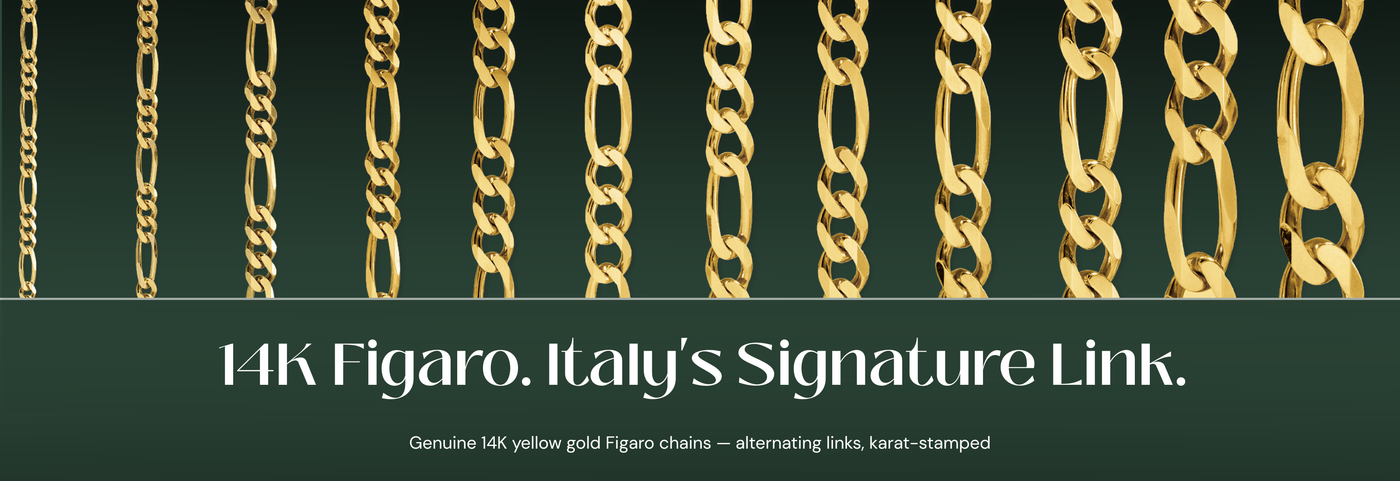
Italian 14K yellow gold Figaro chains with alternating link pattern

14K Yellow Gold Figaro Collection

14K Yellow Gold Figaro Collection: Italy's Pattern Across Chains and Bracelets

The Figaro pattern — alternating short round links and longer oval links — has been a staple of Italian fine gold jewelry making for generations. This collection brings the Figaro style in 14K yellow gold across chains and bracelets, in widths ranging from refined pendant carriers to statement pieces. The alternating link geometry creates a visual rhythm that distinguishes the Figaro from uniform-link chains, giving it more visual interest without the aggressive visual weight of bold styles like Cuban or rope.

Figaro Construction Across Chain and Bracelet Forms

The Figaro pattern translates equally well to chains and bracelets. In chain form, the alternating pattern is most visible at 3mm and above, where the short and long link faces provide enough surface area for the pattern contrast to read clearly. In bracelet form, the flat geometry of the Figaro sits close to the wrist and moves well with hand and wrist movement. The 14K yellow gold standard ensures consistent warm color and the quality of link press and polish that makes the Figaro's pattern as sharp and defined as possible.

Width Selection in 14K Figaro Gold Jewelry

Figaro chains from 2mm to 3mm function primarily as pendant carriers; the pattern is visible but the chain recedes appropriately behind most pendants. The 3mm to 5mm range is the most versatile — a Figaro in this range can be worn alone as a statement or with a small to medium pendant. At 6mm and above, the Figaro pattern makes a bold impression in its own right. Figaro bracelets are most commonly sold at 4mm to 7mm, where the alternating pattern is clearly visible and the bracelet sits with appropriate weight on the wrist.

View as

What is a figaro chain?

A figaro chain is a style of gold chain defined by its alternating link pattern: a sequence of two or three shorter round or oval links followed by one longer, flattened oval link — then the pattern repeats across the full length of the chain. This rhythmic alternation is the figaro's defining visual characteristic, distinguishing it from all uniform-link chains (curb, rope, cable, rolo) where every link is identical in size and shape.

The figaro chain originated in Italy — the name is widely attributed to the Italian city of Genoa and may reference the opera character Figaro, though the exact etymology is disputed. What is undisputed is that the figaro pattern became one of Italy's most significant contributions to global fine jewelry production. Italian goldsmiths in Arezzo and Vicenza refined the figaro link geometry for machine production in the 20th century, making it one of the most consistently produced gold chain styles in the world.

In 14K yellow gold, the figaro's alternating link pattern creates a visual rhythm that is both recognizable and classic. The longer links catch light across their flat faces while the shorter connecting links create articulation and movement. A figaro chain in 14K yellow gold reads as traditional fine jewelry — not fashion-forward, not trend-dependent — a piece with a heritage design language that has maintained continuous production and popularity for decades.

What does a figaro chain look like?

A figaro chain has a visually distinct repeating pattern: look at any section of the chain and you will see a group of two or three small links (round or slightly oval in cross-section) followed by one noticeably longer, wider, flatter link — and then the pattern starts again. This 2:1 or 3:1 small-to-large link ratio creates the figaro's characteristic rhythm. The longer links lie flat and catch light broadly; the shorter links provide the articulation that gives the chain its fluid movement.

The figaro pattern reads differently at different widths. A narrow figaro (2–3mm) shows the link pattern as a fine detail visible only at close range — from a distance it reads as a standard chain bracelet or necklace. A medium figaro (4–6mm) shows the alternating pattern clearly from normal conversation distance, giving the chain a recognizable, textured look. A wide figaro (7mm+) makes the elongated links a dominant visual feature — the contrast between the long flat links and the short connecting links creates an almost architectural quality at wide dimensions.

Color and finish affect the figaro's visual character significantly. Plain polished 14K yellow gold figaro chains have the warm, classic gold color with broad light reflection off the large link faces. Diamond-cut figaro chains facet the link surfaces for sparkle — the faceted large links and small links catch light from multiple angles, creating a brilliance that makes diamond-cut figaros among the most visually impressive gold chains per gram of metal. Both are classic presentations of the figaro pattern.

What is the origin of the figaro chain?

The figaro chain is of Italian origin, associated with the goldsmithing traditions of Genoa and later systematized by the industrial fine jewelry districts of Arezzo and Vicenza. The style takes its name from Italian naming conventions for chain patterns, with 'figaro' becoming the internationally recognized designation for the alternating small-large-link pattern in gold chain production. The name likely references the opera character Figaro — quick, rhythmic, alternating — though the documentation is historical tradition rather than verified etymology.

Italian gold chain manufacturing industrialized significantly in the post-World War II period, with Arezzo becoming the center of machine-production gold chain making. The figaro was among the chain patterns systematized for machine production during this period — the alternating link geometry was adapted from handcraft production to automated chain-making machines that could produce uniform, precise figaro patterns at scale. This Italian industrial tradition is the reason figaro chains became globally available in consistent quality across multiple decades.

The figaro pattern spread globally through Italian gold exports — by the 1970s and 1980s, figaro chains were among the most widely distributed gold chain styles in North American and European jewelry retail. The pattern became associated with classic, traditional fine jewelry rather than fashion or trend jewelry, giving it a stability in the market that persists today. When consumers think of a 'classic' gold chain in a traditional jewelry context, the figaro is frequently among the first styles they picture.

What is the difference between a 2+1 and 3+1 figaro chain?

The numbers in '2+1' and '3+1' figaro patterns refer to the ratio of small links to large links in each repeating unit. A 2+1 figaro has two small links followed by one large link — a tighter, more even pattern where the large and small links are closer in visual proportion. A 3+1 figaro has three small links followed by one large link — a pattern where the groups of small links are noticeably longer relative to the large link, creating more visual separation between the elongated elements.

The practical visual difference: a 2+1 figaro has a more balanced, compact rhythm — the pattern repeats more frequently across the chain length, creating a denser visual texture. A 3+1 figaro has a more expansive rhythm — the three-small-link sections create longer visual groups, making the overall pattern feel more open and less frequent. At the same width, 3+1 figaros are typically slightly lighter per inch than 2+1 versions because the larger number of smaller links per large link uses less total gold than an equivalent-length 2+1 section.

Both are authentic figaro patterns with the same heritage and visual identity — the ratio choice is a matter of aesthetic preference and manufacturing convention rather than quality differentiation. Italian manufacturers produce both ratios; some chains are described simply as 'figaro' without specifying the ratio, while quality retailers specify the ratio as part of the product description. When in doubt about which ratio you are purchasing, request a close-up image of the link pattern to identify the small-to-large link count.

What is a diamond-cut figaro chain?

A diamond-cut figaro chain has had its link surfaces faceted by a diamond-tipped cutting tool, creating multiple precisely angled flat faces across both the small connecting links and the large elongated links. These facets function as tiny mirrors — each angled face reflects light toward a specific viewpoint, so as the chain moves, different facets catch light at different angles, creating a continuous sparkling effect across the full chain length. Diamond-cut figaro chains are among the most brilliant gold chains available in the figaro style.

The cutting is applied primarily to the flat faces of the large elongated links, where the facet geometry has the most visual impact — the broad, flat link face is subdivided into multiple angled surfaces that catch and redirect light in multiple directions simultaneously. The small connecting links may be fully faceted or left partially plain, depending on the manufacturer's design. The combination of the faceted large links with the figaro's alternating rhythm creates a chain with high visual complexity and brilliance.

Diamond-cut figaro chains require slightly different care than plain polished figaro chains. The faceted surfaces are more prone to showing fine scratches — scratches on faceted surfaces interrupt the precise mirror angles and reduce their light-redirection efficiency. Professional polishing of diamond-cut chains requires a jeweler with appropriate equipment; standard polishing cloths maintain the surface but cannot restore damaged facets. For most wearers, the brilliant appearance of diamond-cut figaro chains justifies this minor maintenance consideration.

What is the difference between a solid and hollow figaro chain?

A solid figaro chain has links formed from solid gold wire throughout — each link, both the small round connecting links and the large elongated flat links, is solid gold alloy with no interior void. A hollow figaro chain has links formed from thin gold sheet or tubing — the external appearance is identical to solid, but the interior of each link is air. The difference is invisible to the eye but significant in durability, weight, and gold content.

Hollow figaro chains are vulnerable to the mechanical stress of daily wear in ways solid chains are not. The large flat links in a figaro chain, which are already the widest cross-section elements, are particularly vulnerable to compression damage in hollow form — a hollow large link pressed flat by impact can crease, dent, or collapse permanently. Solid large links in the same impact situation may scratch or deform slightly, but maintain their structural integrity. For a chain worn daily, solid construction is not a luxury — it is the minimum standard for long-term wear.

Identifying solid vs. hollow: weight is the most reliable indicator at the consumer level. A solid 14K figaro chain at 4mm and 20 inches should weigh approximately 12–18 grams; a hollow figaro at the same dimensions may weigh 5–8 grams. If a figaro chain feels lighter than expected for its visual size, hollow construction should be assumed until confirmed otherwise. Ask any seller to disclose gram weight in writing — a seller unwilling to provide this information is a reliable indicator that the construction will not survive scrutiny.

What makes a quality figaro chain?

Quality indicators in figaro chains begin with link uniformity: the large elongated links should all be identical in length, width, and proportion; the small connecting links should all be identical to each other; and the ratio between large and small links should be consistent across the full chain length. In lower-quality production, link dimensions vary visibly across the chain — slight size differences that create an uneven pattern. Premium Italian production maintains link uniformity to tight tolerances across every link.

Surface finish quality is the second major indicator. A premium plain-polished figaro chain should have a mirror-bright surface on all link faces, with invisible solder join points — the metal-to-metal connections where each link closes should be seamless after finishing. A premium diamond-cut figaro should have facets that are crisp, uniformly angled, and consistently spaced across all link faces. In lower-quality production, visible solder ridges, dull patches, or irregular facets indicate manufacturing shortcuts that affect both appearance and longevity.

The clasp is a reliable quality proxy. For a necklace, a spring ring or lobster claw of appropriate diameter for the chain width is the standard; a lobster claw is preferred for heavier chains. For a bracelet, a box clasp with safety latch is the correct quality specification — box clasps provide superior security and distribution of wear stress compared to spring rings on bracelets. Italian triple hallmarking (purity mark, manufacturer code, assay office mark) is the documentation benchmark for quality provenance.

What karat is best for a figaro chain?

For everyday-wear figaro chains and bracelets, 14K gold (58.5% pure gold) is the optimal karat. 14K gold's alloyed metals — copper, silver, and zinc — provide the hardness that resists the surface scratching, link deformation, and clasp wear that daily wear inflicts. The large flat links of a figaro chain are particularly susceptible to surface scratching (their broad surfaces present maximum contact area), and 14K's hardness keeps these surfaces scratch-resistant for significantly longer than softer 18K alloys.

18K gold (75% pure gold) is appropriate for figaro chains worn on special occasions or kept as treasured pieces rather than daily wear. 18K's richer, deeper yellow gold color is superior to 14K — the higher gold content produces a more saturated, warmer hue. However, 18K's softer alloy means the large links will show surface scratches more visibly after daily wear. For a figaro chain that will be worn a few times per week rather than every day, 18K's superior color can justify the tradeoff in scratch resistance.

10K gold (41.7% pure gold) is the hardest option, appropriate for buyers who prioritize maximum scratch resistance and budget efficiency over color richness. 10K yellow gold is noticeably cooler and less saturated in color than 14K or 18K, and the lower gold content means lower intrinsic value per gram. For an everyday wear figaro chain where scratch resistance is the primary concern and gold richness is secondary, 10K is a defensible choice — but 14K remains the best balance of color, durability, and value for most buyers.

How heavy should a 14K yellow gold figaro chain be?

For 14K solid figaro necklaces: a 2–3mm figaro at 18 inches should weigh approximately 5–10 grams; a 4–5mm figaro at 20 inches should weigh approximately 12–20 grams; a 6–7mm figaro at 22 inches should weigh approximately 20–32 grams. Chains significantly lighter than these ranges at their stated dimensions are either hollow, misrepresented in width, or lower karat than claimed. Gram weight disclosure from the seller is the essential transparency verification.

For 14K solid figaro bracelets: a 4mm figaro at 7 inches should weigh approximately 7–12 grams; a 5–6mm figaro at 8 inches should weigh approximately 10–18 grams; a 7mm figaro at 8 inches should weigh approximately 15–24 grams. Bracelets experience more mechanical stress than necklaces and benefit from heavier gauge construction — the minimum acceptable weight for a daily-wear figaro bracelet at any given width is higher than for an equivalent necklace.

Gold content value benchmarking: at current gold prices, 14K gold is worth approximately $60 per gram in melt value (based on mid-2026 gold prices). A 15-gram solid 14K figaro piece has approximately $900 in recoverable gold content. This benchmark helps evaluate whether a retail price reflects reasonable markup over gold value or significant overpricing. A figaro chain priced at less than 1.5x its melt value suggests hollow construction or misrepresented karat; one priced at over 5x melt value without additional design or gem content suggests brand premium rather than gold value.

How durable is a figaro chain for everyday wear?

A solid 14K figaro chain is built for everyday wear — the link geometry is mechanically sound, the 14K alloy is hard enough to resist normal surface scratching, and the clasp (if appropriately specified for the chain weight) provides secure closure through daily on-and-off cycles. The specific vulnerability in figaro chains is the large elongated link: its flat, broad surface presents the maximum contact area of any link element in the chain, making it more prone to surface scratching than rounder-profile chain types.

The large links are also the most visible element of a figaro's design — surface scratches on these links are more visible than scratches on the small connecting links. Plain polished figaro chains in daily wear will develop a surface patina of fine scratches over months and years that transitions the finish from mirror-bright to satin-like. This is a normal aging process for all polished gold jewelry; professional polishing can restore the mirror surface when desired. Diamond-cut figaro chains' facets make scratches slightly less visible by maintaining multiple light-catching angles even with some surface wear.

Recommendations for durability: solid construction (non-negotiable for daily wear); 14K karat for scratch resistance; a lobster claw clasp on necklaces (spring rings on heavy figaros can open under tension); and periodic professional inspection to verify clasp function and solder joint integrity. A solid 14K figaro chain worn daily and maintained with monthly cleaning and annual professional inspection will retain its structural integrity and visual quality for decades.

About 14K Yellow Gold Figaro Jewelry

14K Yellow Gold Figaro Collection: Italy's Pattern Across Chains and Bracelets

The 14K yellow gold Figaro collection brings Italian fine jewelry's signature alternating link pattern across chains and bracelets. The rhythm of short and long links creates more visual interest than uniform-link chains without the aggressive weight of bold styles like Cuban.

The Figaro pattern translates equally well to chains and bracelets. In both forms, the 14K yellow gold standard ensures consistent color and the quality of link press and polish that makes the pattern as sharp and defined as possible.

Chains at 2mm to 3mm serve as pendant carriers. The 3mm to 5mm range is versatile for both pendant use and solo wear. At 6mm and above, the Figaro pattern stands on its own as a bold statement. Bracelets at 4mm to 7mm provide the pattern's full visual character at wrist proportions.

Compare /3

Loading...