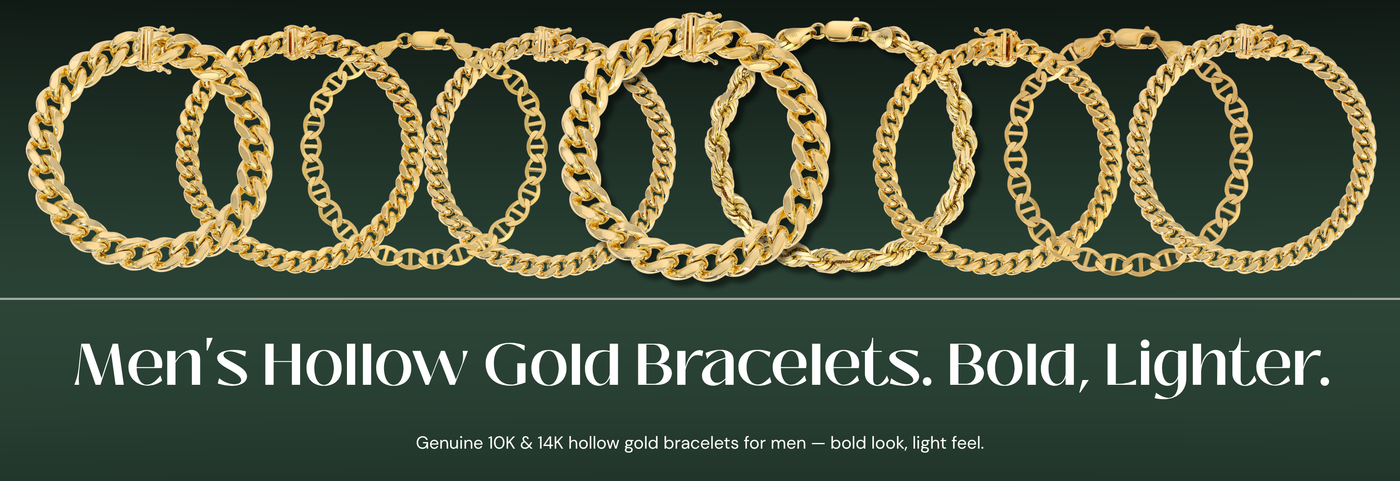
Men's gold bracelets in hollow construction are most accurately understood as a price-and-weight trade-off, not a quality compromise. Hollow construction uses less gold to create the same visual result — the finished bracelet looks identical to a solid equivalent of the same width. For a man who wants a 10mm Cuban bracelet and finds the price of solid impractical, hollow construction delivers the exact aesthetic at a fraction of the cost. For a man who wants the bracelet to be a long-term, daily-wear investment piece that survives physical use without damage, solid is the appropriate choice.
Men's bracelets are worn in more physically demanding contexts than most fine jewelry. A necklace sits against the chest and rarely strikes anything. A bracelet on the wrist of a man who works with his hands contacts metal, concrete, wood, and machinery throughout the day. Hollow link walls — typically 0.5 to 1mm thick — can deform under compression loads that solid links of the same width absorb without visible effect. For desk workers, professionals, and men who remove the bracelet before physical activity, hollow construction lasts reliably.
Width and chain style selection for men's hollow bracelets should account for the longer wear life of certain styles under hollow construction. Cuban link, with its flat interlocking links, performs well in hollow at 8–10mm for standard daily wear. Franco, with its four-sided link structure, has a slightly stronger hollow link geometry. Rope, while visually active, has the thinnest walls in hollow construction because each twisted strand is hollow — rope bracelets are the most vulnerable construction for impact resistance and are best suited for light daily wear contexts.